

On this page
If you have finished our first set of statistics JEE Main practice questions with solutions, here are eight new ones, medium to hard, each mixing two ideas.
What does JEE Main 2027 test in statistics?
Unit 13 of NTA's Syllabus for JEE (Main) 2027 lists mean, median and mode, and standard deviation, variance and mean deviation, for grouped and ungrouped data. Every question stays inside that list.
The JEE (Main) 2027 Information Bulletin marks a correct MCQ +4 and an incorrect one −1, so choosing a trap option instead of the answer costs five marks. Variance here divides by n. For a study plan, read our guide to preparing statistics for JEE Main.
Medium: can you pick the right formula before you calculate?
Q1. Group A has 20 students with mean mark 30 and variance 16; group B has 30 with mean 35 and variance 9. The combined variance is: (A) 11.8 (B) 12.5 (C) 17.8 (D) 23.8
Answer: (C). Σx² is 20 × 916 = 18320 for A and 30 × 1234 = 37020 for B. The combined mean is 33, so the variance is 55340/50 − 33² = 17.8. Trap: (A) is the weighted average of the variances, ignoring that the means differ; (B) is their plain average. Check: 11.8 within groups plus 6 between groups gives 17.8.
Q2. The variance of the first 50 even natural numbers is: (A) 416.5 (B) 833 (C) 850 (D) 208.25
Answer: (B). The variance of 1 to n is (n² − 1)/12 = 2499/12; doubling every value multiplies it by 4. Trap: (A) multiplies by 2; (D) forgets the scaling; (C) divides by n − 1. Check: mean of squares 3434 minus 51² gives 833.
Q3. The values 2, 4, 6, 8, 10 occur with frequencies 1, 4, 6, 4, 1. The mean deviation about the mean is: (A) 1.5 (B) 4.8 (C) 2 (D) 1.2
Answer: (A). By symmetry the mean is 6, and Σf|x − 6| = 24 over N = 16 gives 1.5. Trap: (B) divides by the 5 distinct values; (C) is the standard deviation. Check: mean deviation never exceeds the standard deviation, √(64/16) = 2.
Q4. Ten observations have mean 15 and standard deviation 3. An eleventh observation, 15, is added. The new variance is: (A) 9 (B) 3 (C) 10 (D) 90/11
Answer: (D). The mean stays 15 and the squared deviations still add to 90, now shared by 11 values. Trap: (A) assumes a value at the mean changes nothing. Check: Σx² goes from 2340 to 2565, and 2565/11 − 225 = 90/11.
Hard: can you combine grouped data with variance identities?
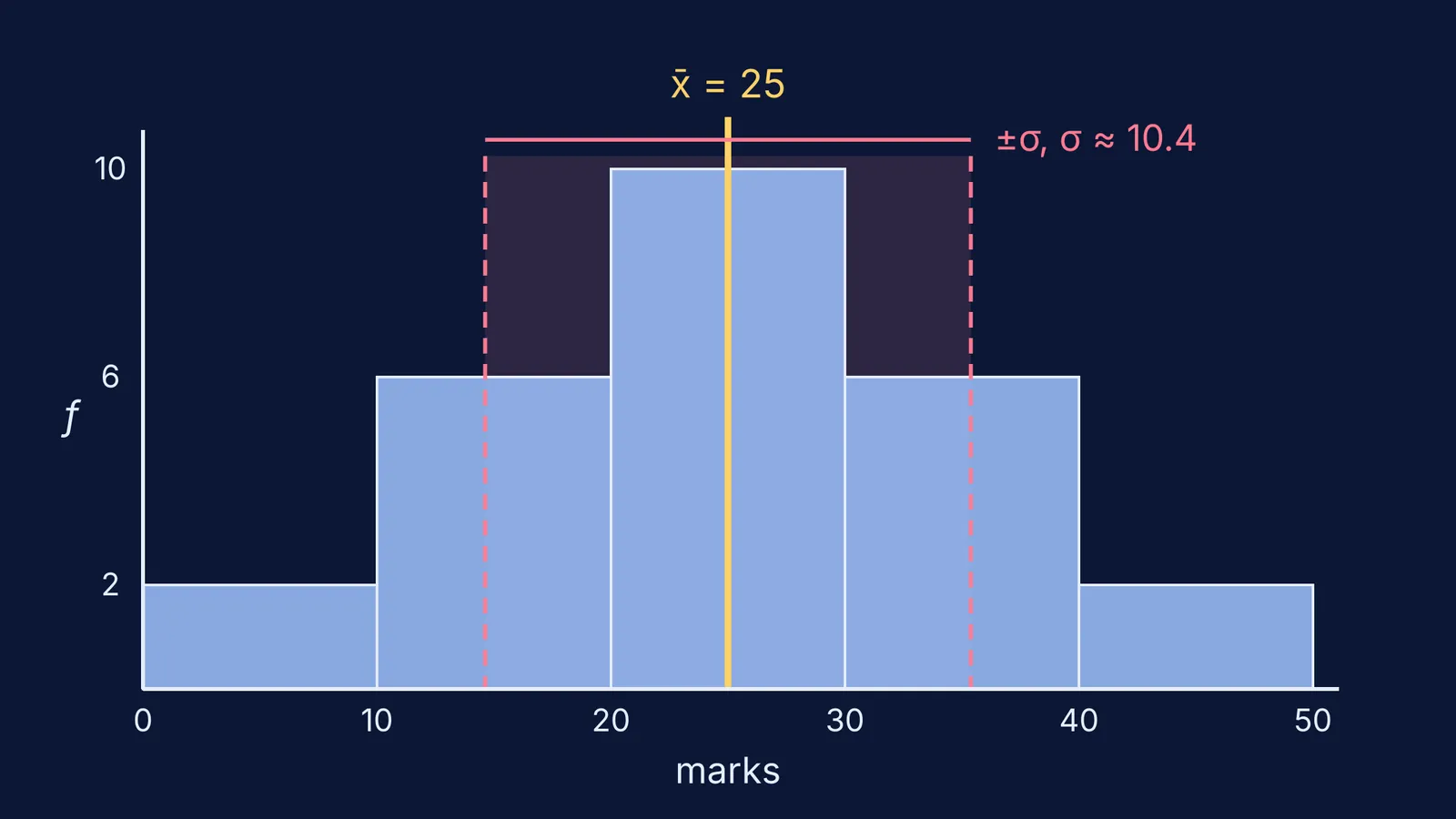
Q5. Classes 0–10, 10–20, 20–30, 30–40, 40–50 have frequencies 2, f, 10, 6, 2, and the mean is 25. The variance is: (A) 140/13 (B) 1400/13 (C) 14/13 (D) 112
Answer: (B). With class marks 5 to 45, 560 + 15f = 25(20 + f), so f = 6 and N = 26. With u = (x − 25)/10, Σfu² = 28, so Var(x) = 10² × 28/26. Trap: (A) multiplies by h, not h²; (C) forgets h; (D) divides by N − 1. Check: Σfu = 0 confirms the mean.
Q6. For 1, 2, 3, 4, 10, 16, the least value of Σ|xᵢ − a| over real a is: (A) 28 (B) 4 (C) 24 (D) 14/3
Answer: (C). The sum is least at the median, any a from 3 to 4, where it equals (4 + 10 + 16) − (1 + 2 + 3). Trap: (A) uses the mean, 6; (B) divides by 6. Check: a = 3 gives 2 + 1 + 0 + 1 + 7 + 13 = 24.
Q7. Five observations have variance 6. The sum of (xᵢ − xⱼ)² over all pairs i < j is: (A) 150 (B) 300 (C) 60 (D) 30
Answer: (A). Expanding, the sum equals nΣx² − (Σx)² = n²σ² = 25 × 6. Trap: (B) counts each pair twice. Check: 1 to 5 have variance 2, and their squared differences add to 50 = 25 × 2.
Q8. For 15 observations, Σ(xᵢ − 5) = 30 and Σ(xᵢ − 5)² = 120. The mean and standard deviation of 3xᵢ − 1 are: (A) 20 and 36 (B) 20 and 6√2 (C) 5 and 6 (D) 20 and 6
Answer: (D). With d = x − 5, d has mean 2 and variance 8 − 2² = 4, so x has mean 7 and standard deviation 2. Trap: (B) skips subtracting 2²; (A) is the variance; (C) forgets the 5. Check: subtracting 1 never changes spread.
How should you use this second set?
Do all eight in one timed sitting, without notes.
Label each miss: wrong divisor, h instead of h², mean instead of median, or a missed shift.
Redo the misses from both sets later in the week with one number changed.
For the other half of Unit 13, try our second set of probability JEE Main practice questions. If you can follow a solution but could not have started it, the Fermi Problem Library has a step-by-step solver that explains the reasoning. For the rest of the syllabus, Fermi Test Prep is our hub for JEE Main and Advanced preparation.


