

On this page
These eight NEET-UG Biology questions on Human Health and Disease are original, not taken from NCERT exercises, exemplar books or past papers.
This is a study summary, not medical advice. Every disease, drug and treatment here appears only as NCERT describes it.
Is Human Health and Disease in the NEET syllabus?
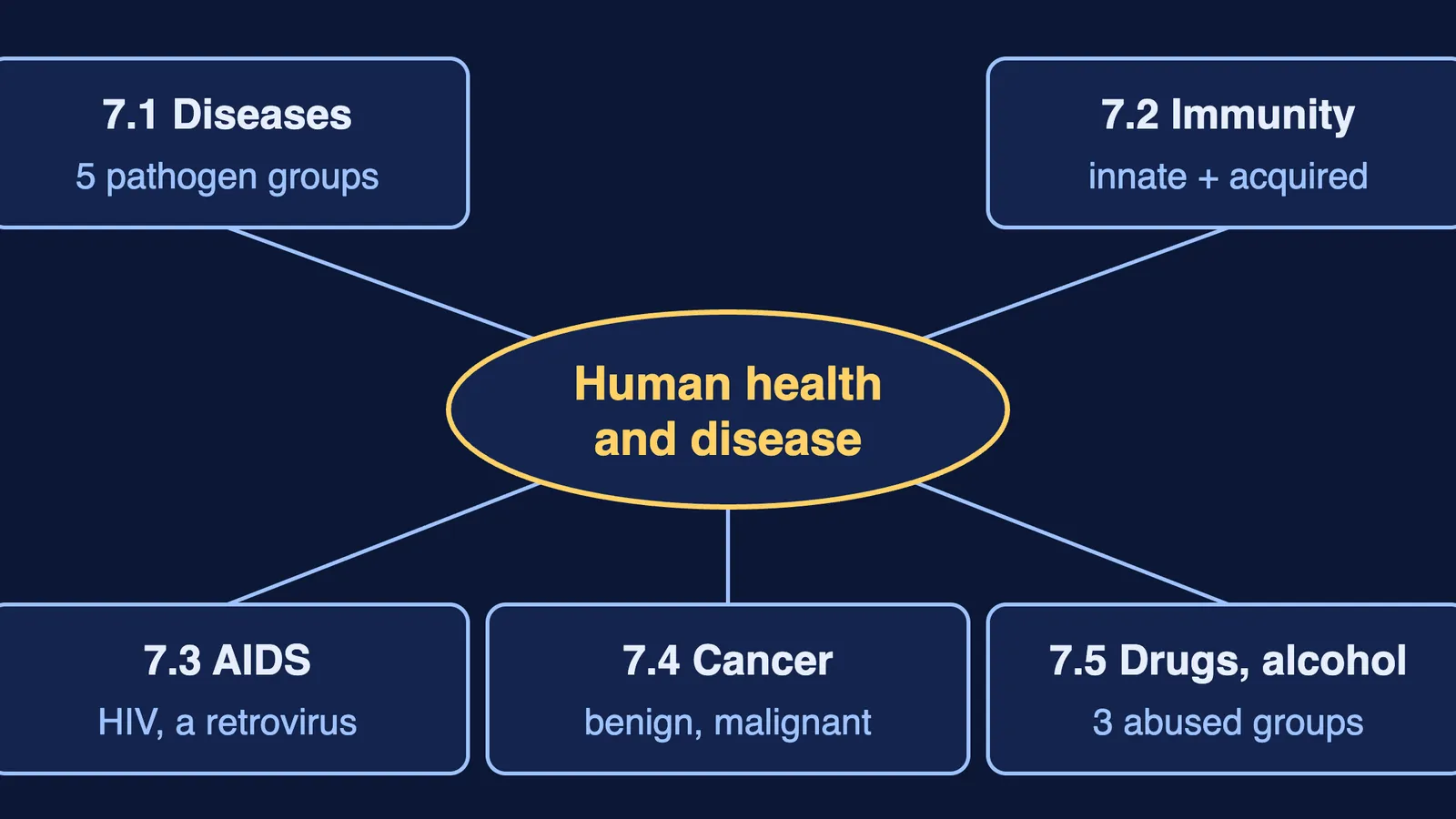
Yes. The National Medical Commission's NEET (UG)-2026 syllabus lists it in Unit 8 of Biology, Biology and Human Welfare, naming pathogens, basic immunology with vaccines, cancer, HIV and AIDS, and adolescent drug, alcohol and tobacco abuse. Every answer is checked against the NCERT Human Health and Disease chapter (Class 12 Biology, Reprint 2026-27), and each solution names its section.
Need the basics first? Start with our NEET guide to pathogens, immunity and vaccines.
How should you work through this set?
Hide the solutions and give each question about one minute.
Write down each trap that caught you and reread that NCERT paragraph before your next mock test.
Easy: do you remember where the chapter starts?
Q1 (easy). Which finding disproved the old "good humor" hypothesis of health?
(1) Hippocrates' reasoning about blackbile (2) William Harvey's experimental discovery of blood circulation, plus thermometer readings showing that people with blackbile had a normal body temperature (3) The discovery of antibiotics (4) The eradication of smallpox
Answer: (2). NCERT's opening says Hippocrates and Ayurveda tied health to a balance of humors, an idea reached by reflective thought alone. Harvey's experiments and the thermometer evidence overturned it.
Why the tempting wrong option fails: (1) is where the humor idea came from, not the evidence against it.
Q2 (easy). Apart from typhoid and pneumonia, which disease does NCERT name as a bacterial disease of humans?
(1) Common cold (2) Amoebiasis (3) Plague (4) Ringworm
Answer: (3). Section 7.1 adds dysentery, plague and diphtheria as other bacterial diseases in man.
Why the tempting wrong option fails: (2) tempts because NCERT also calls amoebiasis amoebic dysentery, but *Entamoeba histolytica* is a protozoan.
Medium: can you place each defence and each cell?
Q3 (medium). Some cells in a tissue are infected by a virus. They secrete proteins that shield the neighbouring uninfected cells from further viral attack. These proteins belong to which barrier of innate immunity?
(1) Physical (2) Physiological (3) Cellular (4) Cytokine
Answer: (4). The proteins are interferons, which section 7.2.1 places in the cytokine barrier, the fourth of the four innate barriers.
Why the tempting wrong option fails: (3) tempts because cells make interferons, but NCERT's cellular barrier means leukocytes and macrophages that phagocytose microbes.
Q4 (medium). Which cells does NCERT describe as a type of lymphocyte working in innate, not acquired, immunity?
(1) B-lymphocytes (2) Helper T-lymphocytes (3) Natural killer cells (4) Mast cells
Answer: (3). Section 7.2.1 lists natural killer cells, a type of lymphocyte, in the blood alongside neutrophils and monocytes in the cellular barrier. B- and T-lymphocytes carry out the primary and secondary responses of acquired immunity (7.2.2).
Why the tempting wrong option fails: (1) and (2) are lymphocytes too, but they belong to pathogen-specific acquired immunity.
Q5 (medium). In a person infected with HIV, which cell does NCERT say goes on producing virus, so that it acts like an HIV factory?
(1) Helper T-lymphocyte (2) Macrophage (3) B-lymphocyte (4) Red blood cell
Answer: (2). Section 7.3 says HIV enters macrophages, where reverse transcriptase turns its RNA genome into viral DNA that joins the host cell's DNA. The macrophages then keep making virus particles.
Why the tempting wrong option fails: (1) HIV does replicate in helper T-lymphocytes, but NCERT stresses that their number keeps falling; the factory label is for macrophages.
Hard: can you pick the fact that answers the stem?
Q6 (hard). Apart from invading and damaging nearby tissue, how do malignant tumour cells harm the normal cells around them, according to NCERT?
(1) They restore contact inhibition in normal cells (2) They deprive normal cells of vital nutrients by competing for them (3) They secrete α-interferon (4) They stay confined to their original site
Answer: (2). Section 7.4 says neoplastic cells grow very rapidly and, while dividing, outcompete normal cells for nutrients and starve them.
Why the tempting wrong option fails: (3) sits in the same section, but α-interferon is given to patients as a biological response modifier; tumour cells do not secrete it.
Q7 (hard). NCERT says some people carry genes that make them susceptible to certain cancers. How does it say such genes can be found, and what may those people then be advised?
(1) A biopsy of healthy tissue, followed by chemotherapy (2) Molecular biology techniques that detect the genes, followed by advice to avoid the particular carcinogens they are susceptible to (3) A CT scan, followed by α-interferon (4) An ELISA, followed by radiotherapy
Answer: (2). Section 7.4 says molecular biology can pick out genes that predispose a person to certain cancers, which helps prevention: that person may be told to avoid the carcinogen concerned, such as tobacco smoke for lung cancer.
Why the tempting wrong option fails: (3) tempts because CT and α-interferon both sit in section 7.4, but CT detects cancers already present in internal organs and α-interferon is a treatment; neither finds inherited genes.
Q8 (hard). NCERT says smoking causes oxygen deficiency in the body. Which mechanism does it give?
(1) Nicotine stimulates the adrenal gland, sending adrenaline and nor-adrenaline into the blood (2) Smoking raises the carbon monoxide content of blood and lowers the amount of oxygen bound to haem (3) Tobacco chewing raises the risk of oral cancer (4) Cannabinoids act on the cardiovascular system
Answer: (2). In section 7.5, NCERT explains that smoking increases CO in the blood and reduces haem-bound oxygen, which leaves the body short of oxygen.
Why the tempting wrong option fails: (1) is a true NCERT line, but it explains the rise in blood pressure and heart rate, not the oxygen shortfall.
What should you do after this set?
Score yourself, then sort every miss by its trap. Then switch formats with our statement and match-the-list questions on this chapter, or move to the next chapter of Unit 8 with the Microbes in Human Welfare practice set.
Which NCERT section should you reread before the next set? Fermi's AI tutor works out what you already know and builds a plan for the session.


