

On this page
These ten questions are new, not reworded from NCERT or past papers.
Which chapters does this Diversity in Living World set cover?
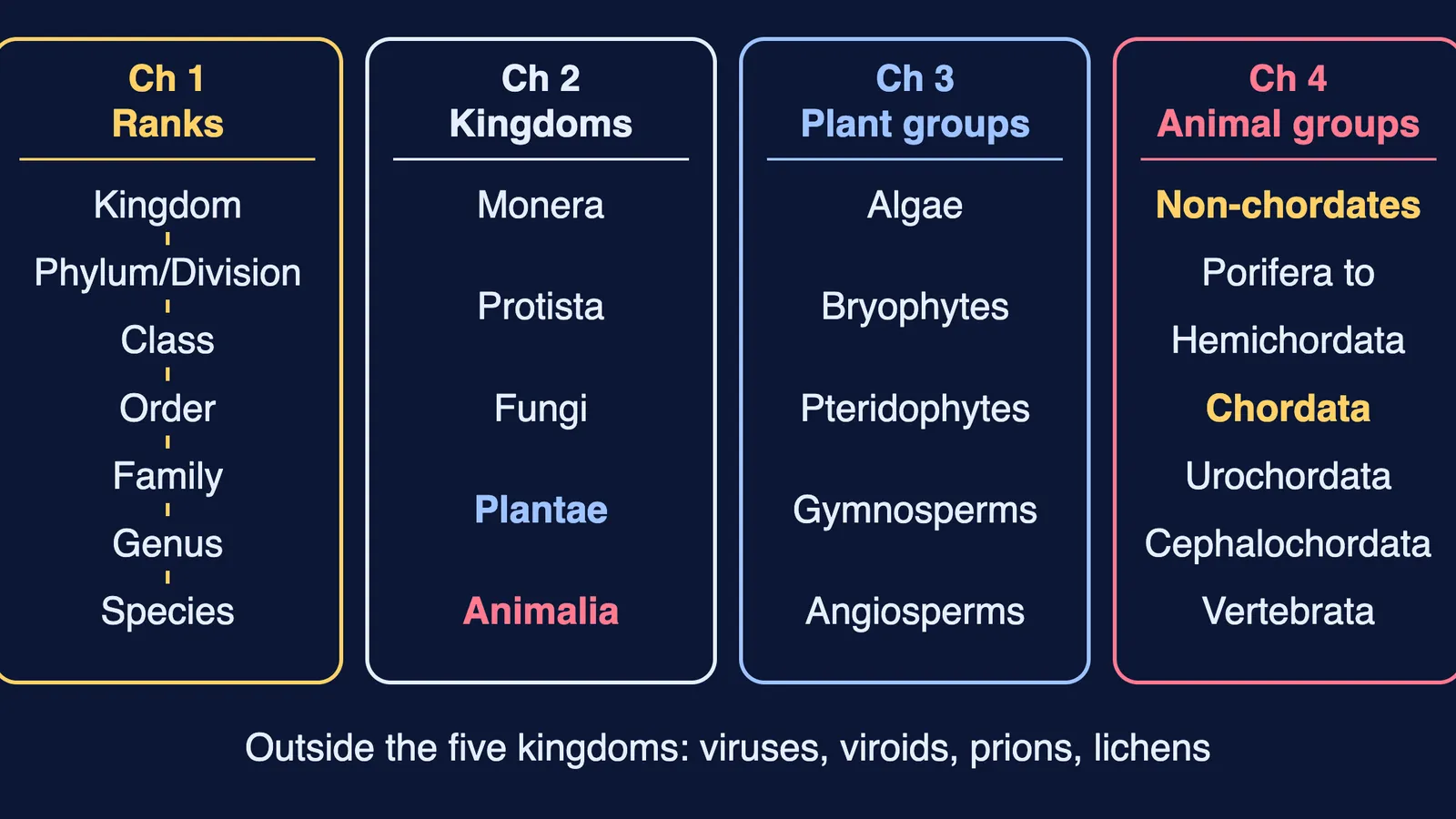
The NMC's NEET (UG) 2026 syllabus lists Diversity in Living World as Biology Unit 1: taxonomy, binomial nomenclature, the five kingdoms, lichens, viruses, viroids and the main plant and animal groups. It matches the first four chapters of NCERT Class 11 Biology (Reprint 2026-27): The Living World, Biological Classification, Plant Kingdom and Animal Kingdom. Each solution cites its NCERT section. For the plant chapter first, read our Plant Kingdom guide for NEET.
How should you use this practice set?
Cover the solutions; allow ten minutes for all ten.
Write your option and a one-word reason before checking.
Read every wrong-option line, even when you were right.
Log misses with their NCERT section; retry them in a week.
Easy: can you recall the core facts?
Q1 (easy). NCERT calls "animals", "mammals" and "dogs" taxa. What does that tell you?
(1) They are taxa at different levels, each inside the one before it (2) They all sit at the rank of species (3) Only "animals" is a taxon; the other two are local names (4) They are morphological aggregates, not biological entities
Answer: (1). Section 1.1 treats any convenient category as a taxon. Every dog is a mammal and every mammal an animal, so these are taxa at different levels.
Why the tempting wrong option fails: (4) contradicts section 1.2, which calls taxonomic groups real biological entities.
Q2 (easy). Which role does NCERT give algae in water bodies?
(1) Primary producers of energy-rich compounds for aquatic food cycles (2) Decomposers of litter that help in mineral cycling (3) Consumers that lower the dissolved oxygen around them (4) Parasites behind most diseases of fish
Answer: (1). Section 3.1 says algae are primary producers whose energy-rich compounds underpin the food cycles of all aquatic animals. They also raise dissolved oxygen nearby.
Why the tempting wrong option fails: (2) is how NCERT describes many deuteromycete fungi (2.3.4), not algae.
Q3 (easy). Which is the second largest phylum of Kingdom Animalia?
(1) Arthropoda (2) Mollusca (3) Chordata (4) Annelida
Answer: (2). Section 4.2.8 calls Mollusca the second largest animal phylum. Arthropoda is the largest: over two-thirds of all named species are arthropods (4.2.7).
Why the tempting wrong option fails: (1) is the largest, not the second.
Medium: can you tell neighbouring groups apart?
Q4 (medium). NCERT notes that some members of one phylum take nutrients from their host directly through the body surface. Which phylum?
(1) Platyhelminthes (2) Aschelminthes (3) Annelida (4) Ctenophora
Answer: (1). Section 4.2.4 describes flatworms as mostly endoparasites, some of which absorb host nutrients through the body surface.
Why the tempting wrong option fails: (2) also has parasites, but NCERT gives roundworms a complete alimentary canal with a muscular pharynx (4.2.5).
Q5 (medium). Which feature does NCERT credit for archaebacteria surviving harsh habitats?
(1) Heterocysts that fix nitrogen (2) A cell wall built differently from that of other bacteria (3) A protein-rich pellicle in place of a wall (4) Walls embedded with silica
Answer: (2). Section 2.1.1 says archaebacteria have a cell wall structure unlike other bacteria, and that this wall is what lets them survive extreme conditions. Heterocysts belong to cyanobacteria (2.1.2), the pellicle to euglenoids (2.2.3).
Why the tempting wrong option fails: (4) sounds tough, but silica walls belong to diatoms, which are protists (2.2.1).
Q6 (medium). Some marine algae make hydrocolloids, water-holding substances. Which pairing does NCERT give?
(1) Algin from red algae (2) Carrageen from red algae (3) Carrageen from green algae (4) Algin from green algae
Answer: (2). Section 3.1 gives algin as the brown-algal hydrocolloid and carrageen as the red-algal one.
Why the tempting wrong option fails: (1) swaps the sources; algin also coats brown algal cell walls (3.1.2).
Q7 (medium). Which class-and-feature pairing matches NCERT?
(1) Aves: air sacs linked to the lungs add to respiration (2) Amphibia: scales shed as a skin cast (3) Mammalia: air sacs linked to the lungs (4) Reptilia: moist skin without scales
Answer: (1). Section 4.2.11.6 says air sacs connected to the lungs supplement respiration in birds. Snakes and lizards shed their scales as a skin cast (4.2.11.5), while amphibian skin is moist and scaleless (4.2.11.4).
Why the tempting wrong option fails: (2) borrows the reptile skin cast; amphibians have no scales to shed.
Hard: can you link facts across chapters?
Q8 (hard). Which plant problem does NCERT NOT link to viruses?
(1) Mosaic formation and vein clearing (2) Leaf rolling and curling (3) Dwarfing and stunted growth (4) Citrus canker
Answer: (4). Section 2.6 lists viral symptoms in plants: mosaic formation, leaf rolling and curling, yellowing and vein clearing, dwarfing and stunted growth. Citrus canker is in section 2.1.2, among bacterial diseases.
Why the tempting wrong option fails: (1) sounds unfamiliar, but NCERT lists vein clearing beside yellowing.
Q9 (hard). In which pair of phyla does NCERT describe digestion as both extracellular and intracellular?
(1) Porifera and Coelenterata (2) Coelenterata and Ctenophora (3) Porifera and Ctenophora (4) Platyhelminthes and Porifera
Answer: (2). NCERT calls cnidarian digestion, in a gastro-vascular cavity, extracellular and intracellular (4.2.2). It says the same of ctenophores (4.2.3). Sponge digestion is intracellular only (4.2.1).
Why the tempting wrong option fails: (1) adds sponges, so every option holding Porifera falls.
Q10 (hard). Across this unit, NCERT names chitin as part of:
(1) fungal cell walls and the arthropod exoskeleton (2) diatom walls and green algal walls (3) the Monera wall and the euglenoid pellicle (4) fungal cell walls and red algal walls
Answer: (1). Fungal cell walls are made of chitin and polysaccharides (2.3, Table 2.1), and the arthropod body is covered by a chitinous exoskeleton (4.2.7). Diatom walls carry silica, green algal walls are cellulose and pectose (3.1.1), and the euglenoid pellicle is protein-rich (2.2.3).
Why the tempting wrong option fails: (4) keeps the correct fungal half, but Table 3.1 gives red algae walls of cellulose, pectin and polysulphate esters.
What should you do after this set?
Sort each miss: wrong chapter, wrong group, or a misread NOT. Reread the cited section and rewrite the fact yourself. For other formats, try the Living World statement and match-the-list set and the Biological Classification statement and match-the-list set.
Not sure which chapter to revise first? Fermi's AI tutor works out what you already know and builds a plan for the session.


