

On this page
These 10 original MCQs target NCERT lines that revision often skips.
Which syllabus unit does this set cover?
The NEET (UG)-2026 syllabus places the chapter in Unit 7, Genetics and Evolution. Every option is checked against NCERT Class 12 Biology Chapter 5, Molecular Basis of Inheritance (Reprint 2026-27), and each solution names its section. As in the exam, each question has four options and a single correct answer, per the NTA information bulletin.
How should you use this practice set?
Allow about a minute per question, solutions covered.
Name the NCERT section before reading the options.
Write each miss next to its section number; that is your revision list.
For a general routine, see our method for NEET genetics problems.
Easy: do you know the basic facts?
Q1 (easy). NCERT gives a second chemical name for thymine. What is it?
(1) 5-methyl cytosine (2) 5-methyl uracil (3) Deoxyuracil (4) Methyl guanosine
Answer: (2). Section 5.1.1 calls thymine 5-methyl uracil: uracil with one extra methyl group. Why the tempting wrong option fails: (3) confuses the base with the sugar; "deoxy" refers to the missing 2' -OH on the sugar.
Q2 (easy). *E. coli* has no defined nucleus. How is its DNA organised?
(1) Wound around histone octamers as nucleosomes (2) Spread freely through the cell (3) In large loops held by positively charged proteins in the nucleoid (4) Condensed by non-histone chromosomal proteins
Answer: (3). Section 5.1.2 places prokaryotic DNA in the nucleoid, held in large loops by positively charged proteins. Why the tempting wrong option fails: (1) is NCERT's eukaryotic account.
Q3 (easy). Which is NOT one of NCERT's criteria for a genetic material?
(1) It can make a copy of itself (2) It is chemically and structurally stable (3) It never changes, so no mutation occurs (4) It can express itself as Mendelian characters
Answer: (3). Section 5.2.2 asks for scope for slow changes (mutation), which evolution needs. Stable is not unchangeable. Why the tempting wrong option fails: (4) sounds out of place, but NCERT lists it as the fourth criterion.
Medium: can you give NCERT's reasons?
Q4 (medium). Which work does NCERT cite as showing semiconservative replication of DNA in chromosomes?
(1) Taylor and colleagues, radioactive thymidine in *Vicia faba* (2) Hershey and Chase, radioactive phosphorus in phages (3) Griffith, heat-killed S strain in mice (4) Avery, MacLeod and McCarty, DNase on the transforming principle
Answer: (1). Section 5.4.1 reports Taylor's 1958 faba bean work with radioactive thymidine. Why the tempting wrong option fails: (2) used a radioactive label too, but showed that DNA is the genetic material, not how it is copied.
Q5 (medium). A eukaryotic cell copies its DNA in S phase, but the division that should follow fails. The result is:
(1) Aneuploidy (2) Polyploidy (3) Conservative replication next cycle (4) A frameshift mutation
Answer: (2). Section 5.4.2 says failed division after replication gives polyploidy, which the inheritance chapter describes as an increase in a whole set of chromosomes. Why the tempting wrong option fails: (1) is the gain or loss of one or more chromosomes when chromatids fail to segregate.
Q6 (medium). How does NCERT interpret the split-gene arrangement of eukaryotes?
(1) A recent feature that arose in bacteria (2) Probably an ancient feature, with splicing reflecting an RNA-dominated past (3) Copying errors not yet repaired (4) Proof that introns hold most coding information
Answer: (2). Section 5.5.3 links introns to antiquity and splicing to the RNA world. Why the tempting wrong option fails: (1) is backwards; section 5.5.2 describes split genes in eukaryotes.
Q7 (medium). An mRNA of 750 nucleotides has a 54-nucleotide 5' UTR and a 93-nucleotide 3' UTR. The rest is one translational unit, AUG to stop codon inclusive. How many amino acids does the polypeptide have?
(1) 250 (2) 201 (3) 200 (4) 199
Answer: (3). 750 − 54 − 93 = 603 nucleotides, or 201 codons (section 5.7). AUG codes for methionine, but stop codons code for no amino acid (5.6), giving 200. Why the tempting wrong option fails: (2) counts the stop codon.
Hard: can you separate close statements?
Q8 (hard). Which statement about bacterial gene regulation matches NCERT?
(1) Splicing is the main control point (2) Transcriptional initiation is the predominant control site, and the lac repressor's control is negative regulation (3) One repressor binds the lac, trp and ara operators alike (4) The lac operon has negative regulation only
Answer: (2). Sections 5.8 and 5.8.1 say both; each operon has its own operator and repressor, ruling out (3). Why the tempting wrong option fails: (4) drops NCERT's hedge that the lac operon is under positive regulation as well.
Q9 (hard). Bulk genomic DNA in a density gradient gives one major peak and several small ones. The small peaks:
(1) Are protein-coding exons (2) Are satellite DNA, classed by base composition, segment length and repeat number (3) Show little polymorphism, since mutations there harm reproduction (4) Form a tiny fraction of the human genome
Answer: (2). Section 5.10 describes satellite DNA as normally non-coding yet a large portion of the genome, ruling out (1) and (4). Why the tempting wrong option fails: (3) reverses NCERT; non-coding mutations may not affect reproduction, so they accumulate and polymorphism is high.
Q10 (hard). NCERT gives about 30,000 human genes averaging 3,000 bases in a 3164.7 million bp genome, yet less than 2 per cent codes for proteins. Which idea reconciles these?
(1) Gene lengths include introns and untranslated regions (2) Repetitive sequences form most coding regions (3) Each gene is counted once per strand (4) Genes of unknown function cannot code for proteins
Answer: (1). 30,000 × 3,000 = 90 million bases, about 2.8 per cent of the genome (5.9.1), more than the protein-coding share. Eukaryotic genes are split, with introns between exons (5.5.2), and UTRs flank the coding part (5.7). Why the tempting wrong option fails: (4) misreads NCERT; an unknown function does not mean non-coding.
Which NCERT sections should you reread after this set?
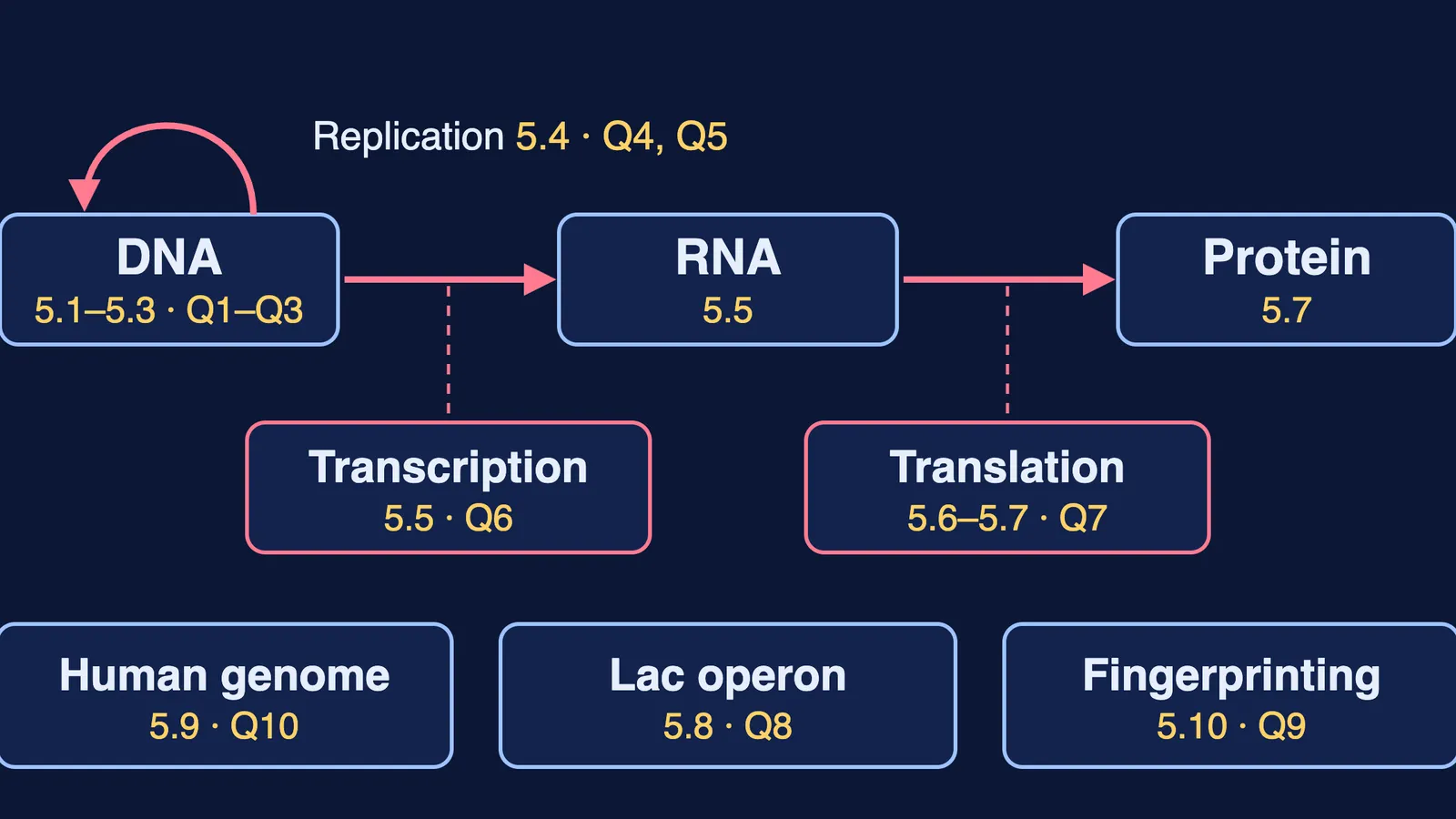
Missed Q1 to Q3: sections 5.1 and 5.2.2.
Missed Q4 to Q7: sections 5.4 to 5.7.
Missed Q8 to Q10: sections 5.8 to 5.10, underlining hedge words.
For other formats on this chapter, there are statement and match-the-list questions or the sequence and order questions.
Unsure where your gaps in this chapter are? Fermi's AI tutor works out what you already know and builds a plan for the session.


