

On this page
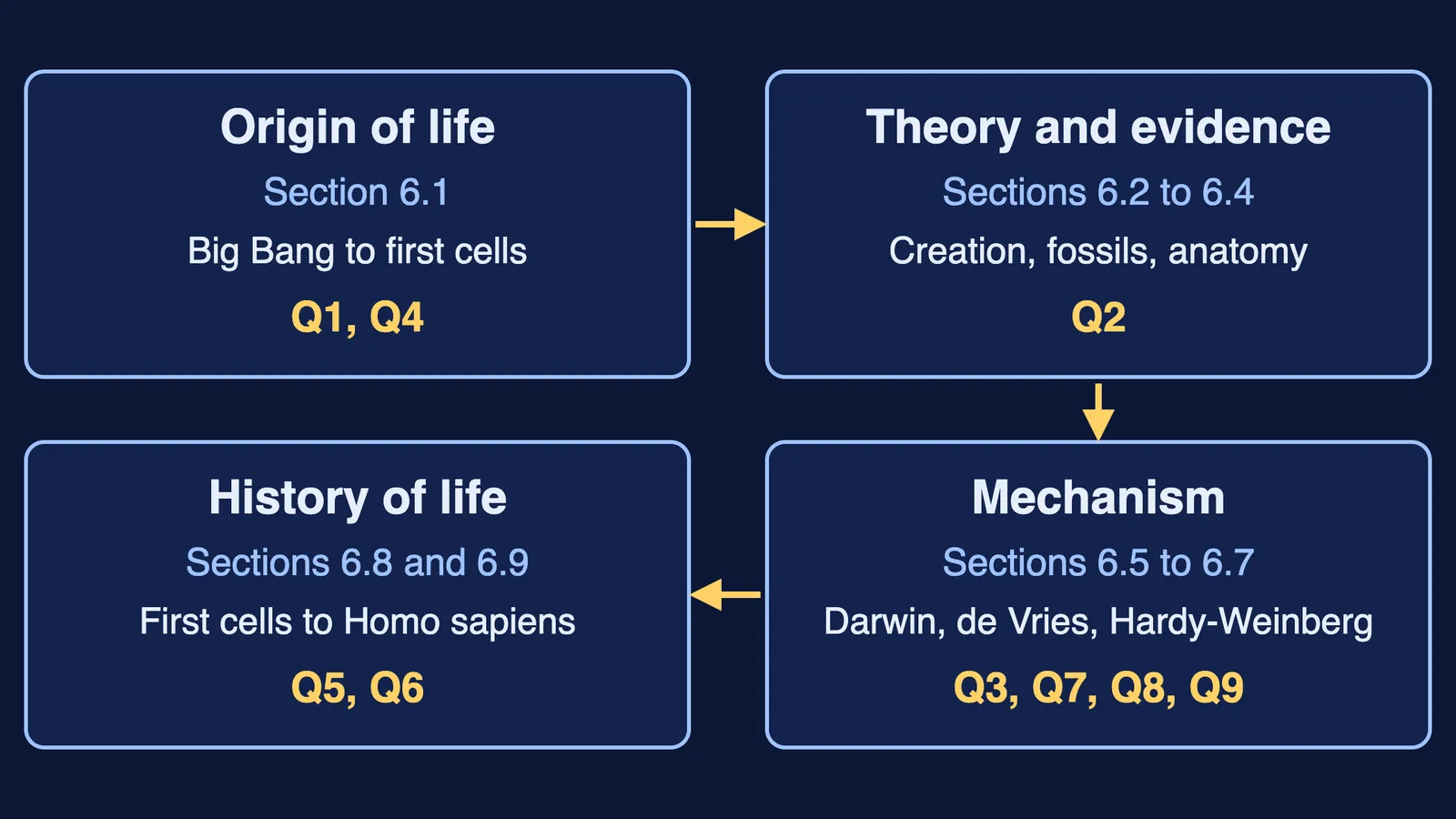
Evolution questions in NEET-UG often turn on one line of NCERT or one step of algebra. These 9 original single-correct MCQs run from the origin of life to population genetics.
Which parts of Evolution does this NEET set test?
The NEET (UG)-2026 syllabus places Evolution in its Unit 7 (Genetics and Evolution). We verified every option in Chapter 6, Evolution, of NCERT Class 12 Biology (Reprint 2026-27), section in brackets. It tests lines our other Evolution sets skip. New to the chapter? Read our guide to Evolution for NEET.
How do you get the most from these questions?
Time yourself: a minute each for Q1 to Q6, two for Q7 to Q9.
Commit to an option before reading the solution.
Study each trap line, including on questions you got right.
Retry your misses in a week.
Easy: do you know the chapter's opening ideas?
Q1 (easy). According to NCERT, roughly how long after the earth formed did life appear?
(1) 500 million years (2) 2000 million years (3) 4 billion years (4) 4.5 billion years
Answer: (1). NCERT dates the earth to about 4.5 billion years ago and says life appeared 500 million years later, close to four billion years before today (6.1).
Why the tempting wrong option fails: (3) is how long ago life appeared, not the gap after the earth formed.
Q2 (easy). Which is NOT one of the three ideas NCERT attaches to the theory of special creation?
(1) Every species today was created in its present form (2) Diversity has stayed the same since creation (3) The earth is about 4000 years old (4) Today's species share ancestors from different periods of earth's history
Answer: (4). NCERT gives (1), (2) and (3) as the theory's three connotations (6.2). Option (4) is Darwin's conclusion.
Why the tempting wrong option fails: (3) sounds too extreme, yet it is one of the three.
Q3 (easy). Which two ideas does NCERT call the key concepts of Darwin's theory?
(1) Branching descent and natural selection (2) Use and disuse, and inheritance of acquired characters (3) Mutation and saltation (4) Gene flow and genetic drift
Answer: (1). NCERT names branching descent and natural selection as the two key concepts (6.5).
Why the tempting wrong option fails: (2) is Lamarck's explanation, which NCERT says nobody accepts any longer.
Medium: can you link evidence to the right conclusion?
Q4 (medium). What does NCERT offer as a sign that chemistry like that in Miller-type experiments also happens in space?
(1) Meteorites contain similar compounds (2) Early Greek thinkers described spores moving between planets (3) Pasteur's open flask grew organisms from killed yeast (4) Starlight reaching us left its source long ago
Answer: (1). NCERT says meteorite analysis showed similar compounds, suggesting similar processes elsewhere in space (6.1).
Why the tempting wrong option fails: (2) is panspermia, the idea that life itself came from outside, not evidence about chemistry.
Q5 (medium). Some early cells could release O2. NCERT compares that reaction to which process?
(1) The light reaction of photosynthesis, where captured solar energy splits water (2) UV rays splitting water in the early atmosphere (3) The electric discharge in Miller's flask (4) Oxygen combining with methane and ammonia on the early earth
Answer: (1). NCERT suggests the reaction may have resembled the light reaction, with light-harvesting pigments channelling solar energy to split water (6.8).
Why the tempting wrong option fails: (2) also splits water, but NCERT places it in the atmosphere before life began (6.1), not inside cells.
Q6 (medium). Which statement about Homo sapiens matches NCERT?
(1) It arose in Africa, spread across continents and developed into distinct races (2) It arose in Java, where fossils were found in 1891 (3) It lived only in the near east and central Asia (4) It appeared about 1.5 mya with a brain of about 900 cc
Answer: (1). NCERT places the origin of Homo sapiens in Africa, from where it spread to other continents (6.9).
Why the tempting wrong option fails: (3) describes Neanderthal man; (2) and (4) describe Homo erectus.
Hard: can you reason through population genetics?
Q7 (hard). One group from population X migrates to population Y, just once. What does NCERT say happens to gene frequencies?
(1) They change in both X and Y (2) Only Y changes, as alleles are added there (3) Only X changes, as alleles leave it (4) Neither changes, as only repeated migration counts
Answer: (1). NCERT says migration changes gene frequencies in the original and the new population, as alleles are added to one and lost from the other (6.7). Repeated migration is gene flow.
Why the tempting wrong option fails: (4) confuses the name with the effect; one migration already shifts frequencies.
Q8 (hard). A population in Hardy-Weinberg equilibrium has dominant allele A (frequency p) and recessive allele a (frequency q), with a the rarer allele (q < p). Heterozygotes make up 0.375 of it. What fraction shows the recessive phenotype?
(1) 0.25 (2) 0.0625 (3) 0.5625 (4) 0.1875
Answer: (2). 2pq = 0.375, so pq = 0.1875. With p + q = 1 the values are 0.75 and 0.25, and p > q gives q = 0.25. The aa frequency is q² = 0.0625 (6.7).
Why the tempting wrong option fails: (1) stops at q instead of squaring it for aa.
Q9 (hard). Under Hardy-Weinberg equilibrium, a recessive trait (aa) shows up in 1 in 36 people. Someone with the dominant phenotype is chosen at random. What is the chance they are a carrier (Aa)?
(1) 5/18 (2) 2/7 (3) 25/36 (4) 5/7
Answer: (2). q² = 1/36, so q = 1/6 and p = 5/6; AA = 25/36 and Aa = 2pq = 10/36. Dominant-phenotype people make up 35/36, so the chance is 10/36 ÷ 35/36 = 2/7 (6.7).
Why the tempting wrong option fails: (1) is the carrier share of the whole population, but the stem has already removed the aa people.
What should you do after this set?
For misses in Q1 to Q6, reread the named section. For Q7 to Q9, redo the working and check that p + q = 1. Next, attempt our Evolution statement and match-the-list questions and Evolution exceptions and odd-one-out questions.
Unsure where to begin your Evolution revision? Fermi's AI tutor works out what you already know and builds a plan for the session.


