

On this page
All eight questions are new, not taken from NCERT exercises or past papers, and none is a forecast. Each option can be checked against Chapter 7 of NCERT's Class 11 Biology (2026-27 reprint), which opens with organs and organ systems (7.1) and then covers the frog (7.2). The NEET (UG) 2026 syllabus puts the chapter in Biology Unit 2, Structural Organisation in Animals and Plants.
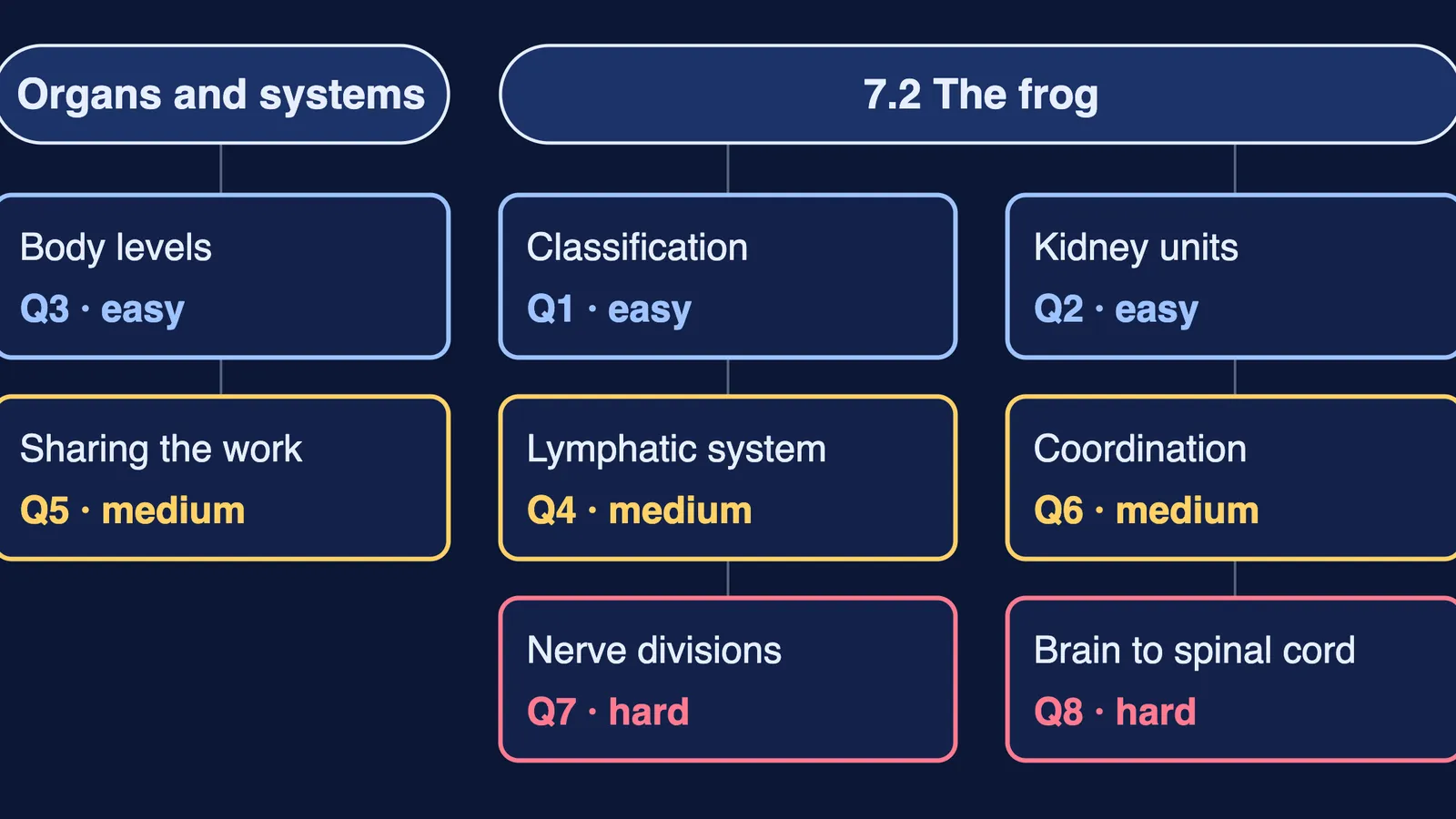
Our other sets already test the frog's gut, heart, ducts, sense organs and brain regions, so this one targets the lines they skip: kidney units, the lymphatic system, levels of organisation, coordination and the nerves.
How do you get the most from these eight questions?
Allow about a minute each, answers covered.
Read every trap line, even after a right answer.
Card each trap that caught you; retry in three days.
Easy: do you know where each part belongs?
Q1 (easy). Frogs live both on land and in freshwater. Where does NCERT place them?
(1) Class Amphibia, phylum Chordata (2) Class Reptilia, phylum Chordata (3) Class Amphibia, phylum Arthropoda (4) Class Pisces, phylum Chordata
Answer: (1). Section 7.2 puts frogs, at home on land and in freshwater, in class Amphibia of phylum Chordata; *Rana tigrina* is the common Indian species.
Why the tempting wrong option fails: (2) keeps the right phylum but swaps the class.
Q2 (easy). Blood carries a frog's nitrogenous wastes to its kidneys, where they are separated out. Each kidney is built of many structural and functional units called:
(1) vasa efferentia (2) Bidder's canals (3) uriniferous tubules, or nephrons (4) villi
Answer: (3). Section 7.2.2 describes compact, bean-like kidneys, each made of several uriniferous tubules, also called nephrons, which do the separating.
Why the tempting wrong option fails: (2) Bidder's canal lies inside the male kidney, but it collects sperm from the vasa efferentia; it is not an excretory unit.
Q3 (easy). Stomach, intestine, liver and pancreas jointly digest food through physical and chemical interaction. This grouping is:
(1) a tissue (2) an organ system (3) an organ (4) a cell
Answer: (2). The chapter opening calls two or more organs that share a common function through such interaction an organ system, and names the digestive system as the example.
Why the tempting wrong option fails: (3) each of the four is an organ; working together, they form a system.
Medium: can you tell one system from another?
Q4 (medium). The frog's vascular system is closed, and it also has a lymphatic system. Which set lists the parts of the lymphatic system?
(1) Heart, blood vessels and blood (2) Lymph, sinus venosus and conus arteriosus (3) Plasma, RBCs and platelets (4) Lymph, lymph channels and lymph nodes
Answer: (4). Section 7.2.2 splits circulation into the blood vascular system (heart, vessels, blood) and the lymphatic system (lymph, lymph channels, lymph nodes).
Why the tempting wrong option fails: (1) lists the other half, the blood vascular system.
Q5 (medium). In a frog, cells, tissues, organs and organ systems each take a share of the body's work, and together they keep the whole body alive. This arrangement shows:
(1) evolutionary trend (2) metamorphosis (3) division of labour (4) sexual dimorphism
Answer: (3). The chapter opening and summary say that splitting the work across these levels exhibits division of labour, which keeps the whole body going.
Why the tempting wrong option fails: (1) evolutionary trend is the pattern of rising complexity in organs and systems across animals, not how one body shares its work.
Q6 (medium). In the frog, the chemical coordination of different organs is brought about by:
(1) hormones secreted by endocrine glands (2) nerve impulses from the brain and spinal cord (3) blood moving through the hepatic portal system (4) sympathetic and parasympathetic nerves
Answer: (1). Section 7.2.2 says control and coordination use both the neural system and endocrine glands, and that chemical coordination comes from hormones those glands secrete, as from the pituitary or thyroid.
Why the tempting wrong option fails: (4) the autonomic nerves do coordinate organs, but by neural signals, not chemical ones.
Hard: can you place each nerve structure?
Q7 (hard). Which statement about the frog's nervous system is correct?
(1) The central nervous system is the brain plus the cranial nerves (2) The peripheral nervous system is cranial and spinal nerves, with twelve pairs of cranial nerves (3) The autonomic nervous system is the brain and spinal cord (4) The peripheral nervous system is cranial and spinal nerves, with ten pairs of cranial nerves arising from the brain
Answer: (4). Section 7.2.2 gives three parts: central (brain and spinal cord), peripheral (cranial and spinal nerves) and autonomic (sympathetic and parasympathetic). It counts ten pairs of cranial nerves.
Why the tempting wrong option fails: (2) has the right parts but the wrong count.
Q8 (hard). Which statement about the frog's brain and spinal cord is correct?
(1) The cerebellum leaves the brain box through the foramen magnum and becomes the spinal cord (2) The medulla oblongata leaves the brain box through the foramen magnum and continues as the spinal cord, inside the vertebral column (3) The medulla oblongata belongs to the midbrain (4) The spinal cord lies inside the cranium
Answer: (2). Section 7.2.2 puts the brain in a bony cranium; the hind-brain is cerebellum plus medulla oblongata. Only the medulla passes out through the foramen magnum, continuing as the spinal cord within the vertebral column.
Why the tempting wrong option fails: (1) picks the right region, the hind-brain, but the wrong part of it.
What should you do after this set?
Reread the NCERT paragraph behind every miss. Next, switch format with statement and match-the-list questions on frogs and tissues, revise from our NEET notes on structural organisation in animals, or go back a chapter with the Animal Kingdom NEET guide.
Which frog line still trips you up? Fermi's AI tutor works out what you already know and builds a plan for the session.


