

On this page
If you have finished our first set of inverse trigonometric functions JEE Main questions with solutions, here are eight new ones, medium to hard, most joining inverse trigonometry to another chapter.
What does JEE Main 2027 test in inverse trigonometric functions?
NTA's JEE (Main) 2027 syllabus lists "inverse trigonometrical functions their properties" under Unit 14, Trigonometry, and "differentiation of ... inverse trigonometric ... functions" under Unit 7. So expect them inside calculus questions too.
The JEE (Main) 2027 Information Bulletin gives Mathematics 20 MCQs and 5 numerical-value questions in Paper 1, with +4 for a correct MCQ and −1 for a wrong one. Picking the trap instead of the answer costs you five marks.
Medium: can you handle principal values and ranges?
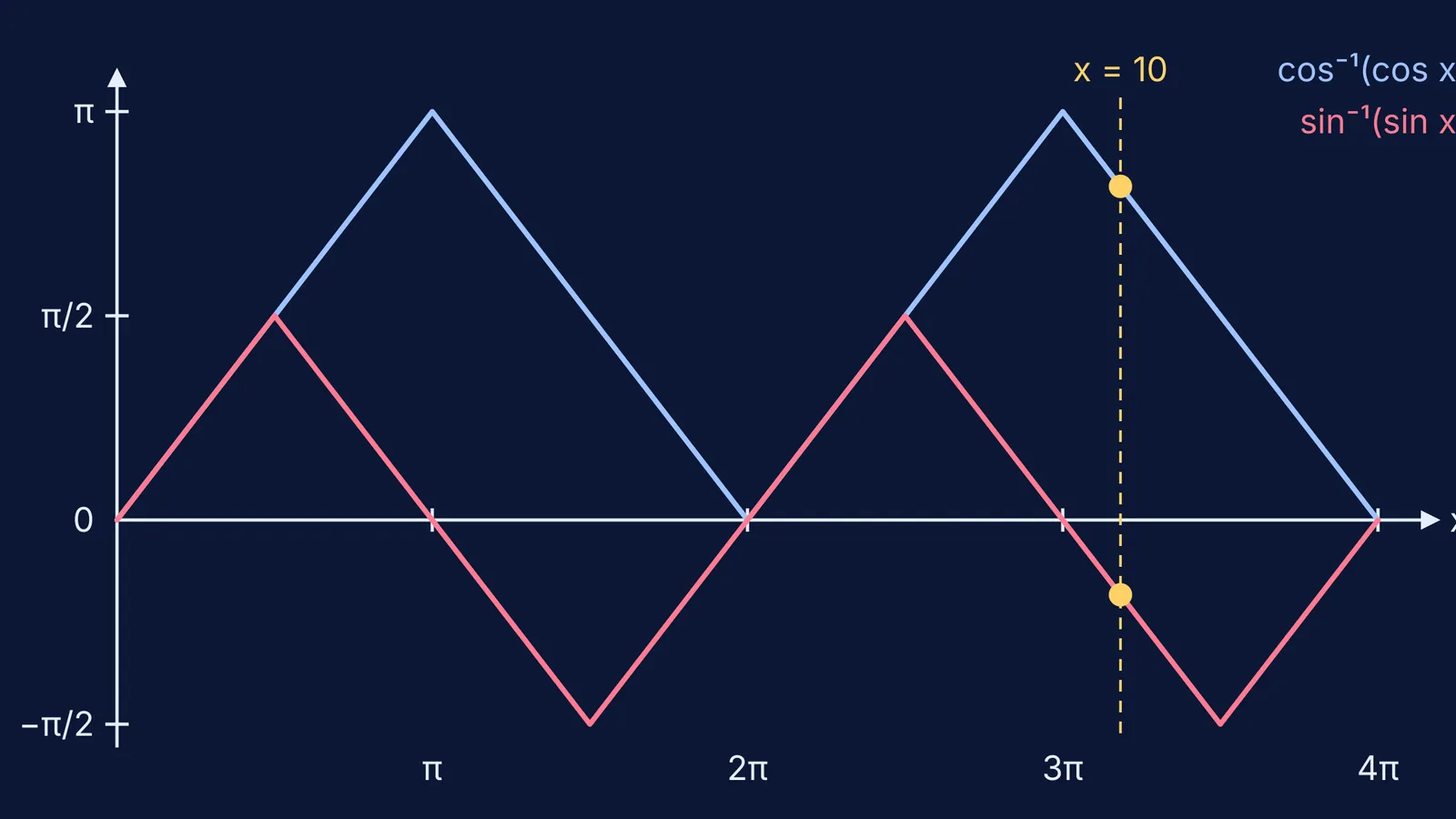
Q1. With angles in radians, sin⁻¹(sin 10) + cos⁻¹(cos 10) equals: (A) 20 (B) 7π − 20 (C) π/2 (D) 20 − 6π
Answer: (B). 10 lies between 5π/2 ≈ 7.85 and 7π/2 ≈ 11.00, where sin⁻¹(sin x) = 3π − x. It also lies between 3π and 4π, where cos⁻¹(cos x) = 4π − x. The sum is 7π − 20. Trap: (C) uses sin⁻¹t + cos⁻¹t = π/2, which needs the same t; sin 10 and cos 10 are different numbers. Check: −0.575 + 2.566 ≈ 1.991, and each part lies in its principal range.
Q2. The range of f(x) = cot⁻¹(x² − 2x + 2) is: (A) (0, π/4] (B) [π/4, π/2) (C) [π/4, π) (D) (0, π/2]
Answer: (A). x² − 2x + 2 = (x − 1)² + 1 takes every value from 1 upwards. cot⁻¹ is decreasing with range (0, π), so f runs from cot⁻¹1 = π/4 down towards 0 without reaching it. Trap: (C) treats cot⁻¹ as increasing, like tan⁻¹. Check: f(1) = π/4 and f(11) = cot⁻¹101 ≈ 0.0099.
Q3. The set of all real x for which cos⁻¹((1 − x²)/(1 + x²)) = 2 tan⁻¹x is: (A) all real x (B) [0, ∞) (C) [−1, 1] (D) [0, 1]
Answer: (B). Put x = tan θ with θ in (−π/2, π/2). The left side is cos⁻¹(cos 2θ), which equals 2θ only when 2θ is in [0, π], that is x ≥ 0. For x < 0 it equals −2 tan⁻¹x. Trap: (A) is the formula learnt without its condition; (C) borrows the interval of the sin⁻¹(2x/(1 + x²)) version. Check: at x = −1 the left side is π/2 and the right side is −π/2.
Q4. For real x, sin(cot⁻¹(cos(tan⁻¹x))) equals: (A) √((x² + 1)/(x² + 2)) (B) √((x² + 2)/(x² + 1)) (C) 1/√(x² + 2) (D) x/√(x² + 2)
Answer: (A). If tan⁻¹x = θ, then cos θ = 1/√(1 + x²), positive because θ is in (−π/2, π/2). If cot φ = 1/√(1 + x²) with φ in (0, π/2), then sin φ = 1/√(1 + cot²φ) = √((1 + x²)/(2 + x²)). Trap: (C) reads the middle cot⁻¹ as tan⁻¹. Check: at x = 1, cos(π/4) ≈ 0.7071, cot⁻¹0.7071 ≈ 0.9553 rad, and sin 0.9553 ≈ 0.8165 = √(2/3).
Hard: can you mix series, calculus and domains?
Q5. The sum of tan⁻¹(2/r²) for r = 1 to ∞ is: (A) π/4 (B) π/2 (C) 3π/4 (D) π
Answer: (C). Write 2/r² = ((r + 1) − (r − 1))/(1 + (r + 1)(r − 1)), so each term is tan⁻¹(r + 1) − tan⁻¹(r − 1). The terms skip by two, so the first n leave tan⁻¹(n + 1) + tan⁻¹n − tan⁻¹1 − tan⁻¹0, which tends to π/2 + π/2 − π/4 = 3π/4. Trap: (A) telescopes as if the gap were one, keeping a single term at each end. Check: the first four terms add to 1.1071 + 0.4636 + 0.2187 + 0.1244 = 1.9138 = tan⁻¹5 + tan⁻¹4 − π/4.
Q6. If y = tan⁻¹((√(1 + x²) − 1)/x) for x ≠ 0, then dy/dx at x = 1 is: (A) 1/2 (B) 1/4 (C) 1/8 (D) −1/4
Answer: (B). With x = tan θ, (sec θ − 1)/tan θ = (1 − cos θ)/sin θ = tan(θ/2), and θ/2 is in (−π/4, π/4). So y = ½ tan⁻¹x and dy/dx = 1/(2(1 + x²)) = 1/4. Trap: (A) differentiates θ/2 with respect to θ, not x. Check: y(1) = tan⁻¹(√2 − 1) = π/8 ≈ 0.39270 and y(1.01) ≈ 0.39519, a slope of about 0.249.
Q7. The sum of all real solutions of tan⁻¹√(x² − 4x) + sin⁻¹√(x² − 4x + 1) = π/2 is: (A) 0 (B) 2 (C) 4 (D) there is no real solution
Answer: (C). The first root needs x² − 4x ≥ 0. The sin⁻¹ needs x² − 4x + 1 ≤ 1, that is x² − 4x ≤ 0. Both hold only when x² − 4x = 0, so x = 0 or 4, and each gives tan⁻¹0 + sin⁻¹1 = π/2. Trap: (A) stops at x = 0, the root you spot by eye. Check: at x = 4 the arguments are √0 and √1.
Q8. The limit as x → 0 of (sin⁻¹x − tan⁻¹x)/x³ is: (A) 1/2 (B) 1/6 (C) −1/6 (D) 0
Answer: (A). The standard expansions are sin⁻¹x = x + x³/6 + … and tan⁻¹x = x − x³/3 + …, so the difference is x³/6 + x³/3 = x³/2. Trap: (C) gives tan⁻¹x a +x³/3 term. Check: at x = 0.1, (0.1001674 − 0.0996687)/0.001 ≈ 0.499.
How should you use this second set?
Do all eight in one sitting, without notes, and time yourself.
Label each miss: principal-value interval, identity used outside its domain, wrong monotonicity, or a slip in the telescoping or expansion.
Later in the week, redo the misses from both sets with one number changed.
If the misses cluster on one idea, revise with our guide on how to prepare inverse trigonometric functions for JEE Main. For Section B, try eight inverse trigonometric functions numerical value questions.
If you can follow a solution but could not have started it yourself, the Fermi Problem Library has worked problems with a step-by-step solver that explains the reasoning. For the rest of the syllabus, Fermi Test Prep is our hub for JEE Main and Advanced preparation.


