On this page
If you have finished our first set of probability JEE Main practice questions with solutions, here are eight more original questions, medium to hard, each joining probability to a second idea.
What does JEE Main 2027 test in probability?
Unit 13 of NTA's JEE (Main) 2027 syllabus lists probability of an event, the addition and multiplication theorems, Bayes' theorem and the probability distribution of a random variable. Every question here draws on those topics.
The JEE (Main) 2027 Information Bulletin gives Mathematics 20 MCQs and 5 numerical-value questions in Paper 1. A correct MCQ earns +4 and a wrong one −1, so picking the trap instead of the answer is a five-mark swing.
Medium: can you pick the right event before you count?
Q1. A fair die is thrown three times. The probability that the largest number shown is exactly 4 is: (A) 37/216 (B) 8/27 (C) 1/6 (D) 61/216
Answer: (A). Largest at most 4 gives 4³ = 64 outcomes; at most 3 gives 3³ = 27; so exactly 4 gives 37. Trap: (B) is 64/216, counting throws like (2, 3, 1) with no 4. Check: throws with one, two or three 4s number 27 + 9 + 1 = 37.
Q2. A and B are independent events with P(A) = 0.3 and P(A ∪ B) = 0.65. Then P(B) is: (A) 0.5 (B) 0.35 (C) 0.45 (D) 0.6
Answer: (A). Independence gives P(A ∩ B) = 0.3p, so 0.65 = 0.3 + 0.7p and p = 0.5. Trap: (B) treats A and B as mutually exclusive. Check: P(neither) = 0.7 × 0.5 = 0.35 = 1 − 0.65.
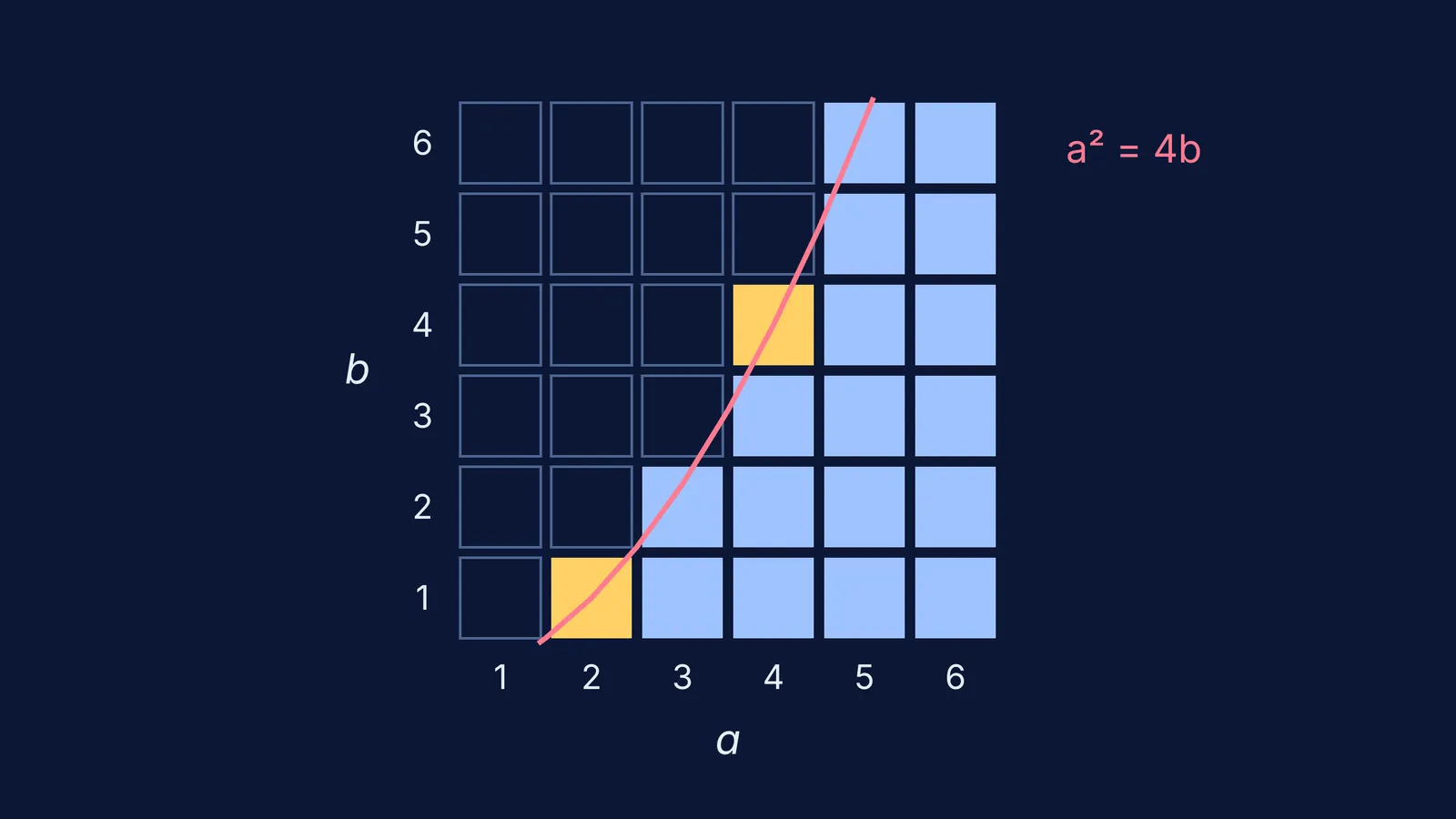
Q3. A die is thrown twice, giving a and then b. The probability that x² + ax + b = 0 has real roots is: (A) 19/36 (B) 17/36 (C) 1/2 (D) 7/18
Answer: (A). Real roots need a² ≥ 4b. For a = 1 to 6 the counts of b are 0, 1, 2, 4, 6, 6, total 19. Trap: (B) uses a² > 4b and drops the equal-roots cases (2, 1) and (4, 4). Check: 6 + 5 + 4 + 2 = 17 pairs have no real roots, and 19 + 17 = 36.
Q4. Two cards are drawn without replacement from a pack of 52. If X is the number of aces, Var(X) is: (A) 400/2873 (B) 24/169 (C) 2/13 (D) 36/221
Answer: (A). P(X = 0, 1, 2) = 1128/1326, 192/1326 and 6/1326. Then E(X) = 2/13 and E(X²) = 216/1326 = 36/221, so Var(X) = 36/221 − 4/169 = 400/2873. Trap: (B) is the binomial npq, as if drawn with replacement. Check: 24/169 × 50/51 = 400/2873.
Hard: can you combine binomial counts with Bayes' theorem?
Q5. A shooter hits a target with probability 1/4 on each shot, independently. The least number of shots for which P(at least one hit) ≥ 0.9 is: (A) 9 (B) 8 (C) 10 (D) 4
Answer: (A). We need (3/4)^n ≤ 0.1. (3/4)^8 = 6561/65536 ≈ 0.1001 is just too big; (3/4)^9 ≈ 0.0751 works. Trap: (B) rounds 0.1001 down to 0.1. Check: ln 10 / ln(4/3) ≈ 8.004. The shortcut is in the 1 − qⁿ rule for at least one success.
Q6. A binomial variable X has mean 4 and variance 8/3. Then P(X ≥ 1) is: (A) 1 − (2/3)^12 (B) 1 − (1/3)^12 (C) (2/3)^12 (D) 1 − (2/3)^6
Answer: (A). q = npq/np = 2/3, so p = 1/3 and n = 12. P(X ≥ 1) = 1 − q^12. Trap: (B) swaps p and q. Check: 12 × 1/3 = 4 and 4 × 2/3 = 8/3.
Q7. Ravi tells the truth 4 times in 5. He throws a die and says it shows more than 4. The probability that it really is 5 or 6 is: (A) 2/3 (B) 4/5 (C) 4/15 (D) 1/3
Answer: (A). By Bayes' theorem, P = (1/3 · 4/5) / (1/3 · 4/5 + 2/3 · 1/5) = (4/15)/(6/15) = 2/3. Trap: (B) is his honesty rate, ignoring that only a third of throws exceed 4. Check: in 15 throws, he truly reports 4 of the 5 high ones and falsely reports 2 of the other 10, so 4 of 6 reports are true.
Q8. A box holds a two-headed coin, a fair coin and a coin that lands heads with probability 3/4. One is picked at random and tossed twice, showing two heads. The probability that it is the two-headed coin is: (A) 16/29 (B) 4/9 (C) 1/3 (D) 16/25
Answer: (A). The chances of two heads are 1, 1/4 and 9/16. With equal priors, P = 1 / (1 + 1/4 + 9/16) = 16/29. Trap: (B) uses one toss, 1/(1 + 1/2 + 3/4). Check: in 48 picks, 16 per coin, two heads appear 16, 4 and 9 times; 16 of those 29 are the two-headed coin.
How should you use this second set?
Do all eight in one sitting, without notes, and time yourself.
Label each miss: wrong event, wrong rule, rounding or a forgotten prior.
Redo the check line for every miss.
Later in the week, redo the misses from both sets with one number changed.
If you can follow a solution but could not have started it yourself, the Fermi Problem Library has worked problems with a step-by-step solver that explains the reasoning. For the rest of the syllabus, Fermi Test Prep is our hub for JEE Main and Advanced preparation.