On this page
This is the second set of eight original questions. If you have not done the first, start with set 1 of matrices and determinants questions, easy to hard. This set is harder, and it mixes chapters the way a real paper does. Seven questions are single-correct; Q8 asks for a number.
Which matrices and determinants topics does set 2 cover?
NTA's Syllabus for JEE (Main) 2027 puts matrices and determinants in Mathematics Unit 3. That unit covers matrix algebra and types of matrices, determinants of order two and three, the area of triangles, adjoint and inverse, and the consistency of linear equations. Q6 and Q7 also borrow from trigonometry (Unit 14) and maxima and minima (Unit 7) in the same syllabus.
Medium: adjoint, skew-symmetric matrices and linear systems
Q1 (medium). A is a 3 × 3 real matrix with AAᵀ = 4I and |A| > 0. Then adj A equals
(A) 2Aᵀ
(B) Aᵀ
(C) 8Aᵀ
(D) Aᵀ/2
Answer: (A). Taking determinants gives |A|² = |4I| = 4³ = 64, so |A| = 8. Also A⁻¹ = Aᵀ/4, so adj A = |A|A⁻¹ = 2Aᵀ. Trap: (B) takes |A| = 4 straight from 4I. Check: A = 2I fits, and adj(2I) = 4I = 2(2I)ᵀ.
Q2 (medium). For A = [[0, 2, −1], [−2, 0, 3], [1, −3, 0]], |I + A| is
(A) 15
(B) 1
(C) 13
(D) 5
Answer: (A). Expand I + A = [[1, 2, −1], [−2, 1, 3], [1, −3, 1]] along row 1: 1(1 + 9) − 2(−2 − 3) − 1(6 − 1) = 15. Trap: (B) uses |A| = 0, which is true, and then adds determinants, which never works. Check: for a 3 × 3 skew-symmetric A with entries a, b, c above the diagonal, |I + A| = 1 + a² + b² + c² = 1 + 4 + 1 + 9.
Q3 (medium). The number of real values of k for which x + y + kz = 0, x + ky + z = 0, kx + y + z = 0 has a non-trivial solution is
(A) 1
(B) 2
(C) 3
(D) 0
Answer: (B). A homogeneous system has a non-trivial solution exactly when its determinant is zero. Here that is −k³ + 3k − 2 = −(k − 1)²(k + 2), so k = 1 or k = −2. Trap: (C) counts the repeated root twice. Check: at k = 1 all three equations become x + y + z = 0.
Q4 (medium). The system x + y + z = 1, x + 2y + 4z = λ, x + 4y + 10z = λ² is consistent. The sum of all possible values of λ is
(A) 3
(B) 2
(C) 1
(D) no such λ exists
Answer: (A). The coefficient determinant is 4 − 6 + 2 = 0, so no solution is unique. Subtracting the first equation gives y + 3z = λ − 1 and 3y + 9z = λ² − 1, which agree only if λ² − 1 = 3(λ − 1), so λ = 1 or 2. Trap: (D) reads a zero determinant as "no solution". Check: (1, 0, 0) works at λ = 1 and (0, 1, 0) at λ = 2.
Hard: powers, a rotation and a determinant as a function
Q5 (hard). A = [[1, 1, 2], [2, 2, 4], [−1, −1, −2]] and (I + A)⁶ = I + kA. Then k is
(A) 63
(B) 64
(C) 6
(D) 32
Answer: (A). Multiplying out shows A² = A, so every power of A is A. The binomial theorem then gives (I + A)⁶ = I + (2⁶ − 1)A. Trap: (C) assumes A² = 0, the trick in set 1; (B) forgets that the C(6, 0) term belongs to I. Check with power 1: I + (2 − 1)A = I + A.
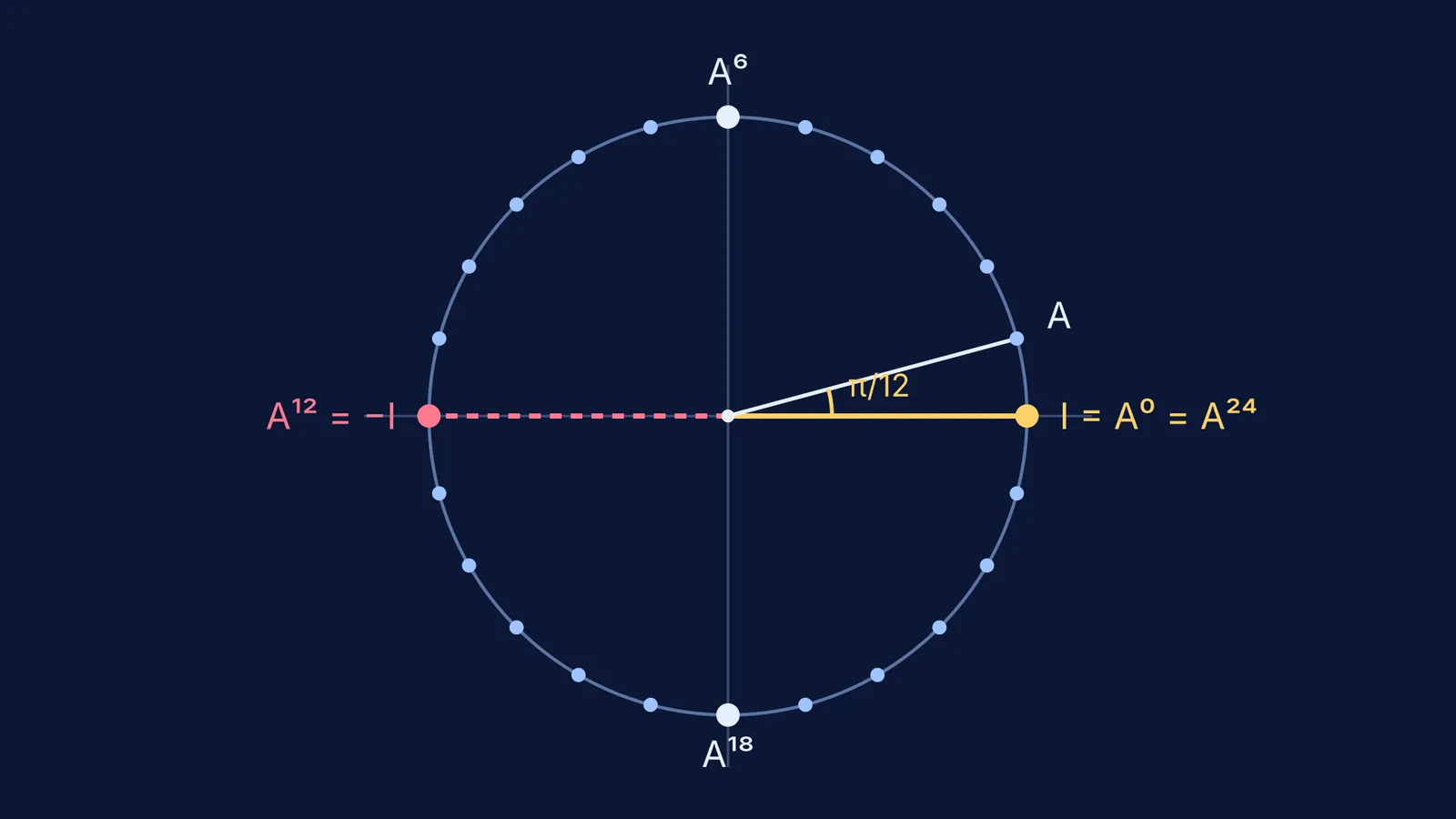
Q6 (hard). A = [[cos θ, −sin θ], [sin θ, cos θ]] with θ = π/12. The smallest positive integer n with Aⁿ = I is
(A) 6
(B) 12
(C) 24
(D) 48
Answer: (C). A rotates the plane by θ, and the angle-addition formulas show Aⁿ rotates by nθ. Aⁿ = I needs nπ/12 to be a multiple of 2π, so n = 24. Trap: (B) is a half-turn, A¹² = −I. Check: A⁶ = [[0, −1], [1, 0]], whose square is −I. The diagram at the top marks the powers.
Q7 (hard). f(x) = |[[x, 1, 1], [1, x, 1], [1, 1, x]]|. The local maximum value of f is
(A) 4
(B) 0
(C) 2
(D) −4
Answer: (A). Expanding gives f(x) = x³ − 3x + 2 = (x − 1)²(x + 2). Then f′(x) = 3x² − 3 is zero at x = ±1, and f″(−1) = −6 < 0, so the local maximum is f(−1) = 4. Trap: (B) is the local minimum, at x = 1. Check: (−1 − 1)²(−1 + 2) = 4.
Q8 (hard, numerical value). a, b and c are the roots of x³ − 6x² + 9x − 2 = 0. The value of |[[a, b, c], [b, c, a], [c, a, b]]| is ____.
Answer: −54. Expanding gives 3abc − (a³ + b³ + c³) = −(a + b + c)(a² + b² + c² − ab − bc − ca). With a + b + c = 6, ab + bc + ca = 9 and abc = 2, a² + b² + c² = 36 − 18 = 18, so the value is −6 × 9 = −54. Trap: +54, from the identity with its sign flipped. Check: Newton's sums give a³ + b³ + c³ = 60, and 3 × 2 − 60 = −54.
How should you review your mistakes from set 2?
Name each miss: a property misused (Q1, Q2, Q5), a case missed (Q3, Q4, Q7) or a sign or count slip (Q6, Q8).
Test every property you used on a small matrix such as 2I before you trust it.
Two days later, redo the misses from a blank page.
Then switch format with these matrices and determinants numerical value questions, where there are no options to work back from. For a plan for the whole chapter, see our guide to preparing matrices and determinants for JEE Main.
If a step still does not make sense, the Fermi Problem Library has worked problems with a step-by-step solver that explains the reasoning rather than printing an answer. For JEE Main and Advanced preparation, see Fermi Test Prep.