On this page
After our first set of definite integrals JEE Main practice questions with solutions, try these eight original medium-to-hard questions. Each pairs a definite integral with a second idea.
What does JEE Main 2027 test in definite integrals?
Unit 8 of NTA's JEE (Main) 2027 syllabus lists "The fundamental theorem of calculus, properties of definite integrals. Evaluation of definite integrals, determining areas of the regions bounded by simple curves".
The JEE (Main) 2027 Information Bulletin gives Mathematics 20 MCQs and 5 numerical-value questions in Paper 1, with +4 for a correct MCQ and −1 for a wrong one. Falling for a trap instead of answering correctly is a five-mark swing.
Medium: can you spot the property before you integrate?
Q1. ∫ from π/6 to π/3 of dx/(1 + √tan x) equals: (A) π/12 (B) π/6 (C) π/4 (D) π/3
Answer: (A). Write the integrand as √cos x/(√cos x + √sin x). Replacing x by π/2 − x swaps sin and cos, and adding the two forms gives 2I = π/6, so I = π/12. Trap: (B) is 2I, left unhalved. Check: the two forms always add to 1, so the average value is 1/2.
Q2. ∫ from −1 to 1 of x²/(1 + e^x) dx equals: (A) 0 (B) 2/3 (C) 1/3 (D) 1/6
Answer: (C). Putting x → −x gives I = ∫ x²e^x/(1 + e^x) dx. Adding, 2I = ∫x² dx = 2/3, so I = 1/3. Trap: (A) assumes the integrand is odd. Check: it is positive away from 0, so 0 is impossible.
Q3. ∫ from 0 to 100π of √(1 − cos 2x) dx equals: (A) 0 (B) 200√2 (C) 100√2 (D) 400
Answer: (B). 1 − cos 2x = 2sin²x, so the integrand is √2|sin x|, with period π. One period gives 2√2, so 100 give 200√2, as in integrating a periodic function over many periods. Trap: (A) writes √(sin²x) as sin x. Check: a never-negative integrand cannot give 0.
Q4. The limit as n → ∞ of the sum from r = 1 to 2n of r/(n² + r²) is: (A) π/4 (B) (1/2) ln 2 (C) ln 5 (D) (1/2) ln 5
Answer: (D). Each term is (1/n) × (r/n)/(1 + (r/n)²), and r/n runs from 0 to 2, so the sum becomes ∫ from 0 to 2 of x/(1 + x²) dx = (1/2) ln 5. Trap: (B) keeps the upper limit at 1. Check: the upper limit is the last r over n, 2n/n = 2.
Hard: can you mix definite integrals with other chapters?
Q5. With [·] the greatest integer function, ∫ from 0 to 2 of [x²] dx equals: (A) 5 − √2 − √3 (B) 1 (C) 3 − √2 (D) 5 + √2 − √3
Answer: (A). [x²] steps up at x = 1, √2 and √3, so the integral is 0 + 1(√2 − 1) + 2(√3 − √2) + 3(2 − √3) = 5 − √2 − √3. Trap: (B) treats [x²] as [x]². Check: ≈ 1.85, between ∫(x² − 1) = 2/3 and ∫x² = 8/3.
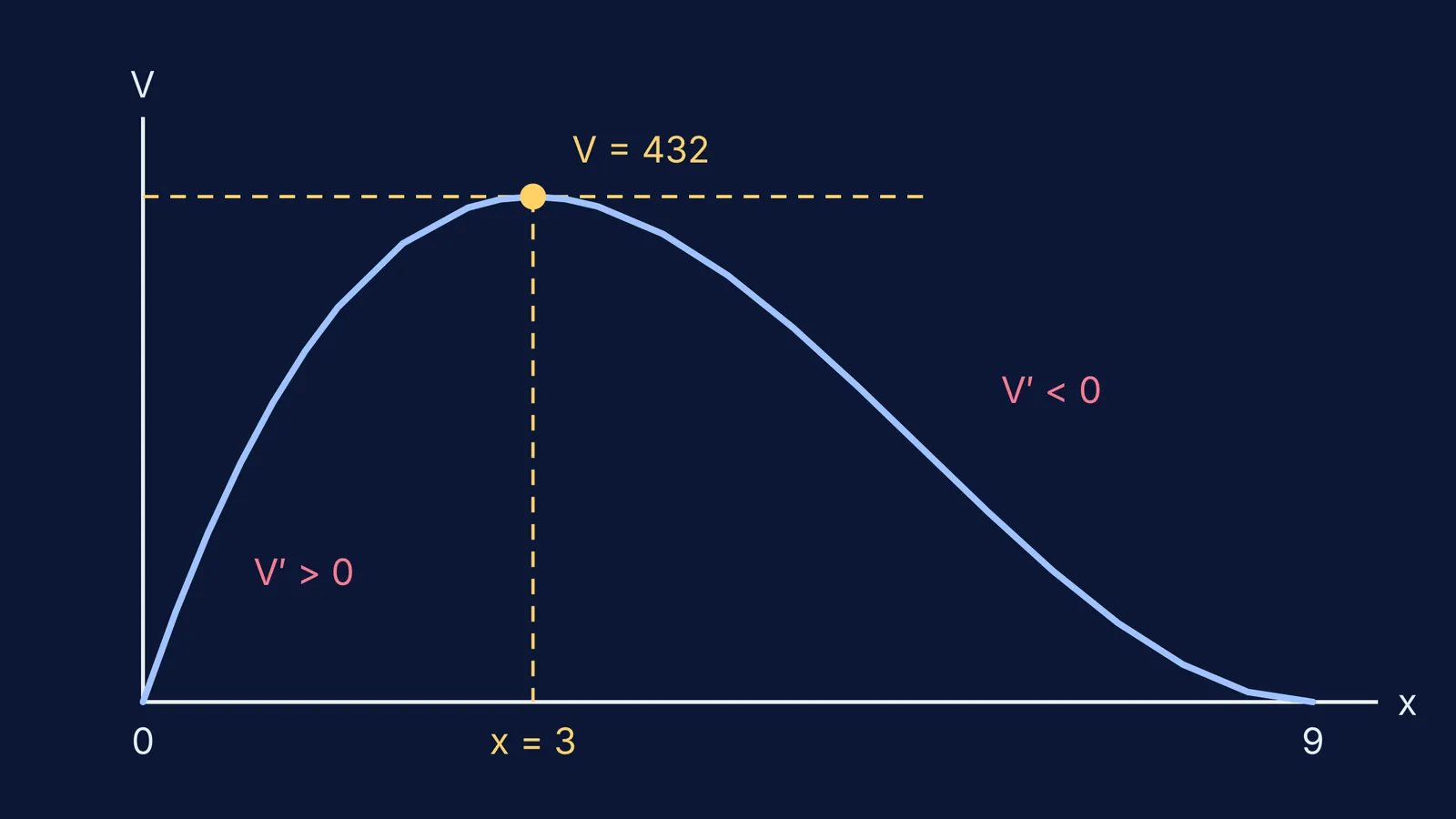
Q6. If f(x) = ∫ from 0 to x of (t² − 3t + 2) dt, the local minimum value of f is: (A) 5/6 (B) 2/3 (C) 1 (D) 2
Answer: (B). By Leibniz's rule f′(x) = (x − 1)(x − 2), which turns positive at x = 2, so the minimum is f(2) = 8/3 − 6 + 4 = 2/3. Trap: (A) is f(1), the local maximum. Check: f(2) − f(1) = ∫ from 1 to 2 of f′ = −1/6.
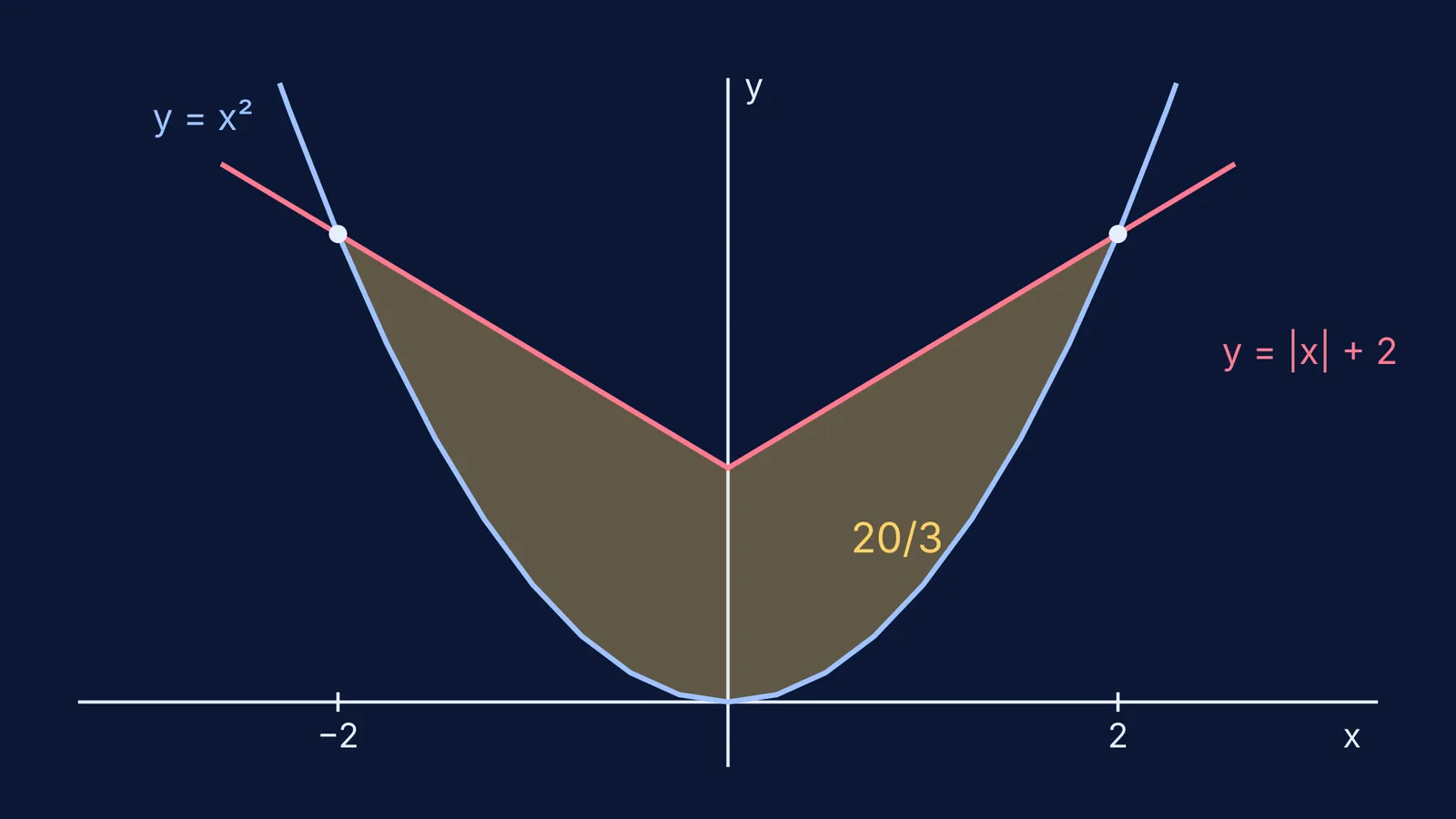
Q7. The area of the region x² ≤ y ≤ |x| + 2 is: (A) 10/3 (B) 16/3 (C) 20/3 (D) 8/3
Answer: (C). The curves meet at |x| = 2, so by symmetry the area is 2 × ∫ from 0 to 2 of (x + 2 − x²) dx = 20/3. Trap: (A) forgets to double. Check: two trapezia of area 6 lie under y = |x| + 2, and 12 − 16/3 = 20/3.
Q8. If f(x) = x + ∫ from 0 to 1 of t f(t) dt, then ∫ from 0 to 1 of f(x) dx equals: (A) 5/6 (B) 3/2 (C) 2/3 (D) 7/6
Answer: (D). The integral is a constant k, so f(x) = x + k and k = ∫ from 0 to 1 of t(t + k) dt = 1/3 + k/2. So k = 2/3 and ∫ f = 1/2 + 2/3 = 7/6. Trap: (A) takes k = 1/3, dropping the k/2. Check: 1/3 + (2/3)/2 = 2/3.
How should you use this second set?
Do all eight in one timed sitting, without notes.
Label each miss with its trap: unhalved sum, lost modulus, wrong limit, or missing double.
Redo the check line for every miss.
Redo the misses with one number changed, and see our guide on how to prepare definite integrals and area for JEE Main.
If you can follow a solution but could not have started it, the Fermi Problem Library has a step-by-step solver that explains the reasoning. Fermi Test Prep is our hub for JEE Main and Advanced preparation.