On this page
If you have worked through our first set of conic sections JEE Main practice questions with solutions, this is the next step: eight original questions, medium to hard, most joining two ideas.
What does JEE Main 2027 test in conic sections?
Conic sections sit in Unit 10, Co-ordinate Geometry, of NTA's JEE (Main) 2027 syllabus, which lists "equations of conic sections (parabola, ellipse and hyperbola) in standard forms" alongside the circle. The questions below build tangents, normals and loci on those standard forms, so treat them as stretch practice.
The JEE (Main) 2027 Information Bulletin gives Mathematics 20 MCQs and 5 numerical-value questions in Paper 1, with +4 marks for a correct MCQ and −1 for a wrong one. Picking the trap instead of the answer costs you five marks.
Medium: can you link a conic to one more idea?
Q1. The circle drawn on the latus rectum of y² = 12x as diameter meets the parabola at how many points? (A) 1 (B) 2 (C) 3 (D) 4
Answer: (B). The focus is (3, 0) and the latus rectum ends are (3, ±6), so the circle is (x − 3)² + y² = 36. Putting y² = 12x gives x² + 6x − 27 = 0, so x = 3 or x = −9. Trap: (D) counts two points for each root, but x = −9 needs y² = −108. Check: (3, 6) gives 0 + 36 = 36.
Q2. For an ellipse, the distance between the foci equals the length of the latus rectum. Its eccentricity is: (A) (√5 − 1)/2 (B) (√5 + 1)/2 (C) 1/√2 (D) (√3 − 1)/2
Answer: (A). 2ae = 2b²/a with b² = a²(1 − e²) gives e = 1 − e², so e² + e − 1 = 0 and e = (√5 − 1)/2. Trap: (B) comes from the sign slip e² − e − 1 = 0 and exceeds 1. Check: 1 − 0.618² ≈ 0.618.
Q3. The asymptotes of x²/a² − y²/b² = 1, with a > b, meet at 60°. The eccentricity is: (A) 2 (B) 2/√3 (C) √2 (D) 4/3
Answer: (B). The asymptotes y = ±(b/a)x make equal angles with the x-axis, each below 45° since a > b, so each is 30°. Then b/a = 1/√3 and e² = 4/3. Trap: (A) takes b/a = tan 60°, which needs b > a. Check: slopes ±1/√3 give tan of the angle = (2/√3)/(2/3) = √3.
Q4. The normal to y² = 4x at (1, 2) meets the parabola again at: (A) (9, −6) (B) (9, 6) (C) (4, −4) (D) (1, −2)
Answer: (A). With a = 1, the point is t = 1 on (t², 2t). The normal at t₁ meets the parabola again at t₂ = −t₁ − 2/t₁ = −3, which is (9, −6). Trap: (C) uses −t₁ − 1/t₁. Check: the normal y = 3 − x passes through (9, −6), and 36 = 4 × 9.
Hard: can you combine conics with tangents, circles and complex numbers?
Q5. A tangent to x²/16 + y²/9 = 1 cuts the coordinate axes at A and B. The least length of AB is: (A) 5 (B) 7 (C) 12 (D) 25
Answer: (B). The tangent at (4 cos θ, 3 sin θ) has intercepts 4 sec θ and 3 cosec θ, so AB² = 16 sec² θ + 9 cosec² θ = 25 + 16 tan² θ + 9 cot² θ ≥ 25 + 2 × 12 = 49. Trap: (A) joins (4, 0) and (0, 3), a chord, not a tangent. Check: tan² θ = 3/4 gives 28 + 21 = 49.
Q6. The locus of points from which the two tangents to x²/25 − y²/16 = 1 are perpendicular is: (A) x² + y² = 9 (B) x² + y² = 41 (C) x² + y² = 25 (D) no real locus
Answer: (A). A tangent y = mx + c needs c² = 25m² − 16. Through (h, k): m²(h² − 25) − 2hkm + (k² + 16) = 0. Perpendicular tangents need the product of roots to be −1, so h² + k² = 9. Trap: (B) is the ellipse's a² + b². Check: from (3, 0), 9m² = 25m² − 16 gives m = ±1.
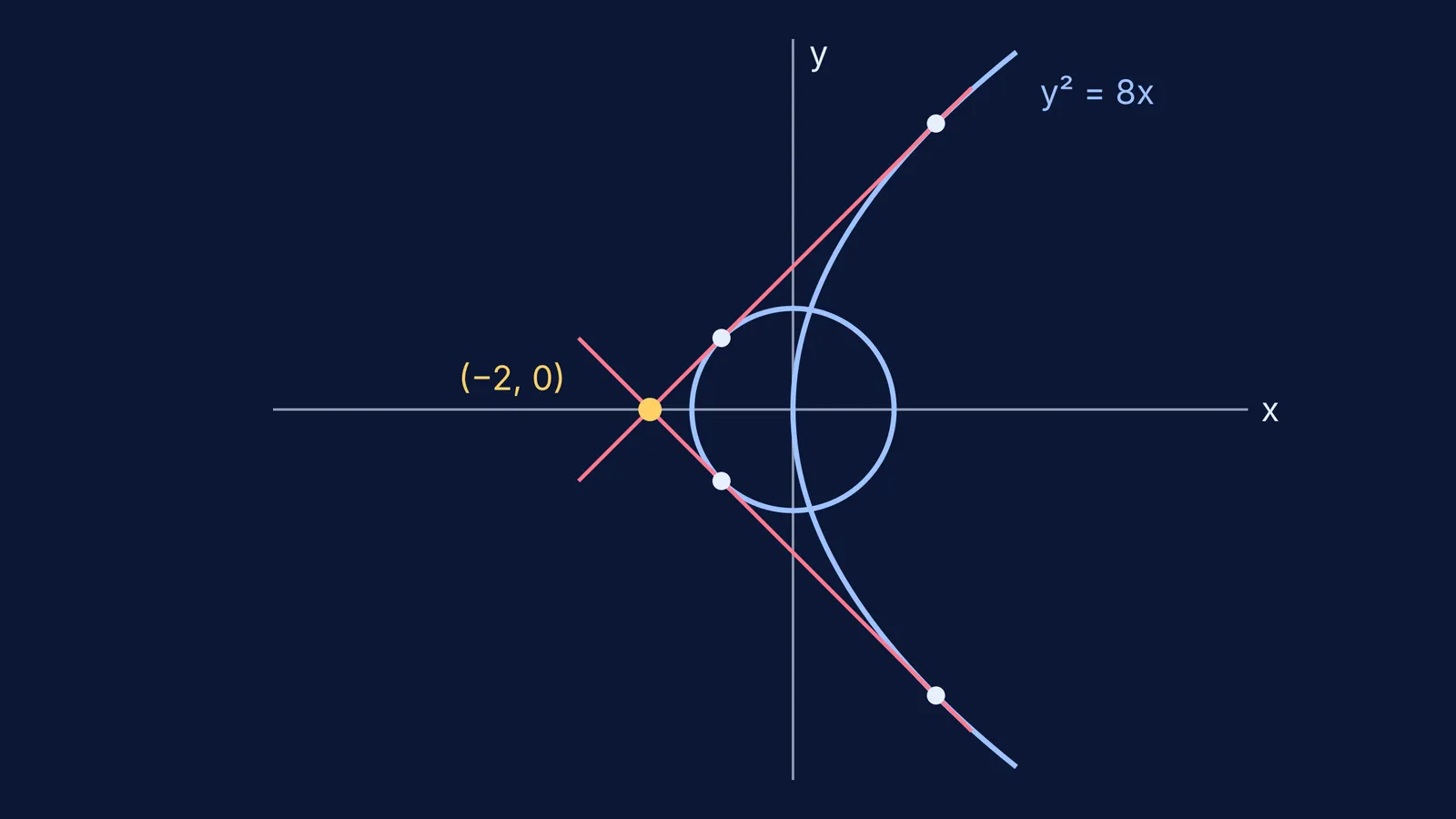
Q7. The two common tangents to y² = 8x and x² + y² = 2 meet at: (A) (−2, 0) (B) (2, 0) (C) (0, 0) (D) (−1, 0)
Answer: (A). A parabola tangent y = mx + 2/m is √2 from the origin when 4/m² = 2(1 + m²), so m⁴ + m² − 2 = 0 and m² = 1. The tangents y = x + 2 and y = −x − 2 meet at (−2, 0). Trap: (B) uses y = mx − 2/m, whose lines meet at the focus. Check: y = x + 2 in y² = 8x gives (x − 2)² = 0, a touch at (2, 4).
Q8. The locus of z = x + iy with ||z − 5| − |z + 5|| = 8 is: (A) x²/16 − y²/9 = 1 (B) x²/16 + y²/9 = 1 (C) x²/25 − y²/16 = 1 (D) x²/9 − y²/16 = 1
Answer: (A). The difference of distances from (±5, 0) is constant, so this is a hyperbola with 2a = 8 and c = 5, giving b² = 25 − 16 = 9. Trap: (D) swaps a² and b². Check: z = 4 gives |−1| − |9| = −8, whose absolute value is 8. See why hyperbola focal distances satisfy |PS − PS′| = 2a.
How should you use this second set?
Do all eight in one sitting, without notes, and time yourself.
Label each miss: sign slip, the other conic's formula, an unrejected root, or a chord taken for a tangent.
Redo the check line for each miss.
Later in the week, redo the misses from both sets with one number changed, and revise with our guide on how to prepare conic sections for JEE Main.
If you can follow a solution but could not have started it yourself, the Fermi Problem Library has worked problems with a step-by-step solver that explains the reasoning. For the rest of the syllabus, Fermi Test Prep is our hub for JEE Main and Advanced preparation.