On this page
This set follows our first set of Permutations and Combinations JEE Main questions. Set 2 sits at the medium and hard end and mixes ideas the way a real paper does.
In NTA's Syllabus for JEE (Main) - 2027, Permutations and Combinations is Mathematics Unit 4: the fundamental principle of counting, P(n, r), C(n, r) and simple applications.
How should you attempt permutations and combinations set 2?
Cover the solutions and allow about three minutes a question.
First write one line: does order matter, are items identical, what is restricted?
Count a guess as wrong.
If the formulas feel shaky, read how to prepare Permutations and Combinations for JEE Main first.
Medium: can you spot what is being counted?
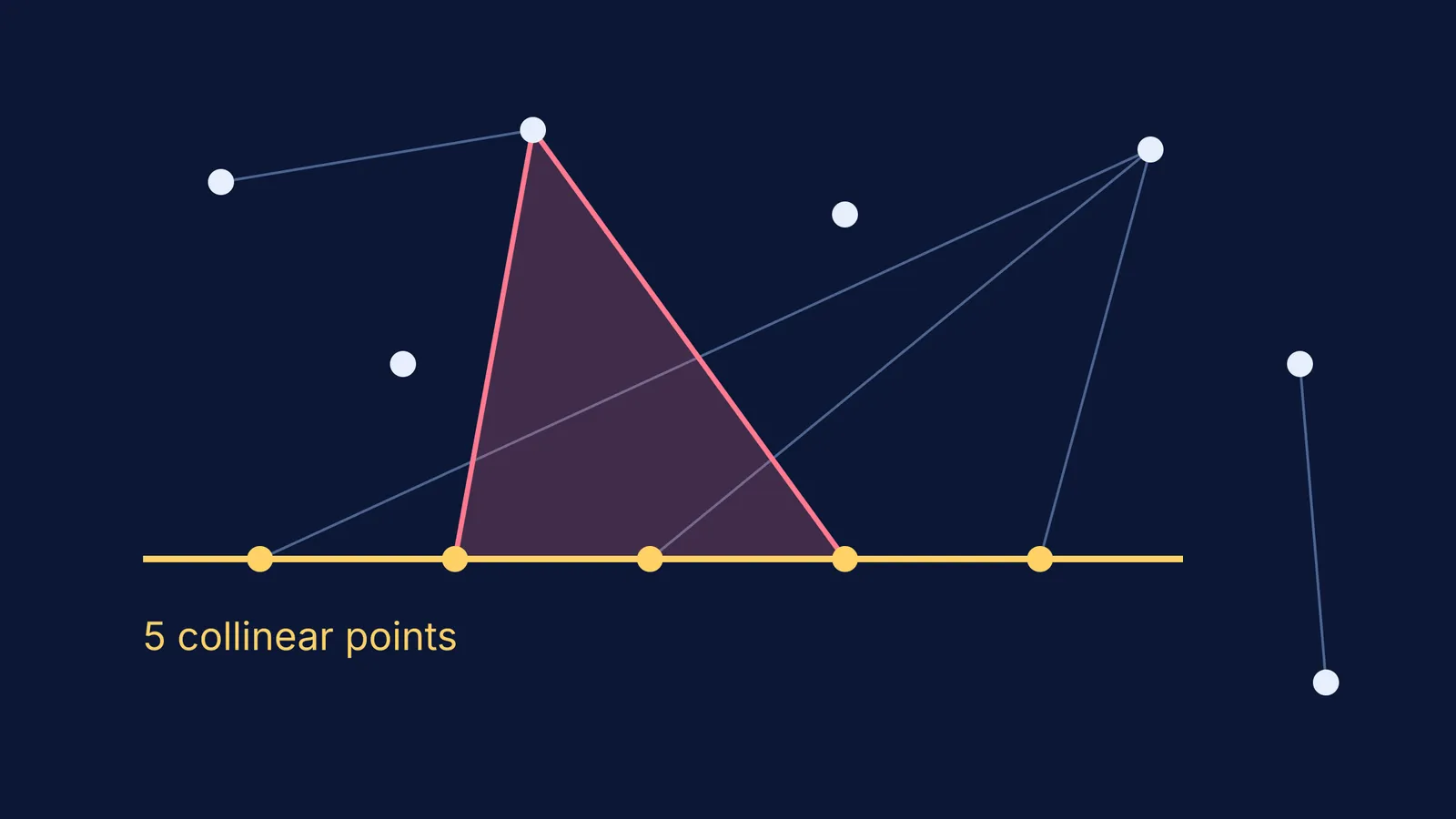
Q1. Of twelve points in a plane, exactly five lie on one line; no other three are collinear. How many lines and triangles do they determine?
(A) 66 lines, 220 triangles (B) 56 lines, 210 triangles (C) 57 lines, 210 triangles (D) 57 lines, 220 triangles
Answer: (C). Lines: C(12,2) − C(5,2) + 1 = 57. Triangles: C(12,3) − C(5,3) = 220 − 10 = 210.
Trap: (B) forgets the ten collinear pairs still make one line. Check: four points, three collinear, give 6 − 3 + 1 = 4 lines.
Q2. How many divisors of 2160 are divisible by 6?
(A) 40 (B) 32 (C) 24 (D) 30
Answer: (C). 2160 = 2⁴ × 3³ × 5. Needing at least one 2 and one 3: 4 × 3 × 2 = 24.
Trap: (B) counts only even divisors. Check: each is 6 times a divisor of 360 = 2³ × 3² × 5, which has 24.
Q3. Six men and four women sit at a round table. In how many ways can no two women be neighbours?
(A) 14 400 (B) 43 200 (C) 86 400 (D) 100 800
Answer: (B). Seat the men: 5! = 120. They leave six gaps for the women: P(6, 4) = 360. Total 43 200.
Trap: (D) uses seven gaps, as for a row. Check: two men and two women give 1! × P(2, 2) = 2, as listing shows.
Q4. In how many ways can nine different books be split into three unlabelled piles of three?
(A) 84 (B) 280 (C) 560 (D) 1680
Answer: (B). C(9,3) × C(6,3) × C(3,3) = 1680 ordered splits. The piles have no names, so divide by 3!: 280.
Trap: (D) fits only if the piles go to three named students. Check: four books into two pairs gives 4!/(2! × 2! × 2!) = 3: AB|CD, AC|BD, AD|BC.
Hard: can you handle caps, repeats and leading zeros?
Q5. Three different dice are thrown. In how many outcomes is the total 10?
(A) 21 (B) 24 (C) 27 (D) 36
Answer: (C). Write each score as 1 + y: y₁ + y₂ + y₃ = 7, each y at most 5. Uncapped: C(9,2) = 36. Remove cases with some y ≥ 6: 3 × C(3,2) = 9. Answer 27.
Trap: (D) forgets a die stops at 6. Check: by symmetry, total 11 also gives 27.
Q6. Five letters go into five addressed envelopes, one each. In how many ways are exactly two correct?
(A) 10 (B) 20 (C) 30 (D) 60
Answer: (B). Choose the two correct letters: C(5,2) = 10. The other three must all be wrong: D₃ = 2 derangements. Total 20.
Trap: (D) lets the other three go anywhere (10 × 3!). Check: counting exactly 0, 1, 2, 3, 4, 5 correct gives 44 + 45 + 20 + 10 + 0 + 1 = 120 = 5!.
Q7. How many four-letter arrangements can be made from the letters of ARRANGE?
(A) 210 (B) 270 (C) 360 (D) 840
Answer: (B). Letters: A, A, R, R, N, G, E.
All different: P(5,4) = 120.
One pair, two singles: 2 × C(4,2) = 12 selections, each in 4!/2! = 12 orders: 144.
Two pairs (AARR): 4!/(2! × 2!) = 6.
Total 270.
Trap: (A) divides 840 by 2! × 2!, though most picks repeat no letter. Check: it must exceed P(5,4) = 120.
Q8. What is the sum of all four-digit numbers formed from 0, 1, 2 and 3, each used once?
(A) 36 000 (B) 38 664 (C) 39 996 (D) 41 328
Answer: (B). Allowing a leading 0, each digit sits in each place 3! = 6 times: 6 × 6 × 1111 = 39 996. Subtract the six strings starting with 0: 6 × 2 × 111 = 1332. Answer 38 664.
Trap: (C) keeps the leading zeros. Check: the average, 38 664/18 = 2148, lies between 1023 and 3210.
What should you do after checking your answers?
Sort every miss into misread, wrong method or arithmetic slip, and redo wrong-method misses first. Then try our numerical value questions on this chapter, where no options rescue a guess.
If a step still doesn't click, the Fermi Problem Library has worked problems with a step-by-step solver that explains the reasoning. For your wider preparation, Fermi Test Prep offers JEE Main and Advanced preparation.