On this page
This set follows our first set of Sequences and series JEE Main practice questions. All are medium or hard; most join two ideas.
In NTA's Syllabus for JEE (Main) - 2027, Unit 6, Sequence and Series, lists arithmetic and geometric progressions, inserting means between two numbers, and the relation between the AM and the GM. Q6 and Q7 also need telescoping and the S − S/2 trick, which the unit does not name.
How should you attempt these practice questions?
Allow three minutes per question, answers covered.
Write the general term or sum formula first.
Count a guess as wrong.
Shaky on formulas? Start with what to study in sequences and series for JEE Main.
Medium: can you join a progression to another idea?
Q1 (medium). log 3, log(3ˣ − 2) and log(3ˣ + 4) are in AP. Then x is:
(A) log₃8 (B) log₃11 (C) 2 (D) log₈3
Answer: (A). Logs in AP mean the numbers are in GP: (3ˣ − 2)² = 3(3ˣ + 4). With y = 3ˣ, y² − 7y − 8 = 0, so y = 8 (not −1) and x = log₃8.
Trap: (B) puts the numbers, not their logs, in AP. Check: 3, 6, 12 is a GP.
Q2 (medium). An infinite GP has sum 20, and the sum of the squares of its terms is 100. Its first term is:
(A) 8 (B) 5 (C) 4 (D) 12
Answer: (A). a/(1 − r) = 20 and a²/(1 − r²) = 100. Dividing gives a/(1 + r) = 5. So 20(1 − r) = 5(1 + r), r = 3/5 and a = 8.
Trap: (B) is a/(1 + r). Check: 8 ÷ (2/5) = 20.
Q3 (medium). The 1st, 2nd and 5th terms of an AP (d ≠ 0) are in GP, and its first 10 terms sum to 200. Its 20th term is:
(A) 76 (B) 78 (C) 82 (D) 98
Answer: (B). (a + d)² = a(a + 4d) gives d = 2a. Then S₁₀ = 5(2a + 9d) = 100a = 200, so a = 2, d = 4 and a₂₀ = 2 + 19 × 4 = 78.
Trap: (C) uses a + 20d. Check: 2, 6, 18 is a GP.
Q4 (medium). The AM of two positive numbers a > b is 5/3 times their GM. Then a : b is:
(A) 3 : 1 (B) 9 : 1 (C) 25 : 9 (D) 5 : 3
Answer: (B). Put t = √(a/b). The condition becomes t + 1/t = 10/3, so t = 3 and a : b = 9 : 1.
Trap: (A) stops at t and forgets to square it. Check: 9 and 1 have AM 5 and GM 3.
Hard: can you spot the structure before calculating?
Q5 (hard). For positive x, y, z with x + y + z = 12, the greatest value of xy²z³ is:
(A) 4096 (B) 6912 (C) 1728 (D) 13824
Answer: (B). Split the sum into six parts: x, y/2, y/2, z/3, z/3, z/3. AM ≥ GM gives 2 ≥ (xy²z³/108)^(1/6), so xy²z³ ≤ 64 × 108 = 6912, with equality at x = 2, y = 4, z = 6.
Trap: (A) sets x = y = z = 4, ignoring the unequal powers. Check: 2 × 16 × 216 = 6912.
Q6 (hard). The AP a₁, a₂, … has a₁ = 1 and common difference 3. The sum of 1/(√aₖ + √aₖ₊₁) for k = 1 to 33 is:
(A) 3 (B) 9 (C) 10 (D) 11
Answer: (A). Rationalised, each term is (√aₖ₊₁ − √aₖ)/3, so the sum telescopes to (√a₃₄ − √a₁)/3 = (10 − 1)/3 = 3.
Trap: (B) forgets to divide by the common difference. Check: the shortcut (n − 1)/(√a₁ + √aₙ) with n = 34 gives 33/11 = 3.
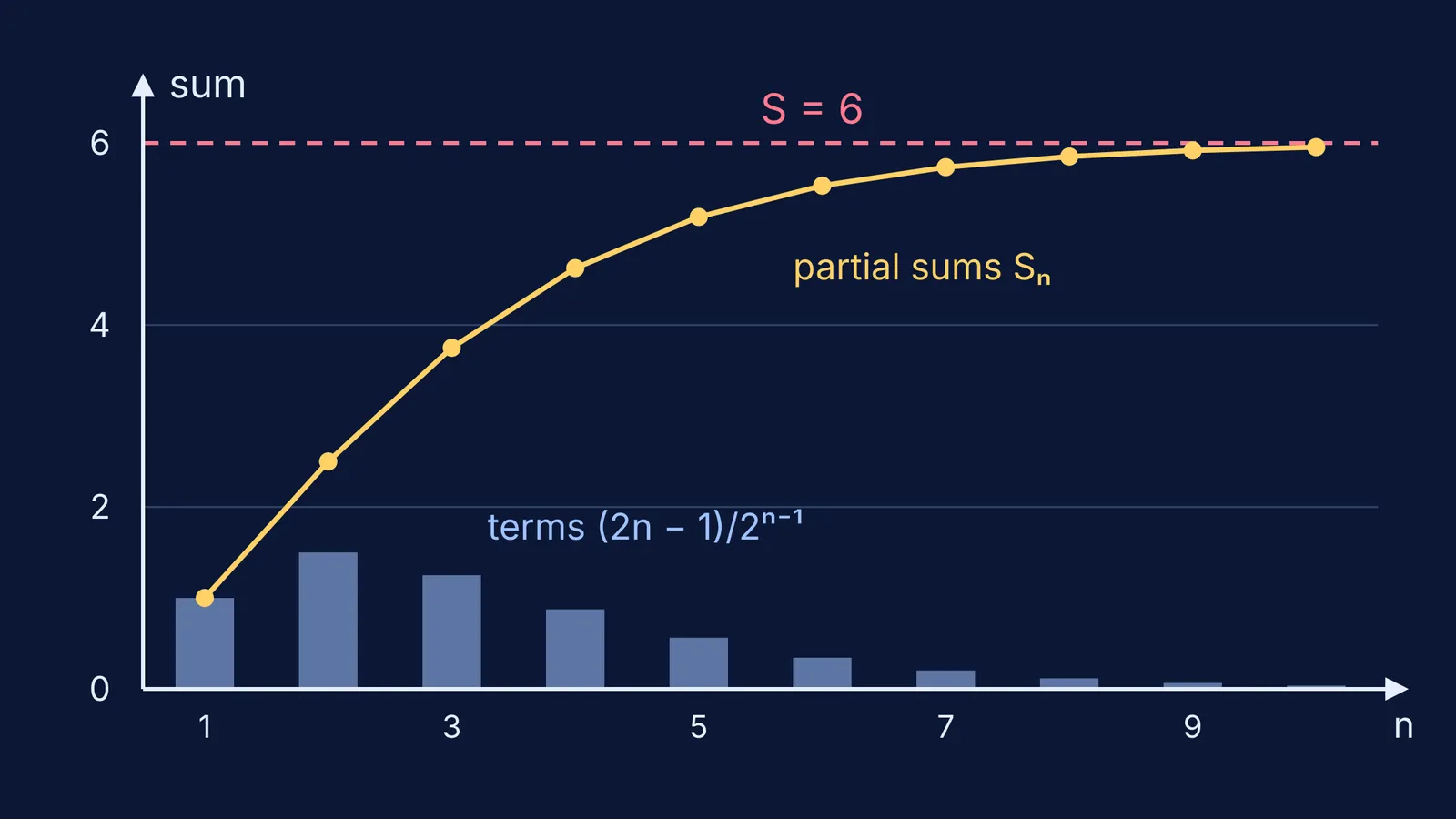
Q7 (hard). The sum to infinity of 1 + 3/2 + 5/4 + 7/8 + … is:
(A) 4 (B) 6 (C) 8 (D) 3
Answer: (B). Subtract S/2 from S: S/2 = 1 + (1 + 1/2 + 1/4 + …) = 1 + 2 = 3, so S = 6.
Trap: (D) is S/2. Check: ten terms already sum to about 5.96.
Q8 (hard). The sum of the first n terms of a sequence is 3ⁿ − 1. The sum of the squares of its first n terms is:
(A) (9ⁿ − 1)/2 (B) (3ⁿ − 1)² (C) 9ⁿ − 1 (D) (9ⁿ − 1)/8
Answer: (A). aₙ = Sₙ − Sₙ₋₁ = 2 × 3ⁿ⁻¹, a GP with ratio 3. The squares form a GP (first term 4, ratio 9) summing to 4(9ⁿ − 1)/8.
Trap: (B) squares the sum instead of summing the squares. Check: n = 1 gives 4 on both sides.
What should you do after checking your answers?
Sort each miss: misread, wrong idea or slip. Redo wrong ideas tomorrow without notes, then try our sequences and series numerical value questions.
If you could follow a solution but not start it, the Fermi Problem Library has a step-by-step solver that explains the reasoning rather than printing an answer. Fermi Test Prep covers JEE Main and Advanced preparation.