On this page
These eight new questions run from easy to hard and stay inside Unit 6 (Sequence and Series) of the NTA syllabus for JEE (Main) 2027, which lists arithmetic and geometric progressions, inserting arithmetic and geometric means, and the relation between AM and GM. For theory first, see what to study for sequences and series in JEE Main.
How are JEE Main numerical-value questions marked?
In Paper 1, each subject has Section A with 20 multiple-choice questions and Section B with 5 numerical-value questions, according to the NTA Information Bulletin for JEE (Main) 2027. A correct Section B answer earns +4, a wrong one costs −1, and a blank earns 0. You type it on an on-screen keypad, rounded off to the nearest integer.
So a guess is not free. Every answer below is an integer with a quick check.
Easy: can you find the terms?
Q1. The 5th term of an AP is 23 and the 12th term is 58. Find the sum of its first 20 terms.
Answer: 1010. 7d = 58 − 23 = 35, so d = 5 and a = 23 − 4 × 5 = 3. S₂₀ = 10(2 × 3 + 19 × 5) = 10 × 101 = 1010.
Check: a₂₀ = 98, and 20 × (3 + 98)/2 = 1010. Slip: 910, from writing the 5th term as a + 5d, which gives a = −2.
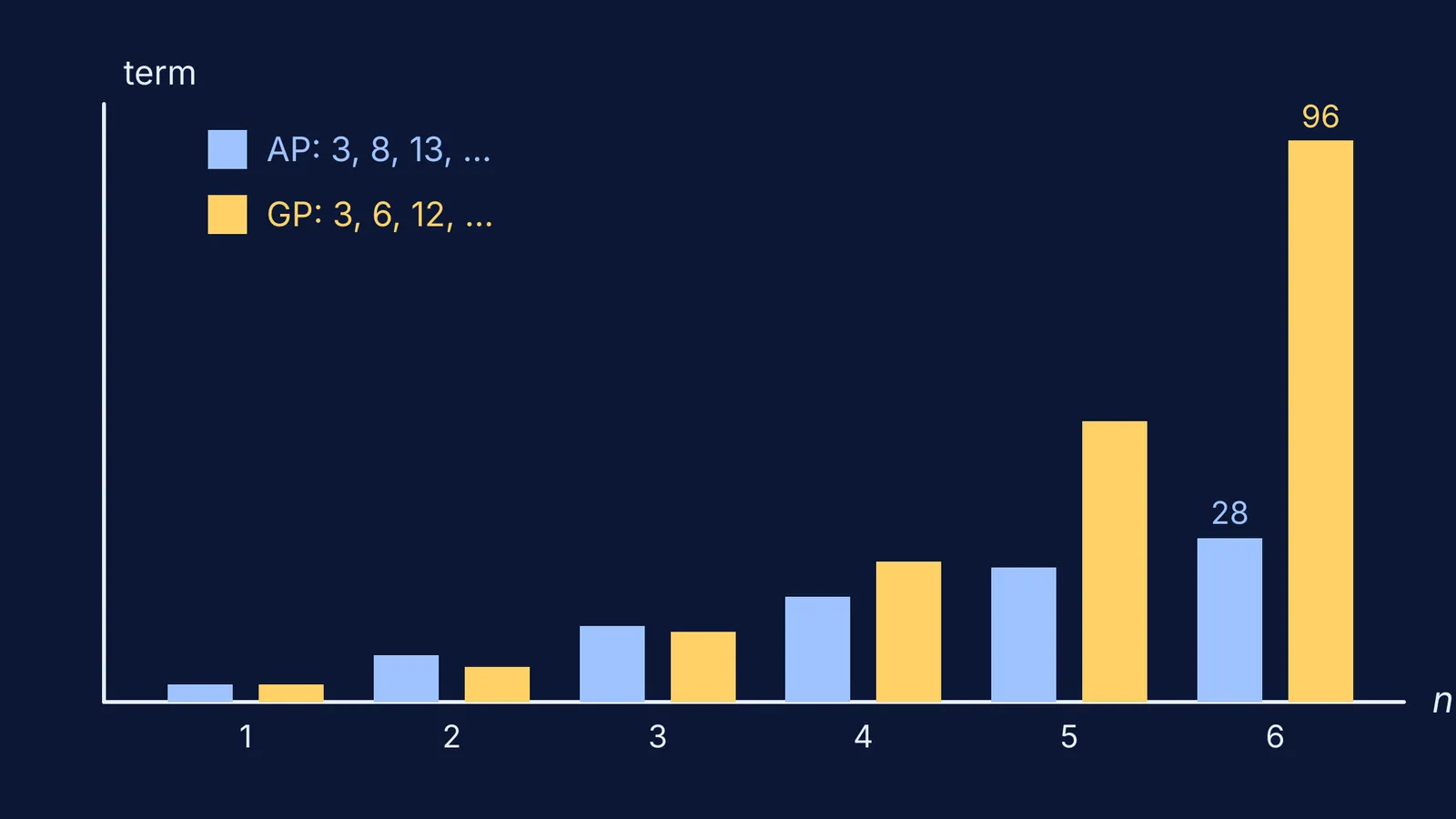
Q2. A GP of positive terms has 3rd term 12 and 6th term 96. Find the sum of its first 8 terms.
Answer: 765. r³ = 96/12 = 8, so r = 2 and a = 12/4 = 3. S₈ = 3(2⁸ − 1)/(2 − 1) = 765.
Check: with r = 2, S₈ = 2a₈ − a = 768 − 3 = 765. Slip: 381, from using 2⁷ in place of 2⁸.
Q3. n arithmetic means are inserted between 7 and 71, and the 5th mean is 27. Find n.
Answer: 15. There are n + 1 gaps, so d = 64/(n + 1). The 5th mean is the 6th term: 7 + 5d = 27 gives d = 4, so n + 1 = 16.
Check: 7, 11, …, 71 has 17 terms, so 15 means. Slip: 16, from d = 64/n.
Medium: means and a word problem
Q4. Four positive geometric means are inserted between 2 and 486. Find their sum.
Answer: 240. There are six terms, so 486 = 2r⁵, r⁵ = 243 and r = 3. The means are 6, 18, 54 and 162.
Check: 162 × 3 = 486. Slip: 728, which adds the end terms too.
Q5. Two positive numbers have arithmetic mean 25 and geometric mean 15. Find the larger number.
Answer: 45. Their sum is 50 and their product is 15² = 225, so they are the roots of t² − 50t + 225 = 0, which are 45 and 5.
Check: (45 + 5)/2 = 25 and √225 = 15. Slip: 50, from taking the product as 15, not 225.
Q6. Riya saves ₹500 in her first month and ₹100 more each month after that. In which month does her total first reach ₹15,000?
Answer: 14. Sₙ = (n/2)(1000 + 100(n − 1)) = 50n² + 450n. Solving 50n² + 450n = 15,000 gives n ≈ 13.4.
Check: S₁₃ = ₹14,300 and S₁₄ = ₹16,100. Slip: 13, from rounding 13.4 to the nearest integer; the first month the total is reached needs rounding up.
Hard: can AM–GM and two progressions trip you?
Q7. Positive numbers a, b and c have a + b + c = 12. Find the greatest value of ab²c.
Answer: 324. Split b into two halves and apply AM ≥ GM to a, b/2, b/2 and c, whose sum is 12: 3 ≥ (ab²c/4)^(1/4), so ab²c ≤ 4 × 81 = 324. Equality needs a = b/2 = c = 3.
Check: a = 3, b = 6, c = 3 add to 12, and 3 × 36 × 3 = 324. Slip: 256, from setting a = b = c = 4.
Q8. Three positive numbers in AP add up to 15. Adding 1, 4 and 19 to them in order gives a GP. Find the product of the three numbers.
Answer: 80. Write them as 5 − d, 5 and 5 + d. Then 9² = (6 − d)(24 + d), so d² + 18d − 63 = 0 and d = 3 or −21. Only d = 3 keeps them positive: 2, 5, 8.
Check: 3, 9 and 27 form a GP with ratio 3. Slip: −2080, from d = −21, which gives 26, 5 and −16.
How do you avoid the wrong number?
Count gaps before you write d or r: k means make k + 1 gaps.
Do the one-line check before typing.
Reread the last sentence: it says whether to round up or discard a root.
If a method keeps going wrong, the Fermi Problem Library has a step-by-step solver that explains the reasoning. For JEE Main and Advanced preparation, start at Fermi Test Prep.
For multiple-choice practice, try our sequences and series JEE Main practice questions with solutions.