On this page
This set follows our first set of complex numbers and quadratic equations practice questions. Every question here is medium or hard, and most mix two ideas, such as a cube root of unity inside a quadratic.
In NTA's Syllabus for JEE (Main) - 2027, Complex Numbers and Quadratic Equations is Mathematics Unit 2, running from the Argand diagram to relations between roots and coefficients. Every question below draws on that unit.
How should you attempt this practice set?
Attempt all eight in one timed sitting, solutions covered.
Mark each right, wrong or guessed, and count a guess as wrong.
Shaky on the basics? Start with how to prepare complex numbers and quadratics for JEE Main. Below, ω is a non-real cube root of unity: ω³ = 1 and 1 + ω + ω² = 0.
Medium: can you combine polar form, ω and the Argand plane?
Q1 (medium). What is (1 + i)¹¹ / (1 − i)⁹?
(A) −2 (B) 2i (C) i (D) 2
Answer: (A). (1 + i)/(1 − i) = i, so the expression is i⁹ × (1 + i)² = i × 2i = −2.
Trap: (C) stops at i⁹ = i and forgets the leftover (1 + i)².
Check: the modulus must be (√2)¹¹/(√2)⁹ = 2, which rules out (C).
Q2 (medium). What is (1 − ω + ω²)⁷ + (1 + ω − ω²)⁷?
(A) 128 (B) −128 (C) 0 (D) 256
Answer: (A). 1 + ω² = −ω and 1 + ω = −ω², so the brackets are −2ω and −2ω². The sum is −128(ω⁷ + ω¹⁴) = −128(ω + ω²) = 128.
Trap: (B) loses a minus sign, usually by writing (−2)⁷ as +128.
Check: the brackets are conjugates, so the sum is 2 Re(−128ω) = 128.
Q3 (medium). z moves on |z − 3 − 4i| = 2. What is the greatest value of |z + 1|?
(A) 2√5 + 2 (B) 4√2 + 2 (C) 4√2 − 2 (D) 7
Answer: (B). z is on the circle with centre 3 + 4i and radius 2. The centre is |4 + 4i| = 4√2 from −1, so the farthest point is 4√2 + 2 away.
Trap: (A) measures from +1, not −1.
Check: the least distance, (C), must be exactly one diameter less.
Q4 (medium, numerical). For how many integers k do both roots of x² − 2kx + k² − 4 = 0 lie strictly between −3 and 5?
Answer: 3. The discriminant is 16, so the roots are k − 2 and k + 2. Then k − 2 > −3 and k + 2 < 5 give −1 < k < 3, so k = 0, 1, 2.
Trap: 5 also counts k = −1 and k = 3, where a root lands on an end point.
Check: k = 2 gives roots 0 and 4, both inside.
Hard: can you mix roots, recurrences and loci?
Q5 (hard). α and β are the roots of x² − 2x + 4 = 0. What is α⁵ + β⁵?
(A) 32 (B) −32 (C) 64 (D) −64
Answer: (A). The roots are 2(cos π/3 ± i sin π/3), so by De Moivre's theorem α⁵ + β⁵ = 2 × 32 cos(5π/3) = 32.
Trap: (C) adds the moduli and drops the cosine.
Check: α = −2ω² and β = −2ω, so the sum is −32(ω¹⁰ + ω⁵) = −32(ω + ω²) = 32.
Q6 (hard). α and β are the roots of x² − 4x − 3 = 0, and aₙ = αⁿ + βⁿ. What is (a₁₂ − 3a₁₀)/a₁₁?
(A) 4 (B) −4 (C) 3 (D) 12
Answer: (A). Each root satisfies t² = 4t + 3. Multiply by t¹⁰ and add over both roots: a₁₂ = 4a₁₁ + 3a₁₀, so the ratio is 4.
Trap: (B) takes the sum of the roots as −4, the sign slip with −b/a.
Check: at n = 2, a₀ = 2, a₁ = 4 and a₂ = 22, and 22 − 6 = 16 = 4 × 4.
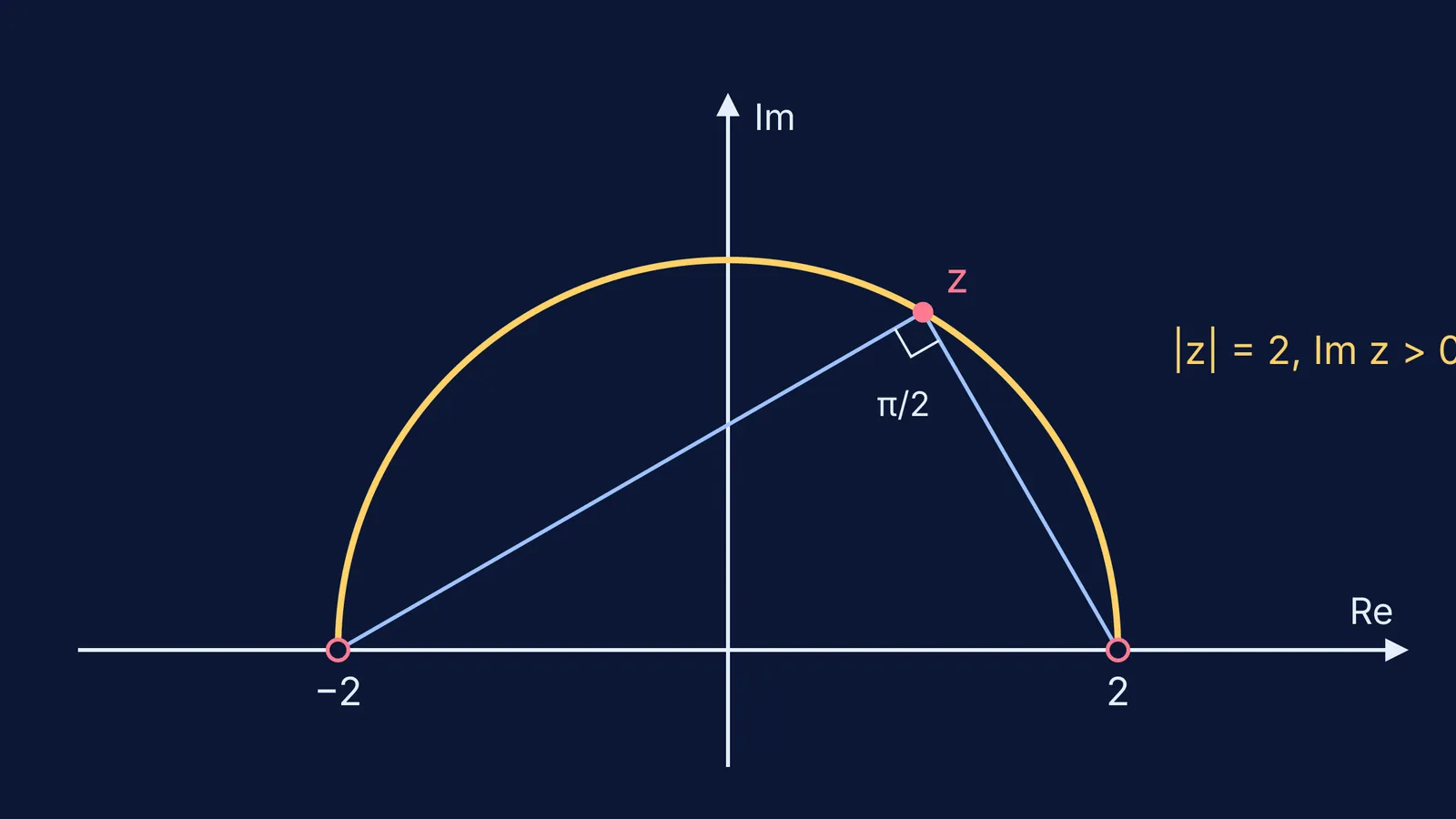
Q7 (hard). If arg((z − 2)/(z + 2)) = π/2, the locus of z is:
(A) the circle |z| = 2 (B) the part of |z| = 2 with Im z > 0 (C) the part of |z| = 2 with Im z < 0 (D) the imaginary axis
Answer: (B). With z = x + iy, multiplying top and bottom by the conjugate of z + 2 gives the numerator (x² + y² − 4) + 4iy. An argument of π/2 needs a zero real part and a positive imaginary part: x² + y² = 4 with y > 0.
Trap: (A) ignores the sign. On the lower half the argument is −π/2.
Check: z = 2i gives (2i − 2)/(2i + 2) = i.
Q8 (hard). z satisfies |z − 6/z| = 1. What is the greatest possible value of |z|?
(A) 2 (B) 3 (C) 6 (D) √7
Answer: (B). With r = |z|, the triangle inequality gives r − 6/r ≤ 1, so (r − 3)(r + 2) ≤ 0 and r ≤ 3.
Trap: (A) is the least value of |z|, from 6/r − r ≤ 1.
Check: z = 3 gives 3 − 2 = 1, so |z| = 3 is reached.
What should you do after checking your answers?
Sort each miss as misread, wrong idea or slip, and redo wrong-idea misses from a blank page. The Fermi Problem Library has a step-by-step solver that explains the reasoning rather than printing an answer, so you can see where your method turned.
For integer-answer practice, try our complex numbers and quadratics numerical value questions. For the rest of your JEE Main and Advanced preparation, start at Fermi Test Prep. Then redo both sets in a week, timed.