On this page
This is the second set of eight original questions, harder than set 1 of vectors and 3D geometry questions, easy to hard and mixed across sub-topics the way a real paper is. If you have not done set 1, start there.
Which vectors and 3D geometry topics does set 2 cover?
NTA's Syllabus for JEE (Main) 2027 lists Three Dimensional Geometry as Mathematics Unit 11 and Vector Algebra as Unit 12. Unit 11 covers coordinates in space, direction ratios and direction cosines, the angle between two intersecting lines, the equation of a line, and skew lines with the shortest distance between them. Unit 12 covers components of a vector and the scalar and vector products. Planes are not named in either unit, so this set leaves them out.
Medium: products, perpendiculars and the image of a point
Q1 (medium). |a| = 2, |b| = 5, |a × b| = 8 and a · b > 0. Then |a − b| is
(A) √17
(B) √29
(C) √41
(D) √13
Answer: (A). Since |a × b|² + (a · b)² = |a|²|b|², (a · b)² = 100 − 64 = 36, so a · b = 6. Then |a − b|² = 4 + 25 − 12 = 17. Trap: (C) is |a + b|; (B) treats a and b as perpendicular. Check: sin θ = 8/10 and cos θ = 6/10 satisfy sin² + cos² = 1.
Q2 (medium). a = i + 2j − 2k and b = 2i + j + 2k. The unit vector perpendicular to both that makes an acute angle with the x-axis is
(A) (2i − 2j − k)/3
(B) (−2i + 2j + k)/3
(C) 6i − 6j − 3k
(D) (2i + 2j − k)/3
Answer: (A). a × b = 6i − 6j − 3k, of magnitude 9, so the unit vectors are ±(2i − 2j − k)/3. The acute angle needs a positive i-component. Trap: (B) is the unit vector along b × a. Check: (2, −2, −1) gives zero dot product with both (1, 2, −2) and (2, 1, 2).
Q3 (medium). a and b are unit vectors, and a + 3b is perpendicular to 7a − 5b. The angle between a and b is
(A) π/3
(B) 2π/3
(C) π/2
(D) π/6
Answer: (A). Expanding (a + 3b) · (7a − 5b) = 7 + 16(a · b) − 15 = 0 gives a · b = 1/2. Trap: (C) moves the perpendicularity from the combinations onto a and b. Check: 16 × ½ − 8 = 0.
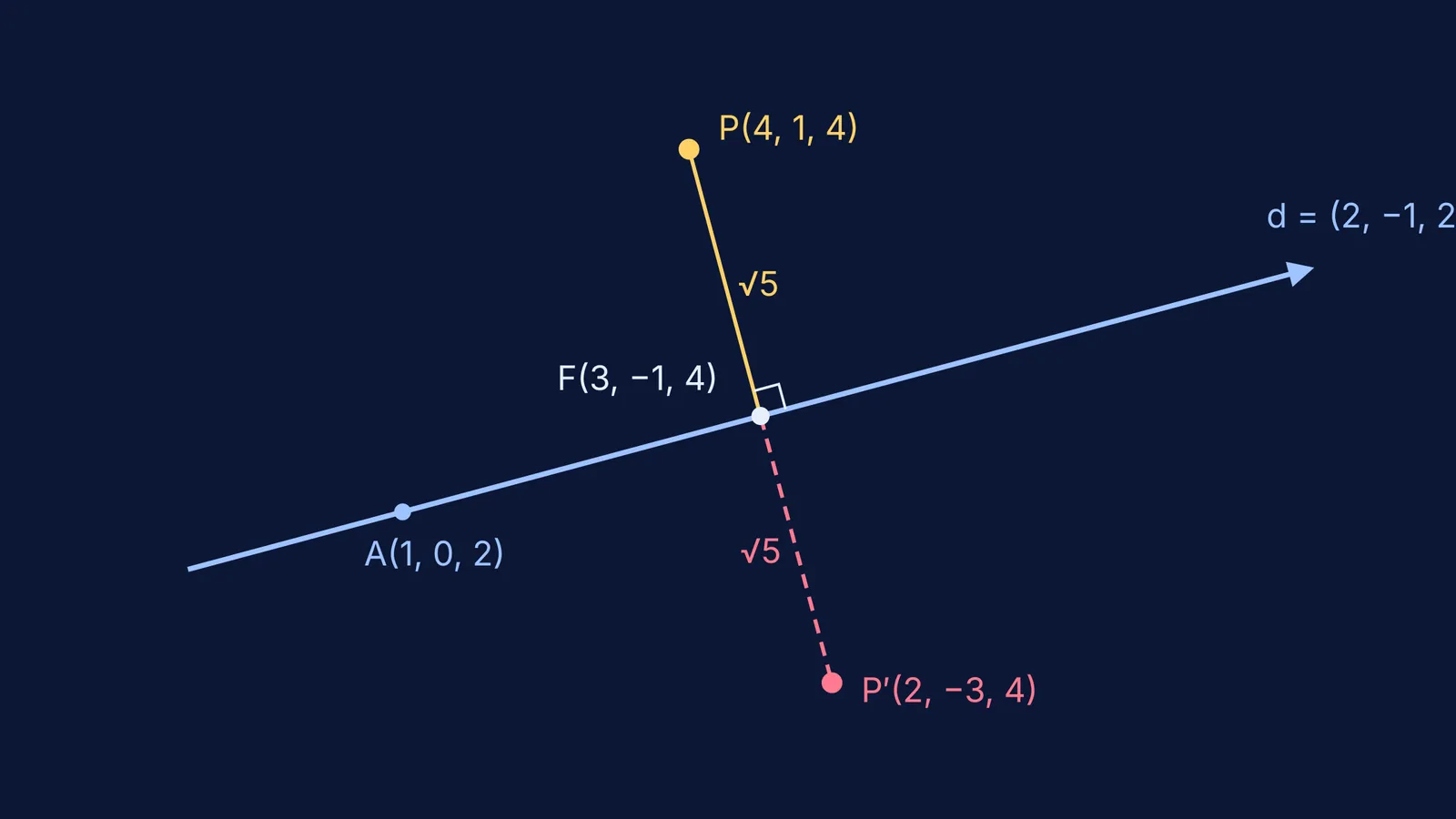
Q4 (medium). The image of P(4, 1, 4) in the line (x − 1)/2 = y/(−1) = (z − 2)/2 is
(A) (2, −3, 4)
(B) (3, −1, 4)
(C) (5, 3, 4)
(D) (−2, 3, −4)
Answer: (A). A general point is F(1 + 2t, −t, 2 + 2t). PF is perpendicular to (2, −1, 2) when 9t − 9 = 0, so t = 1 and the foot is F(3, −1, 4). The image is 2F − P = (2, −3, 4). Trap: (B) is the foot, not the image. Check: F is the midpoint of P and (2, −3, 4). The diagram at the top draws this to scale.
Hard: intersecting lines, skew lines and direction cosines
Q5 (hard). The lines (x − 1)/1 = (y − 2)/2 = (z − 3)/3 and (x − 3)/1 = (y − k)/(−1) = (z − 8)/2 intersect at P. Then
(A) k = 3, OP = 2√14
(B) k = 5, OP = 2√14
(C) k = 3, OP = 14
(D) the lines cannot meet for any k
Answer: (A). Write (1 + s, 2 + 2s, 3 + 3s) and (3 + t, k − t, 8 + 2t). The x and z equations give t = −1 and s = 1, so P = (2, 4, 6). The y equation, 4 = k + 1, gives k = 3, and OP = √56 = 2√14. Trap: (B) writes y = k + t, losing the −1. Check: P gives −1 in all three ratios of the second line.
Q6 (hard). The shortest distance between (x − 1)/1 = (y + 1)/2 = z/2 and (x − 2)/2 = (y − λ)/1 = (z − 1)/(−2) is 1. The sum of all possible values of λ is
(A) 1
(B) 2
(C) −1
(D) 3
Answer: (A). d₁ × d₂ = −6i + 6j − 3k, of magnitude 9. With AB = (1, λ + 1, 1), the distance is |6λ − 3|/9 = 1, so λ = 2 or λ = −1. Trap: (B) drops the modulus and keeps one root. Check: λ = −1 gives AB = (1, 0, 1) and |−9|/9 = 1.
Q7 (hard). a = i + 2j + 2k, a · b = 3 and a × b = 2i + j − 2k. Then b is
(A) i + k
(B) (−i + 4j + k)/3
(C) i + j
(D) 2i − j + k
Answer: (A). With b = (x, y, z), a × b = (2z − 2y, 2x − z, y − 2x). Matching components gives y = 2x − 2 and z = 2x − 1; then a · b = 9x − 6 = 3, so x = 1 and b = i + k. Trap: (B) solves with b × a. (C) passes the dot product but not the cross product. Check: |a|²|b|² = 9 × 2 = 18 = 3² + 9.
Q8 (hard). Two lines have direction cosines satisfying l + m + n = 0 and l² + m² − n² = 0. The angle between them is
(A) π/3
(B) 2π/3
(C) π/2
(D) π/4
Answer: (A). Put n = −(l + m): the second condition becomes −2lm = 0. So the directions are (0, 1, −1)/√2 and (1, 0, −1)/√2, with cos θ = 1/2. Trap: (B) flips one direction, but the angle between lines is the acute one. Check: both directions satisfy both conditions.
How should you review your mistakes from set 2?
Name each miss: a sign or orientation slip (Q2, Q5, Q7), a root dropped (Q6), or the wrong object found (Q1, Q4, Q8).
Make the quick check your last step, in mock tests too.
Two days later, redo the misses from a blank page.
Then try these vectors and 3D geometry numerical value questions, with no options to work back from. For a chapter plan, see how to prepare vectors and 3D geometry for JEE Main.
If a step still does not make sense, the Fermi Problem Library has worked problems with a step-by-step solver that explains the reasoning rather than printing an answer. For JEE Main and Advanced preparation, see Fermi Test Prep.