On this page
If you have finished our first set of application of derivatives JEE Main practice questions, this is the next step: eight original questions, medium to hard, mixing rates of change, monotonicity and maxima and minima.
What does JEE Main 2027 test in application of derivatives?
NTA's JEE (Main) 2027 syllabus places it inside Unit 7 as "Applications of derivatives: Rate of change of quantities, monotonic-Increasing and decreasing functions, Maxima and minima of functions of one variable." Every question here stays inside that sentence.
The JEE (Main) 2027 Information Bulletin gives Mathematics 20 MCQs and 5 numerical-value questions in Paper 1, with +4 marks for a correct MCQ and −1 for a wrong one. Picking a trap option instead of the answer is a five-mark swing.
Medium: can you set up the right function before differentiating?
Q1. A man 1.6 m tall walks away from a 4 m lamp post at 1.2 m/s. The tip of his shadow moves at: (A) 2 m/s (B) 0.8 m/s (C) 1.2 m/s (D) 3 m/s
Answer: (A). With x his distance from the post and s his shadow, similar triangles give s/1.6 = (x + s)/4, so s = 2x/3 and the tip is at x + s = 5x/3, moving at (5/3)(1.2) = 2 m/s. Trap: (B) is the rate the shadow lengthens. Check: starting at the post, after 1 s x = 1.2 and s = 0.8, so the tip is 2.0 m out.
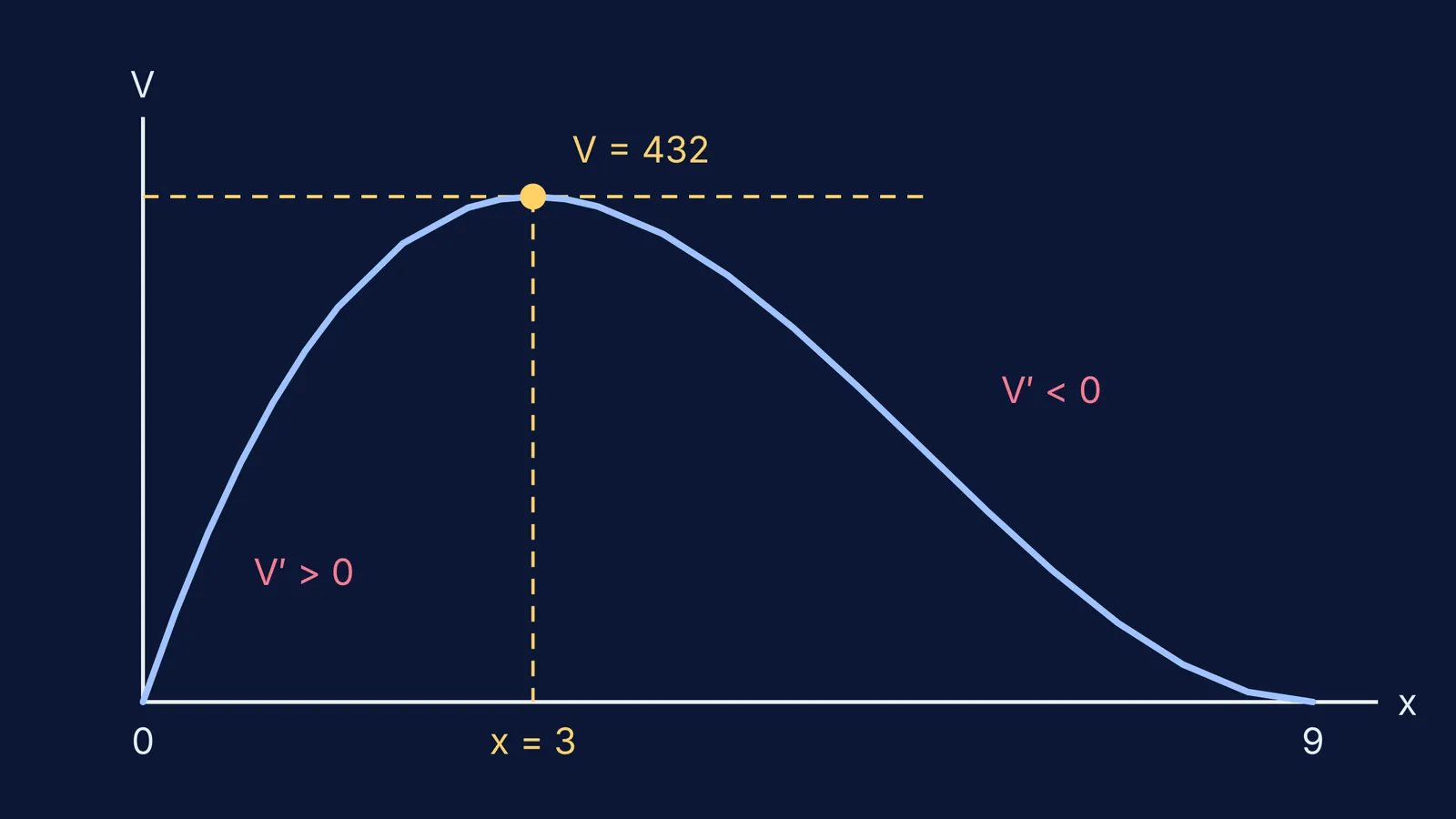
Q2. Squares of side x are cut from the corners of an 18 cm square sheet and the sides folded into an open box. The largest volume is: (A) 432 cm³ (B) 864 cm³ (C) 324 cm³ (D) 486 cm³
Answer: (A). V = x(18 − 2x)², so V′ = (18 − 2x)(18 − 6x), zero at x = 3 inside (0, 9), and V = 3 × 12² = 432. Trap: (B) uses x(18 − x)², forgetting a square comes off both ends of each side. Check: V(2) = 392 and V(4) = 400, both below 432.
Q3. The number of integers k for which x³ − 3x + k = 0 has three distinct real roots is: (A) 3 (B) 5 (C) 4 (D) 2
Answer: (A). f′(x) = 3x² − 3 vanishes at x = ±1. Three roots need the local maximum f(−1) = k + 2 above zero and the local minimum f(1) = k − 2 below it, so −2 < k < 2: k = −1, 0, 1. Trap: (B) allows k = ±2, where a root repeats: x³ − 3x + 2 = (x − 1)²(x + 2). Check: k = 0 gives x = 0, ±√3.
Q4. The greatest of 2^(1/2), 3^(1/3), 5^(1/5) and 6^(1/6) is: (A) 3^(1/3) (B) 2^(1/2) (C) 6^(1/6) (D) 5^(1/5)
Answer: (A). For f(x) = x^(1/x), ln f = (ln x)/x has derivative (1 − ln x)/x², so f increases up to x = e and decreases after it. The winner is 2 or 3; at the sixth power they give 8 against 9. Trap: (B), assuming the smallest base wins. Check: 3^(1/3) ≈ 1.442 and 2^(1/2) ≈ 1.414.
Hard: can you mix derivatives with trigonometry and geometry?
Q5. A 5 m ladder leans on a wall and its foot slides away at 0.3 m/s. When the foot is 3 m from the wall, the angle with the ground decreases at: (A) 0.075 rad/s (B) 0.1 rad/s (C) 0.06 rad/s (D) 0.225 rad/s
Answer: (A). With x = 5 cos θ, dx/dt = −5 sin θ · dθ/dt. At x = 3, sin θ = 4/5, so dθ/dt = −0.3/4 = −0.075 rad/s. Trap: (B) uses cos θ = 3/5 in place of sin θ. Check: the top slides down at 3 × 0.3/4 = 0.225 m/s, and y = 5 sin θ gives 0.225/(5 × 3/5) = 0.075.
Q6. f(x) = kx + sin x + √3 cos x is increasing on all of ℝ exactly when: (A) k ≥ 2 (B) k > 2 (C) k ≥ 1 + √3 (D) k ≥ −2
Answer: (A). f′(x) = k + cos x − √3 sin x = k + 2 cos(x + π/3), whose least value is k − 2. Trap: (C) adds 1 + √3 instead of combining √(1 + 3) = 2; (B) drops k = 2. Check: at k = 2, f′ = 2(1 + cos(x + π/3)) is zero only at isolated points, so f still increases.
Q7. The maximum of sin x (1 + cos x) on [0, π] is: (A) 3√3/4 (B) 2 (C) √3/2 (D) 1
Answer: (A). f′ = cos x + cos²x − sin²x = (2 cos x − 1)(cos x + 1), zero in (0, π) at x = π/3, where f = (√3/2)(3/2) = 3√3/4. Trap: (B) multiplies the separate maxima of sin x and 1 + cos x, which occur at different x. Check: f(π/2) = 1 and f(π/4) ≈ 1.207, both below 3√3/4 ≈ 1.299.
Q8. The largest right circular cylinder inside a sphere of radius 3√3 cm has volume: (A) 108π cm³ (B) 54π cm³ (C) 216π cm³ (D) 36π cm³
Answer: (A). For height h, r² = 27 − h²/4, so V = π(27h − h³/4) and V′ = π(27 − 3h²/4) = 0 at h = 6, giving r² = 18 and V = 108π. Trap: (B) writes r² = 27 − h², treating the half-height as the height. Check: h = 5 gives 103.75π and h = 7 gives 103.25π.
How should you use this second set?
Do all eight in one sitting, without notes, and note your time.
Label each miss: wrong function, wrong trig ratio, repeated root, or maxima taken separately.
Redo the check line for every miss.
Later in the week, change one number in each miss and solve it again.
For typed answers, try our eight application of derivatives JEE Main numerical questions; for a plan, read how to prepare application of derivatives for JEE Main.
If you can follow a solution but could not have started it, the Fermi Problem Library has worked problems with a step-by-step solver that explains the reasoning. For the rest of the syllabus, Fermi Test Prep is our hub for JEE Main and Advanced preparation.