On this page
This set follows our first set of Binomial Theorem JEE Main practice questions with solutions. The eight original questions run from medium to hard, and each pairs the general term with a second idea: surds, remainders, an AP, an integral or a product of two expansions.
What does JEE Main 2027 test in Binomial Theorem?
Unit 5 of NTA's JEE (Main) 2027 syllabus reads: "Binomial theorem for a positive integral index, general term and middle term and simple applications." Every question here builds on that line, sometimes alongside another syllabus unit such as definite integrals or progressions.
The JEE (Main) 2027 Information Bulletin gives Mathematics 20 MCQs and 5 numerical-value questions in Paper 1, with +4 marks for a correct MCQ and −1 for a wrong one. Picking the tempting wrong option instead of the right one costs you five marks.
Medium: can you pair the general term with one more idea?
Q1. The number of rational terms in the expansion of (√3 + ∜5)^16 is: (A) 4 (B) 5 (C) 9 (D) 17
Answer: (B). T(r+1) = 16Cr · 3^((16−r)/2) · 5^(r/4). Both powers must be whole numbers, so r is a multiple of 4 and 16 − r is even: r = 0, 4, 8, 12, 16. Trap: (A) divides 16 by 4 and forgets r = 0. Check: steps of 4 from 0 to 16 give 16/4 + 1 = 5 values.
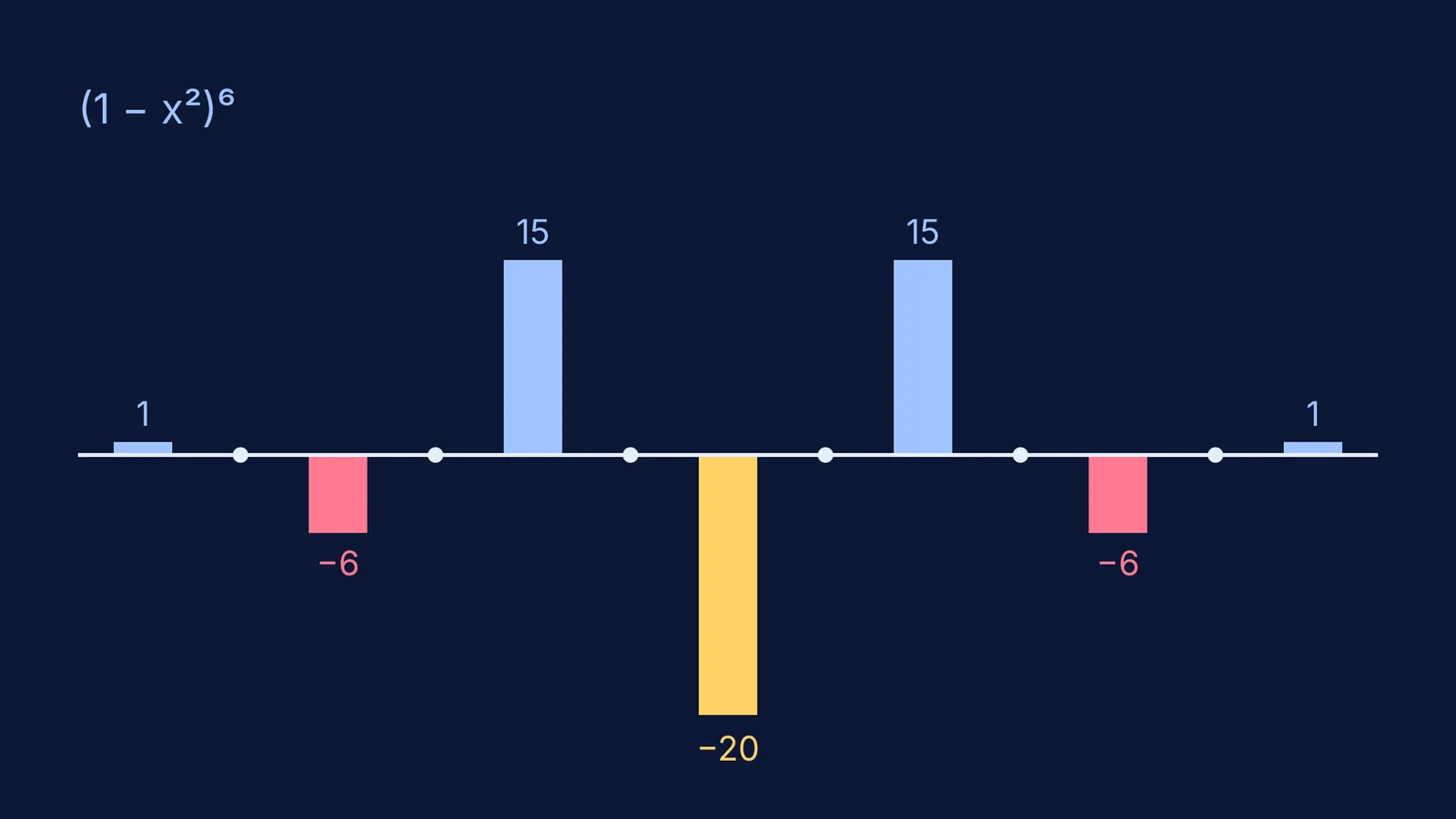
Q2. The coefficient of x^6 in (1 + x)^6 (1 − x)^6 is: (A) −20 (B) 20 (C) 0 (D) −15
Answer: (A). Multiply the brackets first: (1 + x)(1 − x) = 1 − x², so the product is (1 − x²)^6. Then x^6 = (x²)^3 needs k = 3, giving 6C3 · (−1)^3 = −20. Trap: (B) drops the sign of (−1)^3. Check: multiplying the two expansions term by term gives 1 − 36 + 225 − 400 + 225 − 36 + 1 = −20.
Q3. The remainder when 2^2027 is divided by 17 is: (A) 8 (B) 9 (C) 1 (D) 16
Answer: (A). 2^4 = 16 = 17 − 1 and 2027 = 4 × 506 + 3, so 2^2027 = 8 · (17 − 1)^506. Every term but the last has a factor of 17, and the last is (−1)^506 = +1, so the remainder is 8. Trap: (B) takes (−1)^506 as −1, gets −8 and adds 17. Check: 2^8 = 256 = 15 × 17 + 1, so 2^2024 leaves 1 and 2^2027 leaves 2^3 = 8.
Q4. The last two digits of 3^202 are: (A) 09 (B) 89 (C) 91 (D) 99
Answer: (A). 3^202 = 9^101 = (10 − 1)^101. Modulo 100, only the last two terms survive: 101 · 10 · (−1)^100 + (−1)^101 = 1010 − 1 = 1009, which ends in 09. Trap: (D) keeps only the −1; (B) flips the sign of the 1010 term. Check: 3^5 = 243 ends in 43, 43² ends in 49 and 49² ends in 01, so 3^20 ends in 01 and 3^202 ends like 3^2 = 09.
Hard: can you combine binomials with calculus, sequences and surds?
Q5. With Cr = 10Cr, the sum C0 + C1/2 + C2/3 + ... + C10/11 equals: (A) 2047/11 (B) 2048/11 (C) 1023/10 (D) 2^10/11
Answer: (A). Integrate (1 + x)^10 = Σ Cr x^r from 0 to 1. The right side gives Σ Cr/(r + 1); the left gives (2^11 − 1)/11 = 2047/11. Trap: (B) forgets the lower limit, the 1/11 at x = 0. Check: with n = 1 in place of 10, 1 + 1/2 = 3/2 = (2^2 − 1)/2.
Q6. In (1 + x)^n, the coefficients of the 2nd, 3rd and 4th terms are in AP. Then n is: (A) 2 (B) 7 (C) 2 or 7 (D) 14
Answer: (B). The coefficients are nC1, nC2 and nC3, and an AP needs 2 · nC2 = nC1 + nC3. Dividing by n and clearing fractions gives n² − 9n + 14 = 0, so n = 2 or 7. Trap: (C) keeps n = 2, but (1 + x)^2 has only three terms, so it has no 4th term. Check: 7C1, 7C2, 7C3 are 7, 21, 35, which rise by 14 each time.
Q7. The sum 10C0 · 10C2 + 10C1 · 10C3 + ... + 10C8 · 10C10 equals: (A) 20C8 (B) 20C10 (C) 20C2 (D) 20C9
Answer: (A). Write 10C(r+2) as 10C(8 − r). Then Σ 10Cr · 10C(8 − r) is the coefficient of x^8 in (1 + x)^10 · (1 + x)^10 = (1 + x)^20, which is 20C8. Trap: (B) is the sum of squares of 10Cr, where the lower indices add to 10, not 8. Check: with 2 in place of 10 the sum is 2C0 · 2C2 = 1, and the same method gives 4C0 = 1.
Q8. Let (√5 + 2)^(2n+1) = I + f, where I is an integer and 0 < f < 1. Then: (A) f(I + f) = 1 (B) (I + f)(1 − f) = 1 (C) f = 1/2 (D) I is odd
Answer: (A). Let g = (√5 − 2)^(2n+1), which lies between 0 and 1. In (√5 + 2)^m − (√5 − 2)^m with m odd, the odd powers of √5 cancel, so I + f − g is an integer. As f − g lies strictly between −1 and 1, it is 0, so f = g and f(I + f) = [(√5 − 2)(√5 + 2)]^(2n+1) = 1. Trap: (B) is the result when the two powers add to an integer, as in (5 + 2√6)^n; here they subtract. Check: for n = 0, √5 + 2 ≈ 4.236, so I = 4 (even, ruling out D) and 0.236 × 4.236 ≈ 1. The added case is worked in why the integral part of (5 + 2√6)^n is always odd.
How should you use this second set?
Do all eight in one sitting, without notes, and write down your time.
Label each miss with its trap: lost sign, forgotten r = 0, extraneous root, missing lower limit, or wrong index sum.
Redo the check line for every miss; it catches the same slip faster than solving again.
Later in the week, redo the misses from both sets, changing one number in each.
If you can follow a solution but could not have started it yourself, the Fermi Problem Library has worked problems with a step-by-step solver that explains the reasoning. For the rest of the syllabus, Fermi Test Prep is our hub for JEE Main and Advanced preparation.