On this page
This is a classic binomial theorem question in JEE preparation: show that the integral part of (5 + 2√6)ⁿ is odd for every natural number n. You cannot expand the power and look, because √6 is irrational. The trick is to bring in a partner number, the conjugate 5 − 2√6, and let the two expansions cancel each other's irrational parts.
What does the question actually ask?
Write (5 + 2√6)ⁿ = I + f, where I is an integer and 0 ≤ f < 1. I is the integral part (the greatest integer, written [x] or ⌊x⌋) and f is the fractional part. If the bracket notation feels shaky, our post on graphing the greatest integer function is a quick refresher.
In fact f > 0, because (5 + 2√6)ⁿ is irrational for every n ≥ 1. If it were a whole number, f would be 0 and the proof below would not work.
We need to prove that I is odd.
Why is (5 − 2√6)ⁿ between 0 and 1?
Let f′ = (5 − 2√6)ⁿ. Compare 5 with 2√6 by squaring: 5² = 25 and (2√6)² = 24. Since 25 > 24, we have 5 > 2√6, so 5 − 2√6 is positive. It is also less than 1, because 2√6 > 4 (as 24 > 16).
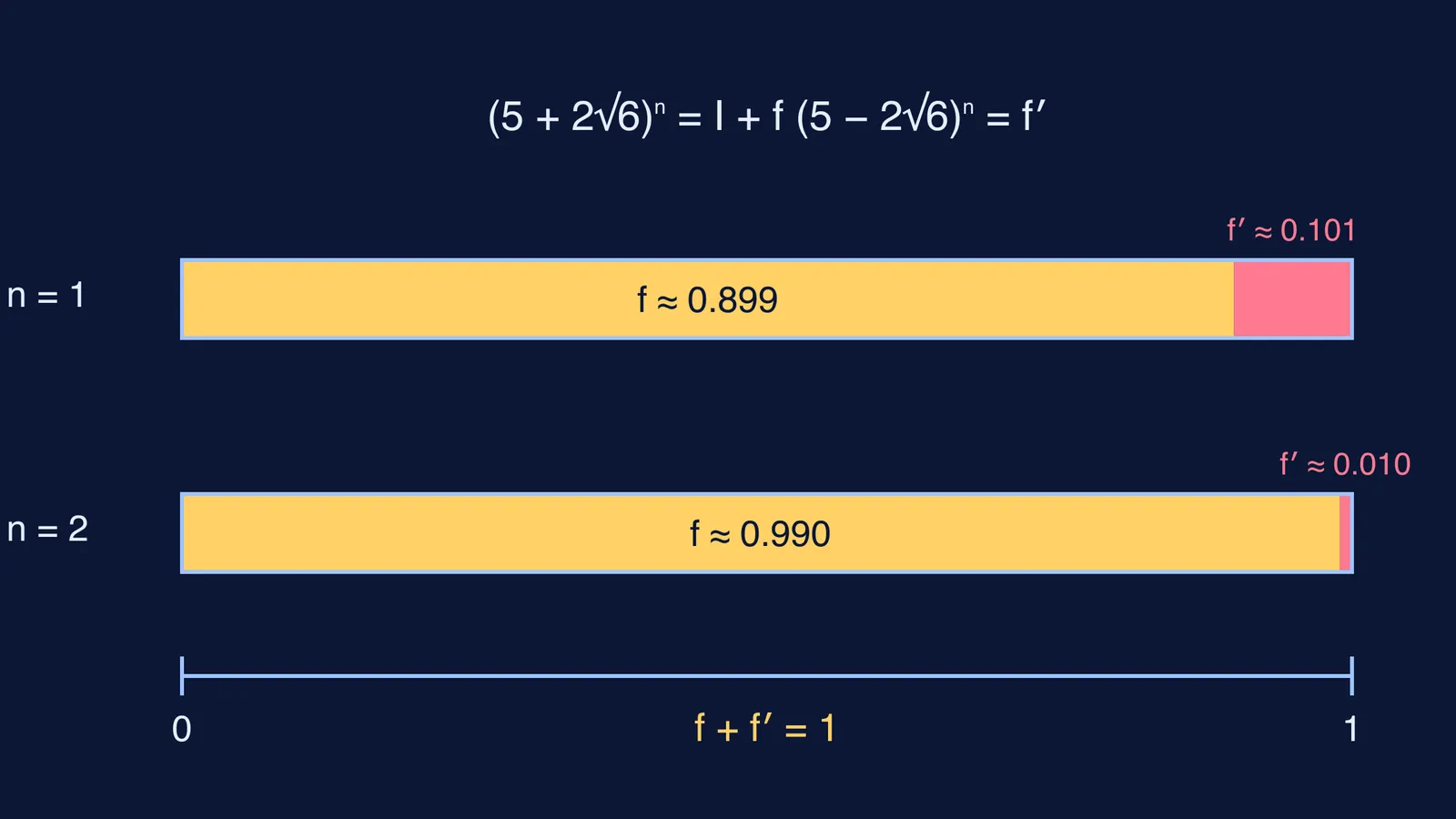
So 0 < 5 − 2√6 < 1 (it is about 0.101), and every positive power of a number in that range stays in that range. That gives 0 < f′ < 1 for all n ≥ 1.
How does the binomial theorem make the sum even?
Expand both powers with the binomial theorem:
(5 + 2√6)ⁿ = ⁿC₀5ⁿ + ⁿC₁5ⁿ⁻¹(2√6) + ⁿC₂5ⁿ⁻²(2√6)² + ⁿC₃5ⁿ⁻³(2√6)³ + …
(5 − 2√6)ⁿ = ⁿC₀5ⁿ − ⁿC₁5ⁿ⁻¹(2√6) + ⁿC₂5ⁿ⁻²(2√6)² − ⁿC₃5ⁿ⁻³(2√6)³ + …
Add them. Every term with an odd power of 2√6 appears once with + and once with −, so it cancels. Every term with an even power appears twice. An even power of 2√6 is a power of 24, which is a whole number. So:
(5 + 2√6)ⁿ + (5 − 2√6)ⁿ = 2[5ⁿ + ⁿC₂5ⁿ⁻²·24 + ⁿC₄5ⁿ⁻⁴·24² + …]
The bracket is a sum of whole numbers, so the right side is an even integer. Call it 2k. The same pairing is worked through for other surds in our post on expanding (x + y)ⁿ + (x − y)ⁿ.
Why must the two fractional parts add to 1?
Put the pieces together:
I + f + f′ = 2k
I and 2k are integers, so f + f′ = 2k − I is an integer too. But 0 < f < 1 and 0 < f′ < 1, so 0 < f + f′ < 2. The only integer strictly between 0 and 2 is 1. Therefore:
f + f′ = 1
I = 2k − 1, which is odd
That finishes the proof. As a bonus, f′ = 1 − f, so (I + f)(1 − f) = 1ⁿ = 1, a result sometimes asked as a follow-up.
Does it work for n = 2?
Check with real numbers. Take √6 ≈ 2.44949.
(5 + 2√6)² = 25 + 20√6 + 24 = 49 + 20√6 ≈ 97.98979.
(5 − 2√6)² = 49 − 20√6 ≈ 0.01021.
The sum is exactly 98: the 20√6 terms cancel.
f ≈ 0.98979 and f′ ≈ 0.01021, which add to 1.
The integral part is 97 = 98 − 1, which is odd.
The On-Line Encyclopedia of Integer Sequences lists the sums as OEIS A087799, with formula a(n) = (5 + √24)ⁿ + (5 − √24)ⁿ and recurrence a(n) = 10a(n − 1) − a(n − 2). Its terms for n = 0 to 4 are 2, 10, 98, 970 and 9602, so the integral parts for n = 1 to 4 are 9, 97, 969 and 9601, all odd.
How do you use this trick on other questions?
The same four steps handle (2 + √3)ⁿ, (3 + √8)ⁿ, (8 + 3√7)ⁿ and their cousins:
Name the parts: (a + √b)ⁿ = I + f.
Pick the conjugate that lies between 0 and 1 and call its power f′.
Add or subtract the expansions so the surd terms cancel, leaving an integer.
Use the range of f + f′ (or f − f′) to pin it to a single integer.
For (√2 + 1)ⁿ with n odd, subtracting is what cancels the surds, and the range argument gives f − f′ = 0, so f = (√2 − 1)ⁿ. The same conjugate pairing drives rationalising 1/(1 + √2 + √3).
If you get stuck on a variant, the Fermi Problem Library has worked problems with a step-by-step solver that explains the reasoning rather than printing an answer. For a refresher on the theorem itself, the Fermi Concept Library gives each mathematics concept its own lesson.