

On this page
When confronted with an expression like (√2 + 1)⁶ + (√2 − 1)⁶ in a school exam or competitive test, calculating each term individually by hand is an invitation to arithmetic disaster. Expanding two separate six-term binomial polynomials, multiplying out mixed roots, and combining dozens of terms takes several minutes and usually produces sign errors.
Under the CBSE Senior Secondary Mathematics curriculum, the binomial theorem provides a direct algebraic shortcut. By combining the expansions of (x + y)ⁿ and (x − y)ⁿ before substituting any numerical values, half the terms cancel out entirely, leaving an expression you can evaluate mentally or in two lines of neat working.
What happens when you expand (x + y)ⁿ + (x − y)ⁿ?
To see why the shortcut works, write both expressions using the standard binomial theorem for positive integral index n:
(x + y)ⁿ = ⁿC₀ xⁿ + ⁿC₁ xⁿ⁻¹ y + ⁿC₂ xⁿ⁻² y² + ⁿC₃ xⁿ⁻³ y³ + ⁿC₄ xⁿ⁻⁴ y⁴ + ... + ⁿCₙ yⁿ
Replacing y with −y yields the expansion for the difference:
(x − y)ⁿ = ⁿC₀ xⁿ − ⁿC₁ xⁿ⁻¹ y + ⁿC₂ xⁿ⁻² y² − ⁿC₃ xⁿ⁻³ y³ + ⁿC₄ xⁿ⁻⁴ y⁴ − ... + (−1)ⁿ ⁿCₙ yⁿ
Under the CBSE curriculum guidelines, notice what occurs when you add these two equations vertically:
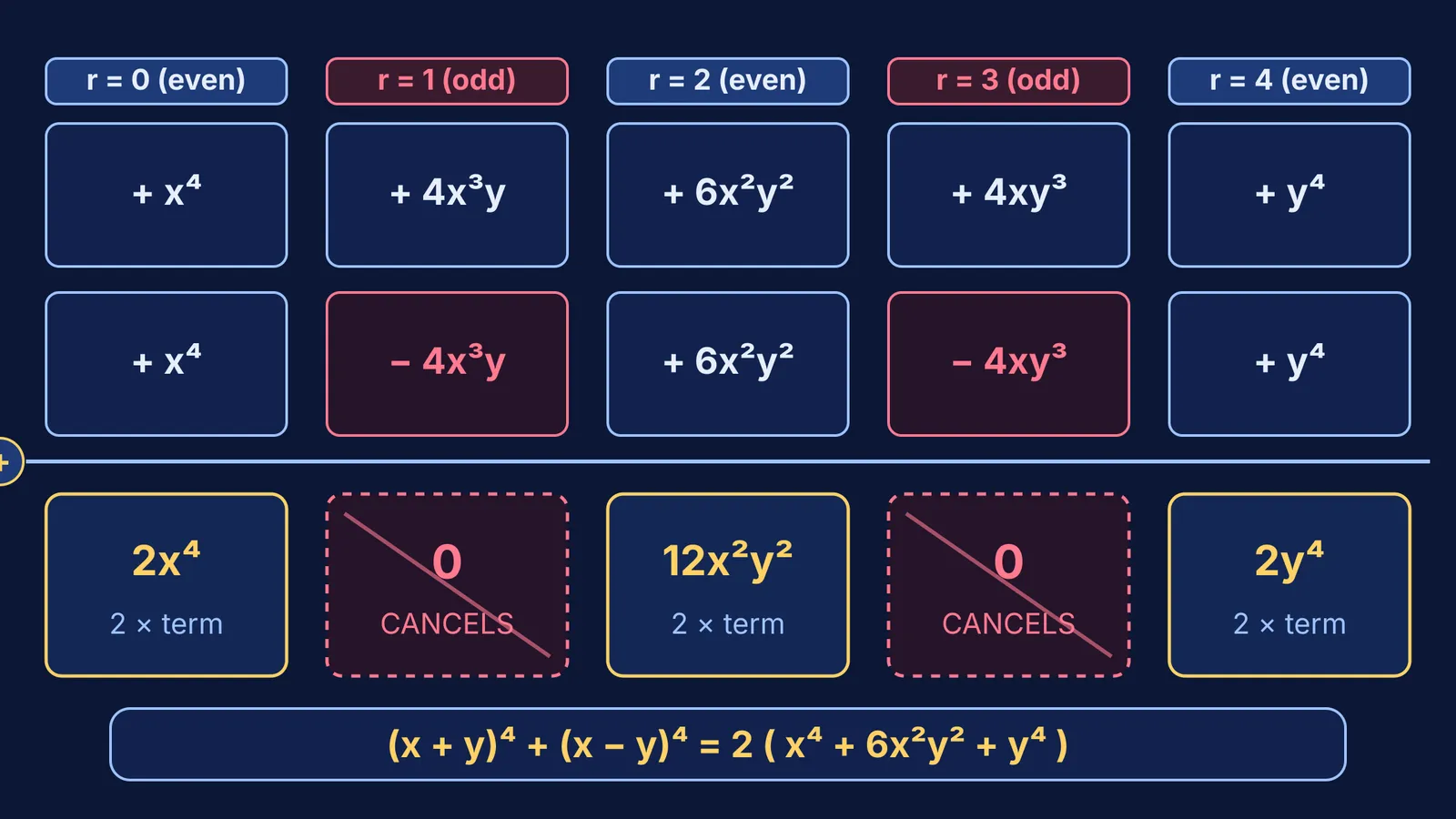
The terms with even powers of y (y⁰, y², y⁴, ...) share identical positive signs in both lines, doubling to 2 ⁿCᵣ xⁿ⁻ʳ yʳ.
The terms with odd powers of y (y¹, y³, y⁵, ...) have opposite signs (+ and −), canceling completely to zero.
Adding both expansions produces the master identity: (x + y)ⁿ + (x − y)ⁿ = 2 [ ⁿC₀ xⁿ + ⁿC₂ xⁿ⁻² y² + ⁿC₄ xⁿ⁻⁴ y⁴ + ... ]
A common point of confusion among students is terminology. If you label terms by their 1-based position (first term T₁, second term T₂, third term T₃), the terms with odd powers of y sit in the second, fourth, and sixth positions—which are even-numbered positions. But when indexed by the exponent r = 0, 1, 2, 3..., every term with an odd index r cancels out. Recognizing this distinction prevents misidentifying which terms vanish during a timed test.
Why do terms cancel in the sum of binomial expansions?
The cancellation is driven entirely by the algebraic symmetry of negative signs: (−1)ʳ equals 1 when r is even, and −1 when r is odd. Historically explored in Al-Karaji's early work on binomial induction, this symmetry creates an alternating sign pattern in (x − y)ⁿ that mirrors the positive terms in (x + y)ⁿ.
In cognitive psychology, Sweller (1988) demonstrated that problem solvers who rely on structured algebraic schemas reduce extraneous cognitive load compared to those attempting brute-force calculation. Furthermore, Cooper and Sweller (1987) showed across classroom experiments that studying worked examples helps students automate rule application and transfer algebraic templates accurately to novel problems.
Instead of tracking fourteen separate multiplications in an expansion with n = 6, the identity collapses the problem into just four terms. This structure connects directly to other combinatorics principles, such as calculating sums of binomial coefficients, where setting x = 1 and y = 1 isolates coefficient sums.
How do you evaluate surds with (x + y)ⁿ + (x − y)ⁿ without a calculator?
Surd expressions that look intimidating at first glance simplify cleanly under the standard CBSE Mathematics framework. Consider evaluating (√2 + 1)⁶ + (√2 − 1)⁶ without using a calculator.
Follow this systematic four-step procedure:
Identify the components: Set x = √2, y = 1, and power n = 6. Because n = 6 is even, all surviving powers of both x and y are even.
Write the expansion template: For n = 6, only even values of r survive (r = 0, 2, 4, 6):
(x + 1)⁶ + (x − 1)⁶ = 2 [ ⁶C₀ x⁶ + ⁶C₂ x⁴ (1)² + ⁶C₄ x² (1)⁴ + ⁶C₆ (1)⁶ ]
Calculate the binomial coefficients: From row 6 of Pascal's triangle, the required coefficients are ⁶C₀ = 1, ⁶C₂ = 15, ⁶C₄ = 15, and ⁶C₆ = 1.
Evaluate powers of x: Because x = √2, every even power yields an integer: (√2)⁶ = 8, (√2)⁴ = 4, (√2)² = 2, and 1⁶ = 1.
Substitute these values into the bracket: Sum = 1(8) + 15(4) + 15(2) + 1(1) = 8 + 60 + 30 + 1 = 99
Finally, multiply by 2: (√2 + 1)⁶ + (√2 − 1)⁶ = 2 × 99 = 198
Every irrational term containing √2 was eliminated during the vertical addition, leaving the exact integer 198 without a single decimal approximation.
How does (x + y)ⁿ − (x − y)ⁿ differ from the sum?
When an exam problem features a subtraction sign between the binomial powers, the cancellation flips completely under the standard curriculum syllabus: (x + y)ⁿ − (x − y)ⁿ = 2 [ ⁿC₁ xⁿ⁻¹ y + ⁿC₃ xⁿ⁻³ y³ + ⁿC₅ xⁿ⁻⁵ y⁵ + ... ]
Subtracting reverses the signs of the second row:
The terms with even powers of y (y⁰, y², y⁴, ...) now cancel out because ⁿCᵣ xⁿ⁻ʳ yʳ − ⁿCᵣ xⁿ⁻ʳ yʳ = 0.
The terms with odd powers of y (y¹, y³, y⁵, ...) now double because ⁿCᵣ xⁿ⁻ʳ yʳ − (−ⁿCᵣ xⁿ⁻ʳ yʳ) = 2 ⁿCᵣ xⁿ⁻ʳ yʳ.
For example, evaluating (√3 + 1)⁵ − (√3 − 1)⁵ uses n = 5 with odd r values (r = 1, 3, 5): 2 [ ⁵C₁ (√3)⁴ (1)¹ + ⁵C₃ (√3)² (1)³ + ⁵C₅ (√3)⁰ (1)⁵ ] = 2 [ 5(9)(1) + 10(3)(1) + 1(1) ] = 2 [ 45 + 30 + 1 ] = 2 [ 76 ] = 152
Recognizing whether you are adding or subtracting allows you to instantly determine which terms survive. Similar structural habits are essential when solving sequences and series for JEE.
When working through multi-step algebraic expansions and polynomial identities, the Fermi Problem Library provides worked problems with a step-by-step solver that explains the reasoning rather than printing an answer. If you want to connect binomial formulas with combinations and algebraic proofs, the Fermi Concept Library covers every concept in physics, chemistry, biology, mathematics and computing, each with its own lesson and its place in the map.


