

On this page
A denominator with three terms, like 1 + √2 + √3, looks as if it needs a new trick. It doesn't. You use the same conjugate you learnt for two-term denominators, just twice: first to cut three terms down to one surd, then to clear that last surd.
Below is the full working for 1/(1 + √2 + √3), a rule for choosing which two terms to group, and two practice questions with answers.
Why doesn't one conjugate clear three surds?
Rationalisation is the process of removing radicals from the denominator of a fraction, as the Wikipedia article on rationalisation) defines it. The same article notes that the conjugate method can be adapted to remove one square root at a time.
With two terms, one step is enough. In NCERT Class 9 Number Systems you rationalise 1/(√7 − √6) by multiplying by √7 + √6, and the denominator becomes 7 − 6 = 1 (worked solution on Teachoo).
With three terms, there is no single conjugate. If you write the denominator as (a + b) + c and multiply by (a + b) − c, you get (a + b)² − c². The c² is rational, but (a + b)² = a² + 2ab + b² still carries the cross term 2ab. That cross term is the surd you clear in round two.
How do you rationalise 1/(1 + √2 + √3)?
Group two terms: write the denominator as (1 + √2) + √3.
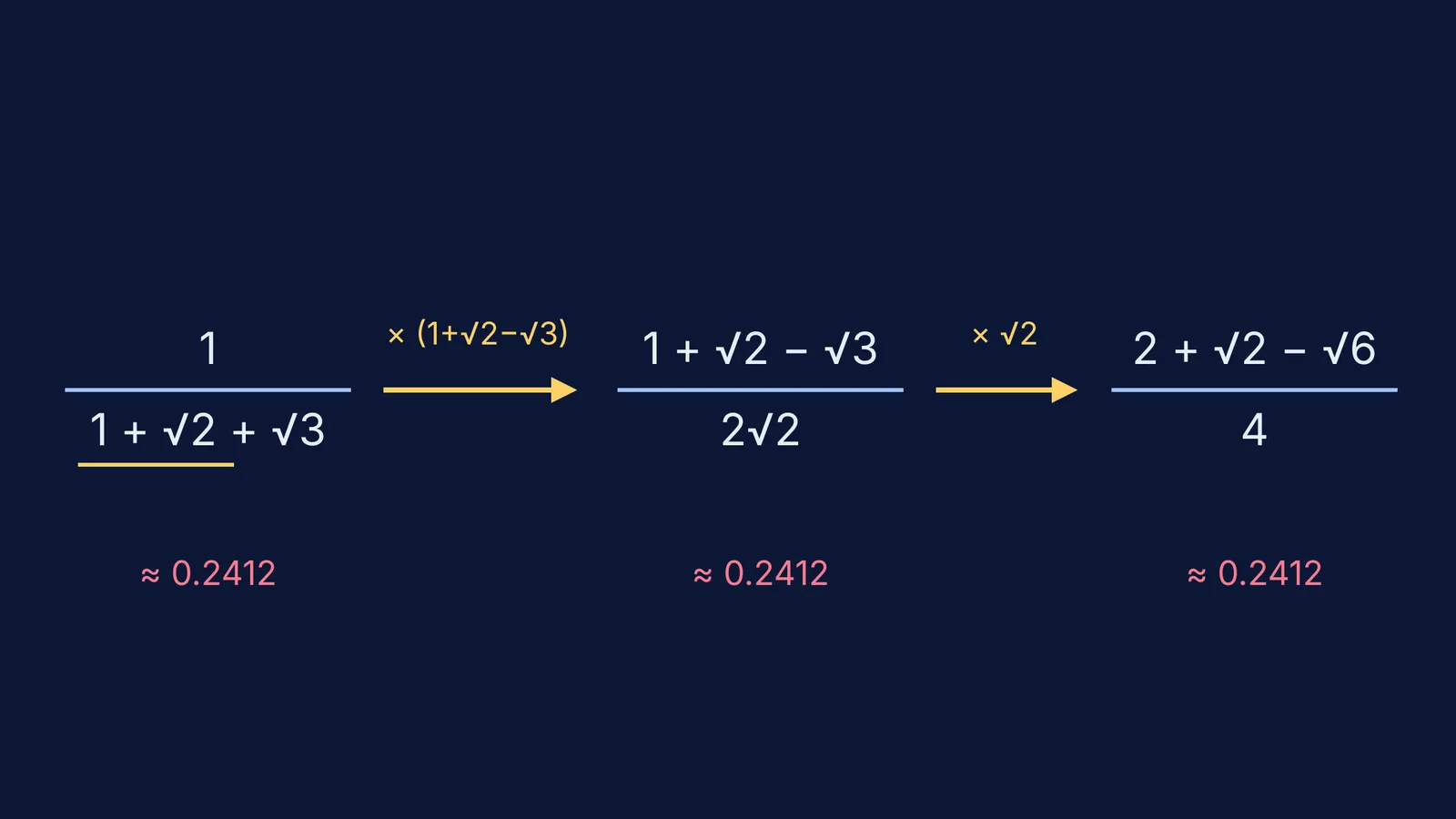
Multiply top and bottom by (1 + √2) − √3.
Denominator: (1 + √2)² − (√3)² = (1 + 2√2 + 2) − 3 = 2√2.
Numerator: 1 × (1 + √2 − √3) = 1 + √2 − √3. You now have (1 + √2 − √3)/(2√2).
Round two: multiply top and bottom by √2. The numerator becomes √2 + 2 − √6 and the denominator becomes 2 × 2 = 4.
Answer: (2 + √2 − √6)/4.
Which two terms should you group?
Any grouping gives the same final answer, but one grouping makes round two much shorter. Here is how the three choices play out for 1 + √2 + √3:
Group (1 + √2), leave √3: the constants 1 + 2 cancel the 3, so only 2√2 remains. Round two is a single multiplication by √2.
Group (1 + √3), leave √2: you get 4 + 2√3 − 2 = 2 + 2√3. Round two needs another conjugate, √3 − 1, which gives 2 × (3 − 1) = 4.
Group (√2 + √3), leave 1: you get 1 − (5 + 2√6) = −4 − 2√6. Round two multiplies by −4 + 2√6 and gives 16 − 24 = −8, with bigger numbers to tidy in the numerator.
The rule: look for the pair whose squares add up to the square of the third term. Here 1² + (√2)² = 1 + 2 = 3 = (√3)², so grouping 1 with √2 leaves nothing but the cross term. When no pair fits exactly, group the pair that makes the leftover constant smallest.
What mistakes cost marks on this question?
Squaring (1 + √2) as 1 + 2. The cross term 2√2 is the whole point of round two.
Multiplying only the denominator. Whatever you multiply below, multiply above too.
Stopping after round one. (1 + √2 − √3)/(2√2) still has a surd in the denominator, so it is not rationalised.
Slips with products of surds: √2 × √3 = √6, and √2 × √2 = 2, not 4. The laws of radicals are worth a quick revision first.
If you keep picking the wrong multiplier, the Fermi Problem Library has worked problems with a step-by-step solver that explains the reasoning rather than printing an answer, so you can see why a given conjugate was chosen.
Try these two
Rationalise 1/(1 + √2 − √3). Group (1 + √2) − √3 and multiply by (1 + √2) + √3; the denominator is 2√2 again.
Rationalise 1/(√2 + √3 + √5). Here (√2)² + (√3)² = 5 = (√5)², so group (√2 + √3).
Answers: (2 + √2 + √6)/4 for the first, and (2√3 + 3√2 − √30)/12 for the second. Check each on a calculator the way the callout above shows.
For the two-term version step by step, read our guide on how to rationalise the denominator with surds. The same conjugate idea returns in Class 11 calculus, covered in when to rationalise limits with square roots. If surds themselves still feel shaky, the Fermi Concept Library has a lesson for every concept in mathematics, each with its place in the map.


