

On this page
A surd in the denominator is not wrong, but it makes a fraction awkward to add or estimate. Rationalising the denominator means rewriting a fraction so its denominator has no square roots, without changing its value. You multiply the top and bottom by the same expression, which is multiplying by 1.
What does rationalising the denominator mean?
The syllabus wording is precise. CBSE's Class 9 mathematics syllabus for 2025-26 listed "Rationalization (with precise meaning) of real numbers of the type 1/(a+b√x) and 1/(√x+√y) (and their combinations), where x and y are natural numbers and a and b are integers."
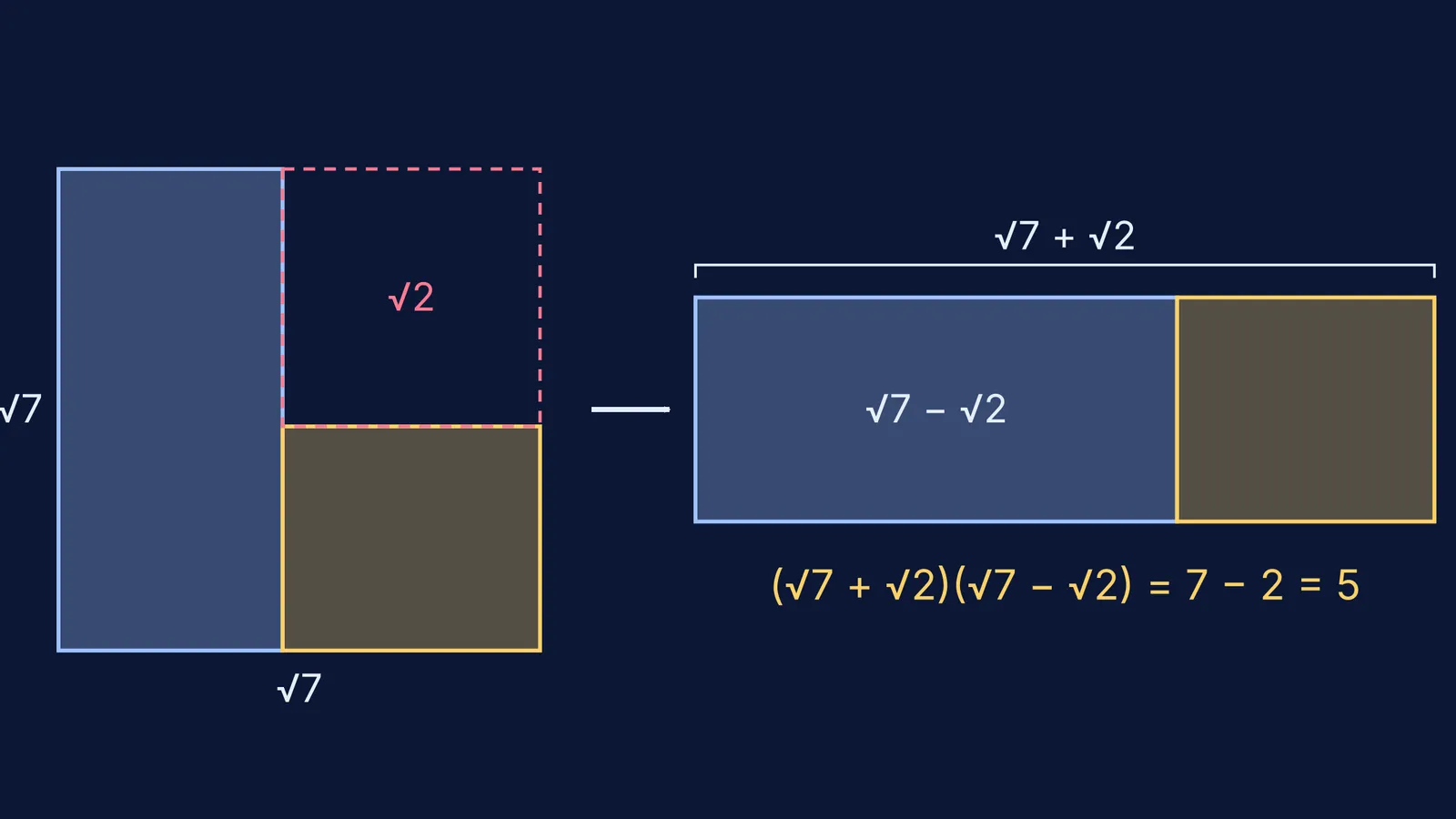
The whole method rests on one identity: (√a + √b)(√a − √b) = a − b. The same two terms with the middle sign flipped are called the conjugate, and multiplying by it squares the roots away. If identities feel shaky, revise them first with our guide to algebraic identities in Class 8.
How do you rationalise 1/(√a ± √b)?
Use the same three steps every time:
Write the conjugate: flip only the sign between the two terms.
Multiply the numerator and the denominator by it.
Expand the denominator as a − b first, then simplify the numerator.
Example 1: 1/(√5 − √3). The conjugate is √5 + √3. The denominator becomes 5 − 3 = 2, so the answer is (√5 + √3)/2.
Example 2: (√7 + √2)/(√7 − √2). Multiply by √7 + √2. The denominator is 7 − 2 = 5. The numerator is (√7 + √2)² = 7 + 2√14 + 2 = 9 + 2√14. The answer is (9 + 2√14)/5.
Example 3: 6/(3 − √3). Multiply by 3 + √3. The denominator is 9 − 3 = 6, which cancels the 6 on top, so the answer is 3 + √3.
How do you rationalise a denominator with three terms?
Three terms need two rounds. Group two of them so the denominator looks like p + q, multiply by p − q, and repeat if a surd is left.
Example 4: 1/(1 + √2 + √3).
Group it as (1 + √2) + √3 and multiply top and bottom by (1 + √2) − √3.
The denominator becomes (1 + √2)² − 3 = 1 + 2√2 + 2 − 3 = 2√2. One surd remains.
Second round: multiply top and bottom by √2. The numerator becomes √2 + 2 − √6 and the denominator becomes 4.
The answer is (2 + √2 − √6)/4, about 0.241, which matches 1/(1 + √2 + √3) on a calculator.
The grouping matters. Here (1 + √2)² gives 3 + 2√2, and the 3 cancels against (√3)². Grouping it as 1 + (√2 + √3) leaves a denominator of 1 − (5 + 2√6) = −4 − 2√6, a messier second round. Pick the pair whose whole numbers cancel.
How do you simplify longer surd expressions step by step?
Rationalise each fraction on its own, then collect like surds.
Example 5: 1/(√2 + 1) + 1/(√3 + √2) + 1/(2 + √3). Write 2 as √4: in each denominator the two squares differ by 1, so each conjugate leaves a denominator of 1:
1/(√2 + 1) = √2 − 1
1/(√3 + √2) = √3 − √2
1/(2 + √3) = 2 − √3
Add them and the surds cancel in pairs. The sum is 1.
A short checklist for any surd simplification:
Simplify each surd first: √12 = 2√3 and √50 = 5√2.
Rationalise one fraction at a time.
Collect like surds only: 3√2 + √2 = 4√2, but √2 + √3 stays as it is.
Finish with no root in the denominator and the fraction in lowest terms.
If a question keeps going wrong, the Fermi Problem Library has a step-by-step solver that explains the reasoning rather than printing an answer, so you can see which step you missed.
Is rationalisation still in the CBSE Class 9 syllabus?
Check before you plan revision. In the CBSE Class 9 mathematics syllabus for 2026-27, the Number System chapter's key concepts run from rational numbers to the irrationality of √2 and √3 and the square root spiral, and rationalisation is not listed. The same document gives the Number System unit 7 of the 80 theory marks, down from 10 in the 2025-26 syllabus. ICSE and state boards set their own syllabi, so ask your teacher what applies to you.
The skill does not go away. In trigonometry, tan 30° = 1/√3 is often written as √3/3, and limits such as (√(1 + x) − 1)/x are found by multiplying by the conjugate √(1 + x) + 1. The groundwork is in our posts on number systems in Class 9 and real numbers in Class 10. To revisit the idea behind surds, the Fermi Concept Library covers every concept in mathematics, each with its own lesson.
Try Example 4 again tomorrow without looking, then check it with decimals.


