

On this page
Two laws do almost all the work of simplifying a surd like √72, and one rule tells you when you may add surds. Here is each, with worked Class 9 examples.
It matters for marks. In CBSE's 2025-26 mathematics curriculum, Number Systems carries 10 of the 80 marks in the Class 9 theory paper, and the unit includes the nth root of a real number and rationalising expressions such as 1/(√x + √y). Simplifying surds sits underneath all of it.
What are the laws of radicals in Class 9?
For square roots, the two laws are:
Product law: √a × √b = √(ab)
Quotient law: √a / √b = √(a/b), with b not zero
The OpenStax textbook *Intermediate Algebra 2e* states them as the Product Property of Roots and the Quotient Property of Radical Expressions, with a condition: they hold when √a and √b are real numbers. For Class 9 that means a and b must not be negative.
The laws work in both directions. Read left to right, they combine: √75 / √3 = √25 = 5. Read right to left, they split: √(5/9) = √5 / √9 = √5 / 3.
A surd is in simplest form when the number under the root has no perfect-square factor other than 1.
How do you simplify √72 step by step?
List the perfect squares you know: 4, 9, 16, 25, 36, 49, 64, 81, 100.
Find the largest one that divides 72. It is 36, because 72 = 36 × 2.
Split with the product law: √72 = √36 × √2.
Take the root of the perfect square: √36 = 6.
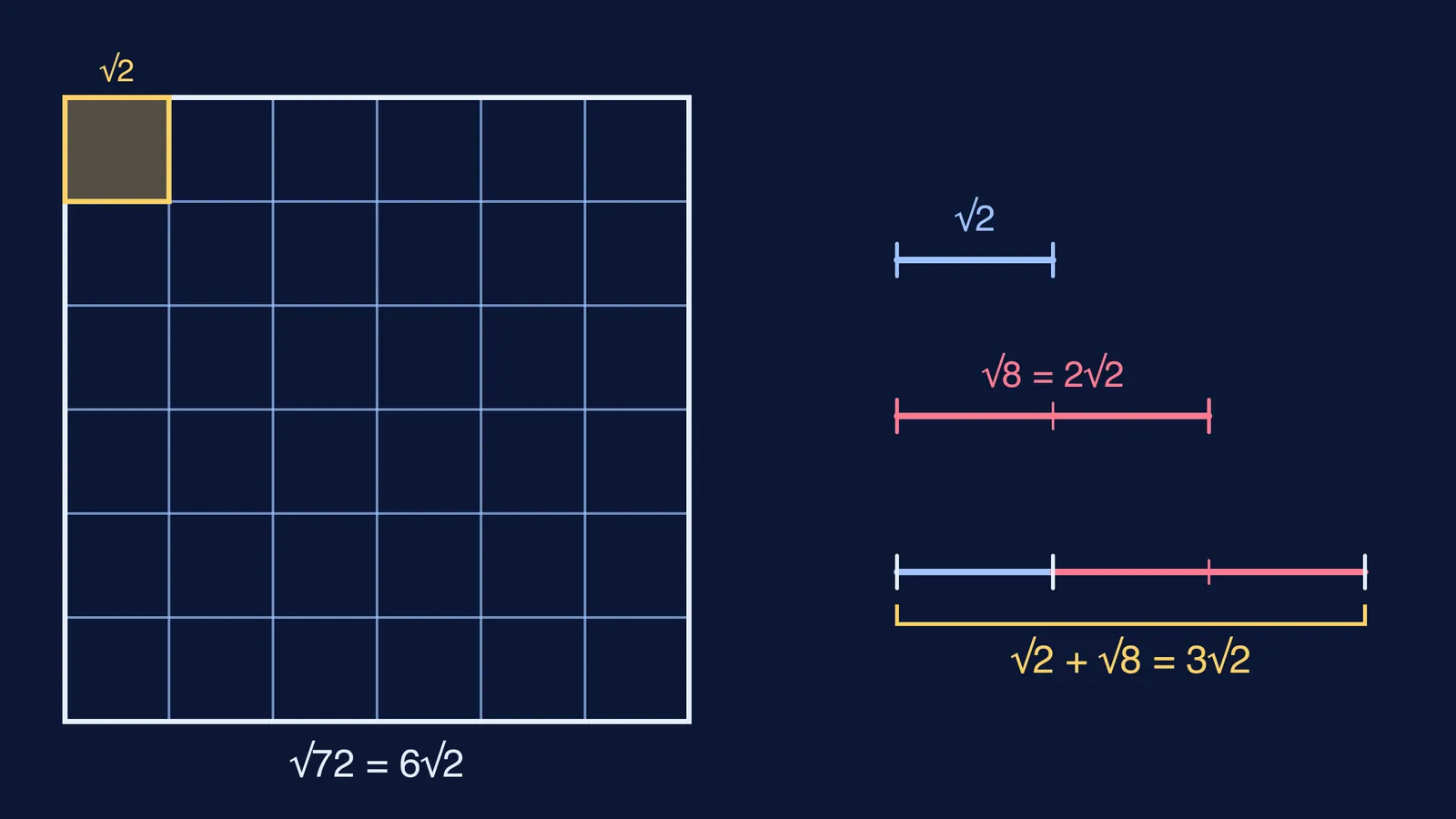
Write the answer: √72 = 6√2.
Check: 2 has no square factor, so you are done. Squaring back confirms it: (6√2)² = 36 × 2 = 72.
If you miss the largest square, you are not wrong, only slower. √72 = √4 × √18 = 2√18, and 18 still hides a 9, so 2√18 = 2 × 3√2 = 6√2. The step 6 check catches this every time.
Surds turn up elsewhere too: NCERT's new Grade 9 textbook, *Ganita Manjari*, gets a distance of √40 units in its coordinates chapter. The same steps give √40 = √4 × √10 = 2√10.
When can you add surds?
Only like surds can be added or subtracted. OpenStax defines like radicals as radical expressions with the same index and the same radicand, the number under the root. You add the numbers in front and keep the surd, just as 4x + 3x = 7x.
The catch: surds that look unlike often become like once simplified. Always simplify first.
√48 + √27 = 4√3 + 3√3 = 7√3 (an end-of-section exercise in OpenStax 8.4)
√18 − √8 = 3√2 − 2√2 = √2
3√20 − √45 = 6√5 − 3√5 = 3√5
√2 + √3 stays as it is: the radicands differ and neither simplifies
What mistakes cost marks with surds?
Splitting a sum. √(a + b) is not √a + √b. Test it: √(9 + 16) = √25 = 5, but √9 + √16 = 3 + 4 = 7. The laws cover multiplication and division only.
Adding radicands. √2 + √3 is not √5. Square both sides and see: (√2 + √3)² = 5 + 2√6, not 5.
Stopping early. 2√18 is not simplest form, because 18 still contains 9.
Using the laws on negatives. √(−4) × √(−9) is not √36 in Class 9 maths, because √(−4) is not a real number.
If one of these keeps coming back in your homework, the trouble is usually the method rather than the arithmetic. The Fermi Problem Library has worked problems with a step-by-step solver that explains the reasoning rather than printing an answer, so you can see the exact line where your working went off.
Can you simplify these six surds?
√50
√108
√12 + √75
√98 − √32
√45 / √5
√3 + √12 + √27
Answers: (1) 5√2, since 50 = 25 × 2. (2) 6√3, since 108 = 36 × 3. (3) 2√3 + 5√3 = 7√3. (4) 7√2 − 4√2 = 3√2. (5) √9 = 3, by the quotient law. (6) √3 + 2√3 + 3√3 = 6√3.
Once these feel easy, the next step is clearing surds from the bottom of a fraction: see how to rationalise the denominator with surds, step by step. For where surds sit among rational and irrational numbers, read number systems in Class 9, and for a stretch, try simplifying nested radicals like √(7 + 4√3).
If one law still feels shaky, the Fermi Concept Library gives each mathematics concept its own lesson and shows where it sits in the map.


