

On this page
When you encounter an expression like √(7 + 4√3) in algebra or during exam preparation, it looks like a dead end. However, these "nested radicals" (a root inside a root) can often be rewritten as a simple sum or difference of two smaller roots.
The trick lies in working backwards from the fundamental algebra identity for a perfect square: (x + y)² = x² + y² + 2xy.
How do you simplify √(a + 2√b)?
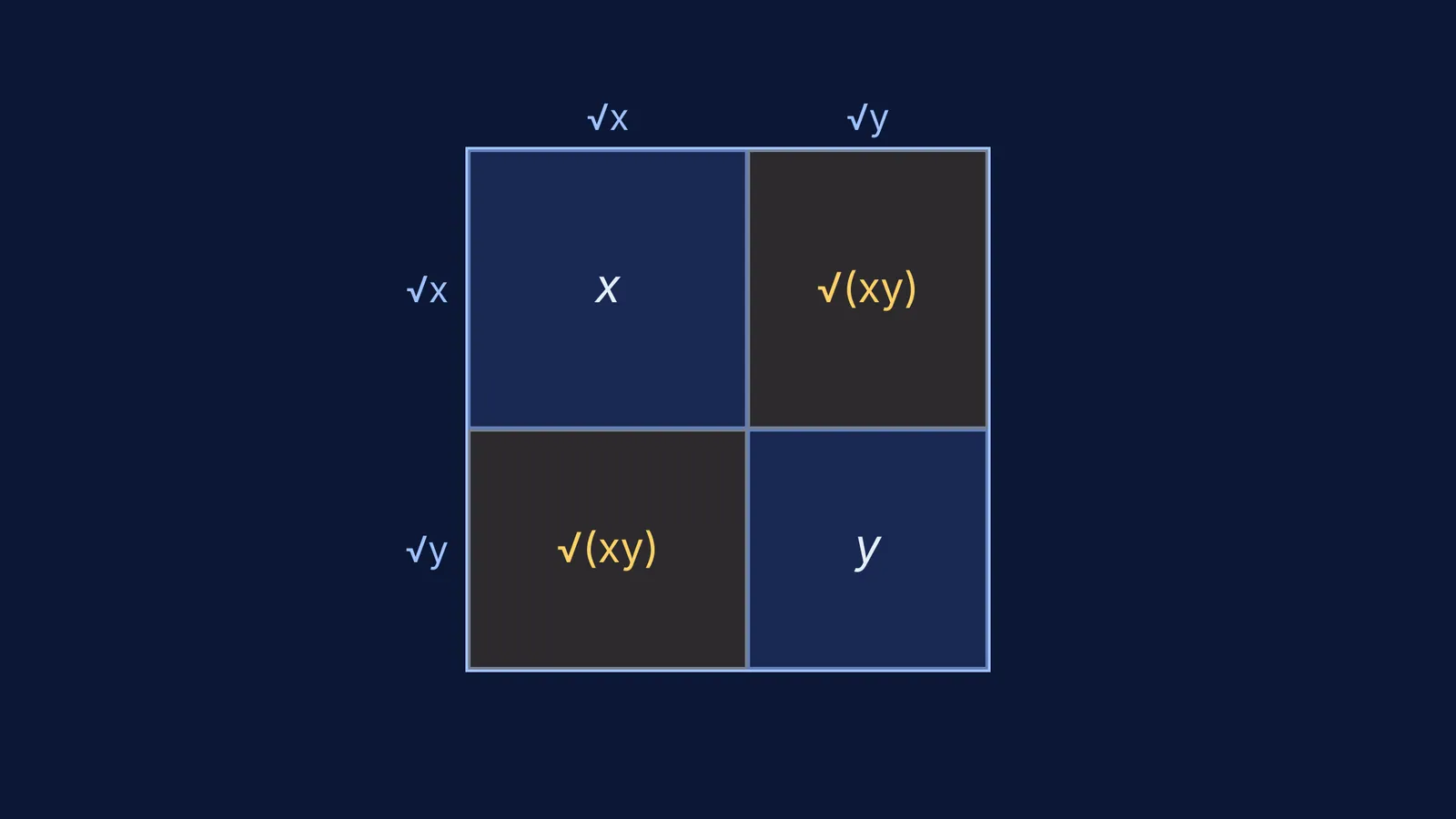
The goal is to turn the expression under the outer square root into a perfect square of the form (√x + √y)². If we expand this squared expression using the binomial identity, we get:
(√x + √y)² = (√x)² + (√y)² + 2(√x)(√y) (√x + √y)² = x + y + 2√(xy)
Comparing this result directly to our target mathematical form, (a + 2√b), we can match the distinct parts together. We must find two specific numbers, x and y, that satisfy two conditions at the same time:
Their sum is a (so x + y = a).
Their product is b (so xy = b).
Once you identify x and y, the nested radical √(a + 2√b) simplifies to √x + √y, removing the nested layer entirely.
How to simplify root of 7 plus 4 root 3?
Let us apply this sum and product method to the target expression: √(7 + 4√3).
First, the expression must match the strict a + 2√b format. Our current expression has a 4 in front of the inner root, not a 2. We fix this by pushing a factor of 2 inside the square root. Since a 2 moving inside a square root becomes 2² (which is 4), we adjust it like this: 4√3 = 2 × 2√3 = 2√(4 × 3) = 2√12
Now rewrite the original expression with this updated term: √(7 + 4√3) = √(7 + 2√12)
Now we look for our two numbers. We need x and y such that:
x + y = 7
xy = 12
The integer factors of 12 are 1 and 12, 2 and 6, and 3 and 4. Examining the sums of these pairs, we see that 1 + 12 = 13 and 2 + 6 = 8. The only pair that adds up perfectly to 7 is 4 and 3.
Therefore, we can rewrite the expression and finish the simplification: √(4 + 3 + 2√(4 × 3)) = √((√4 + √3)²) = √4 + √3 = 2 + √3
The nested radical is fully simplified.
What about the minus-sign version?
The same logical framework applies to expressions containing a subtraction sign, such as √(a − 2√b). By using the alternative binomial identity (√x − √y)² = x + y − 2√(xy), the final result is √x − √y.
However, you must be careful with subtraction. Because the principal square root of a real number must always be positive, you must ensure that x is strictly the larger number. For example, to simplify √(8 − 2√15), you need numbers that add to 8 and multiply to 15. The numbers are 5 and 3. Because 5 is larger than 3, the answer is √5 − √3. Writing √3 − √5 would be mathematically incorrect since it evaluates to a negative number.
Can every nested radical be simplified?
No. While textbook problems are usually engineered to work out cleanly, random combinations of numbers rarely do. In 1989, the mathematician Susan Landau introduced the first systematic algorithm to determine if a nested radical can be denested. Using Galois theory, she proved that simplification is only possible under specific algebraic conditions.
If you cannot find integers or simple fractions for x and y that fit the sum and product rules, the expression likely cannot be denested into the simple √x + √y form.
What is the checklist for exam problems?
When tackling these under time pressure, follow this structured process:
Check the coefficient: Is there a 2 in front of the inner root? If it is a 4 or 6, push the extra factors inside. If there is no number, extract it from the root or multiply and divide the expression by 2.
List the factors: Write down the factor pairs of the inner number (b).
Check the sum: Do any of those pairs add up to the outer number (a)?
Write the answer: If yes, your answer is √x ± √y. Remember to put the larger number first if it is a subtraction problem.
Just as you might use the discriminant test to check if a quadratic is positive, or the case-split method to handle absolute values, checking the sum and product of factors is the standard test for nested roots.
If you struggle with spotting these algebraic patterns, the Fermi Problem Library has worked problems with a step-by-step solver that explains the reasoning rather than printing an answer.
Mastering this algebraic trick turns a confusing double root into a simple mental math exercise, saving you valuable time.


