

On this page
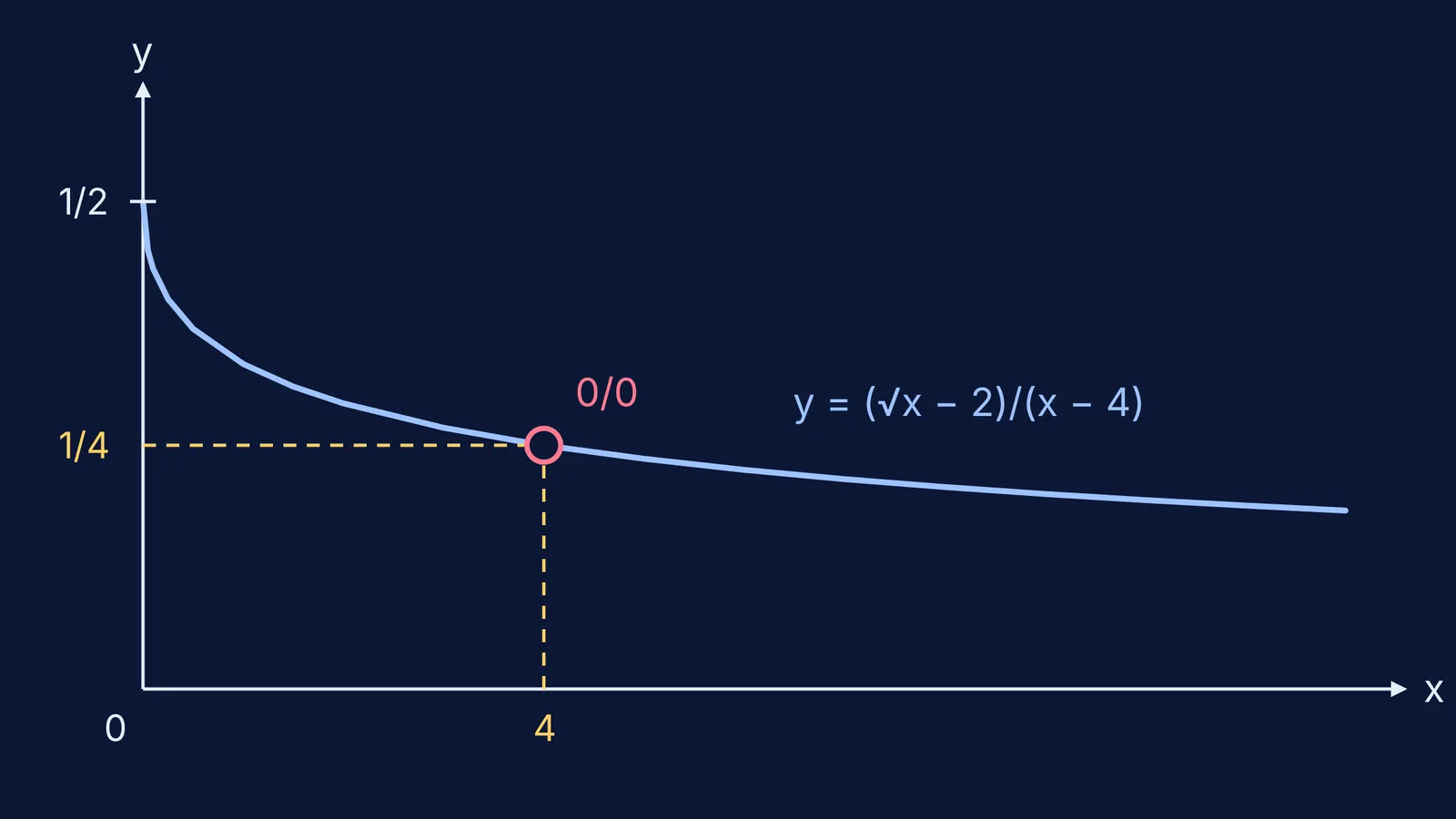
Put x = 4 into (√x − 2)/(x − 4) and you get 0/0. That is not an answer. It means the expression hides a common factor. NCERT's Class 11 chapter Limits and Derivatives says the limit of a quotient equals the quotient of the limits only "whenever the denominator is non zero" (NCERT Class 11 Mathematics, Chapter 12). So you must rewrite before you substitute, and for square roots the standard move is rationalisation.
How do you solve a limit with a square root by rationalisation?
The rule from OpenStax Calculus Volume 1, section 2.3 is this: if the numerator or denominator contains a difference involving a square root, multiply both by the conjugate of that expression. It works because (√A − B)(√A + B) = A − B². The root disappears, and the factor that caused the 0/0 comes out where you can see it.
Here is the limit from the opening, lim x→4 (√x − 2)/(x − 4), step by step:
Check the form. At x = 4 both top and bottom are 0.
Multiply the top and bottom by the conjugate, √x + 2.
The top becomes (√x)² − 2² = x − 4. Leave the bottom as (x − 4)(√x + 2).
Cancel x − 4. This is allowed because x approaches 4 but never equals it.
You are left with 1/(√x + 2). Substitute x = 4 to get 1/4.
To check, try x = 4.01: the original gives about 0.2498. The graph at the top shows why. The curve is just 1/(√x + 2) with one hole at (4, 1/4). If conjugates feel rusty, revise rationalising denominators with surds first. It is the same algebra.
What is double rationalisation, and when do you need it?
You rationalise twice when both the numerator and the denominator contain a root that goes to zero. Take lim x→2 (√(x + 7) − 3)/(√(3x − 2) − 2). At x = 2 the top is 3 − 3 and the bottom is 2 − 2.
Multiply the top and bottom by √(x + 7) + 3. The top becomes x + 7 − 9 = x − 2.
Multiply the top and bottom by √(3x − 2) + 2. The bottom becomes 3x − 2 − 4 = 3(x − 2).
Cancel x − 2. What remains is (√(3x − 2) + 2) / [3(√(x + 7) + 3)].
Substitute x = 2: (2 + 2)/(3 × 6) = 4/18 = 2/9.
Each conjugate ends up on the opposite side of the fraction from the root it removed. Write both in brackets before you simplify, so you don't lose track of them.
When is factorising or an expansion quicker than rationalising?
Rationalising is not always the shortest route. Use this decision list:
x − a over √x − √a: factorise instead. For lim x→9 (x − 9)/(√x − 3), write x − 9 = (√x − 3)(√x + 3), cancel, and the answer is 3 + 3 = 6. That takes one line. The same idea drives 0/0 limits by factorisation.
Cube roots and other powers: a single conjugate cannot remove a cube root. Use NCERT's Theorem 2 instead: lim x→a (xⁿ − aⁿ)/(x − a) = naⁿ⁻¹, and the chapter's remark says this holds for any rational n when a is positive (NCERT Chapter 12). So lim x→8 (∛x − 2)/(x − 8) = (1/3)·8^(−2/3) = 1/12.
x → 0 and you need the second-order term: expand. The binomial series gives √(1 + x) = 1 + x/2 − x²/8 + … for |x| < 1 (OpenStax Calculus Volume 2, section 6.4). So lim x→0 (√(1 + x) − 1 − x/2)/x² = −1/8, with no messy algebra. More examples are in limits using series expansions.
x → ∞ with √(x² + x) − x: rationalise. You get x/(√(x² + x) + x). Divide the top and bottom by x, and the limit is 1/(1 + 1) = 1/2.
What mistakes cost marks in these limits?
Multiplying only the numerator by the conjugate. That changes the expression.
Using the wrong sign. The conjugate of √A − B is √A + B.
Cancelling x − a before it appears as a whole factor.
Forgetting that √(x²) = |x|. When x → −∞, |x| = −x, which can flip the sign of the answer.
If you keep reaching 0/0 and are unsure which move to try, the Fermi Problem Library has worked problems with a step-by-step solver that explains the reasoning rather than printing an answer. If the difference-of-squares step itself feels shaky, the Fermi Concept Library gives each mathematics concept its own lesson.
Try it now: work out lim x→5 (√(x − 1) − 2)/(x − 5) by rationalising, then check it with x = 5.01. You should get 1/4.


