

On this page
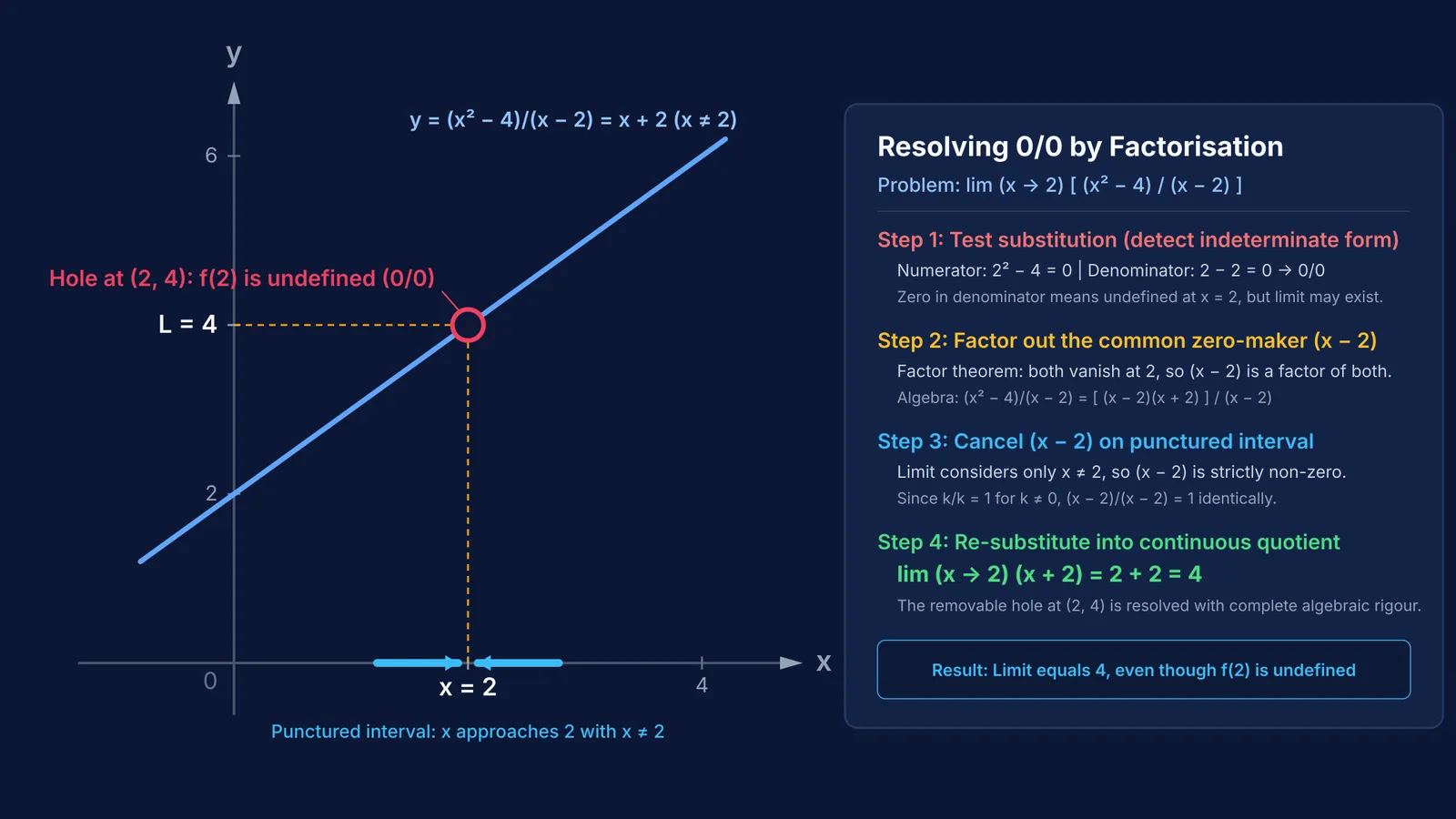
When substituting x = a into a rational function P(x) / Q(x) produces 0/0, arithmetic comes to a halt. Division by zero is undefined in real arithmetic. In calculus, however, 0/0 is not a numerical value, nor does it mean the limit does not exist. It is an indeterminate form—a mathematical signal that direct evaluation hides the ratio's true behaviour near that point.
In an investigation of 630 first-year university mathematics students in the *International Journal of Mathematical Education in Science and Technology*, researcher Jan Bezuidenhout found that many students confuse a function's value at a point with its limit as x approaches that point. When substitution yields zero over zero, students often abandon the problem, assuming the expression is broken.
Algebraically, 0/0 reveals a clear structure. By the polynomial factor theorem established by René Descartes in 1637, if substituting x = a into a polynomial gives zero, then (x − a) is a linear factor. When both numerator and denominator vanish at x = a, both share the factor (x − a). The indeterminacy proves an algebraic zero-maker is present in both parts. If you need to revisit polynomial foundations, the Fermi Concept Library covers every concept in mathematics, each with its own lesson and its place in the map.
Why is cancelling (x − a) mathematically valid if x approaches a?
After factoring out (x − a), students often hesitate to cancel it. Elementary arithmetic forbids dividing by zero, so striking out (x − a) feels illegitimate when x is approaching a.
In their study on concept images in *Educational Studies in Mathematics*, David Tall and Shlomo Vinner identified this cognitive conflict. Students know that at x = a, (x − a) equals zero, making cancellation feel like dividing zero by zero.
The resolution comes from the formal definition of a limit. When evaluating a limit as x approaches a, we inspect values on a punctured neighbourhood: an open interval where 0 < |x − a| < δ. The condition |x − a| > 0 guarantees that x is never equal to a.
Because x ≠ a throughout the limiting process, (x − a) is strictly non-zero. For any non-zero quantity k, k / k = 1. Therefore, (x − a) / (x − a) = 1 across the entire punctured neighbourhood. Cancelling (x − a) replaces a function with a removable hole by an identical continuous function. You can see how standard limits build on this equivalence in our guide to limits and continuity for JEE.
How do you solve a 0/0 limit by factorisation step by step?
Solving an algebraic 0/0 limit follows four direct steps:
Test by substitution: Verify the expression produces 0/0 before factoring.
Extract (x − a): Use the factor theorem with difference of squares, grouping, or synthetic division to pull out (x − a).
Cancel the common factor: Simplify the fraction because x ≠ a.
Re-substitute: Evaluate the continuous quotient at x = a.
Consider the limit of (2x² − 5x − 3) / (x² − 9) as x approaches 3:
Direct substitution gives (2(9) − 15 − 3) / (9 − 9) = 0/0. Since x = 3 makes both polynomials zero, (x − 3) is a common factor.
Factorising both polynomials gives:
Numerator: 2x² − 5x − 3 = (2x + 1)(x − 3)
Denominator: x² − 9 = (x + 3)(x − 3)
Write the factored limit:
lim (x → 3) [ (2x + 1)(x − 3) ] / [ (x + 3)(x − 3) ]
Because x ≠ 3, cancel (x − 3):
lim (x → 3) (2x + 1) / (x + 3)
Substituting x = 3 yields:
(2(3) + 1) / (3 + 3) = 7 / 6
The limit is 7/6. For structured practice across polynomial limits, the Fermi Problem Library provides worked problems with a step-by-step solver that explains the reasoning rather than printing an answer.
When does factorisation beat L'Hôpital's rule?
Many students treat L'Hôpital's rule as an automatic shortcut, differentiating expressions whenever 0/0 appears. Yet factorisation is frequently faster and conceptually sound.
Factorisation prevents circular reasoning. The derivative is itself defined as a 0/0 limit: f'(a) = lim (x → a) [f(x) − f(a)] / (x − a). Using L'Hôpital's rule to evaluate that quotient assumes the derivative you are trying to find. When learning derivatives from first principles in Class 11, factorisation is the only valid path.
Factorisation also avoids the pitfalls of differentiating indeterminate forms. In *The American Mathematical Monthly*, mathematician Ralph P. Boas Jr. highlighted that L'Hôpital's rule is frequently misapplied when its foundational conditions are ignored—such as applying it to non-indeterminate quotients, vanishing denominator derivatives, or expressions where the ratio of derivatives fails to converge. Factoring out (x − a) resolves the removable singularity directly without navigating derivative hypotheses.
Finally, school boards enforce strict marking criteria. In CBSE Class 11 exams, algebraic limit problems require factoring; applying Guillaume de l'Hôpital, the 0/0 rule and the first calculus textbook forfeits method marks. Factoring ensures both mathematical rigour and exam marks.


