

On this page
Some limits as x → 0 come out as 0/0 and only give way after several rounds of L'Hôpital's rule. Series get there faster: near x = 0, each standard function behaves like a short polynomial, so swap the polynomial in and the limit becomes algebra.
Which series expansions do you need for limits?
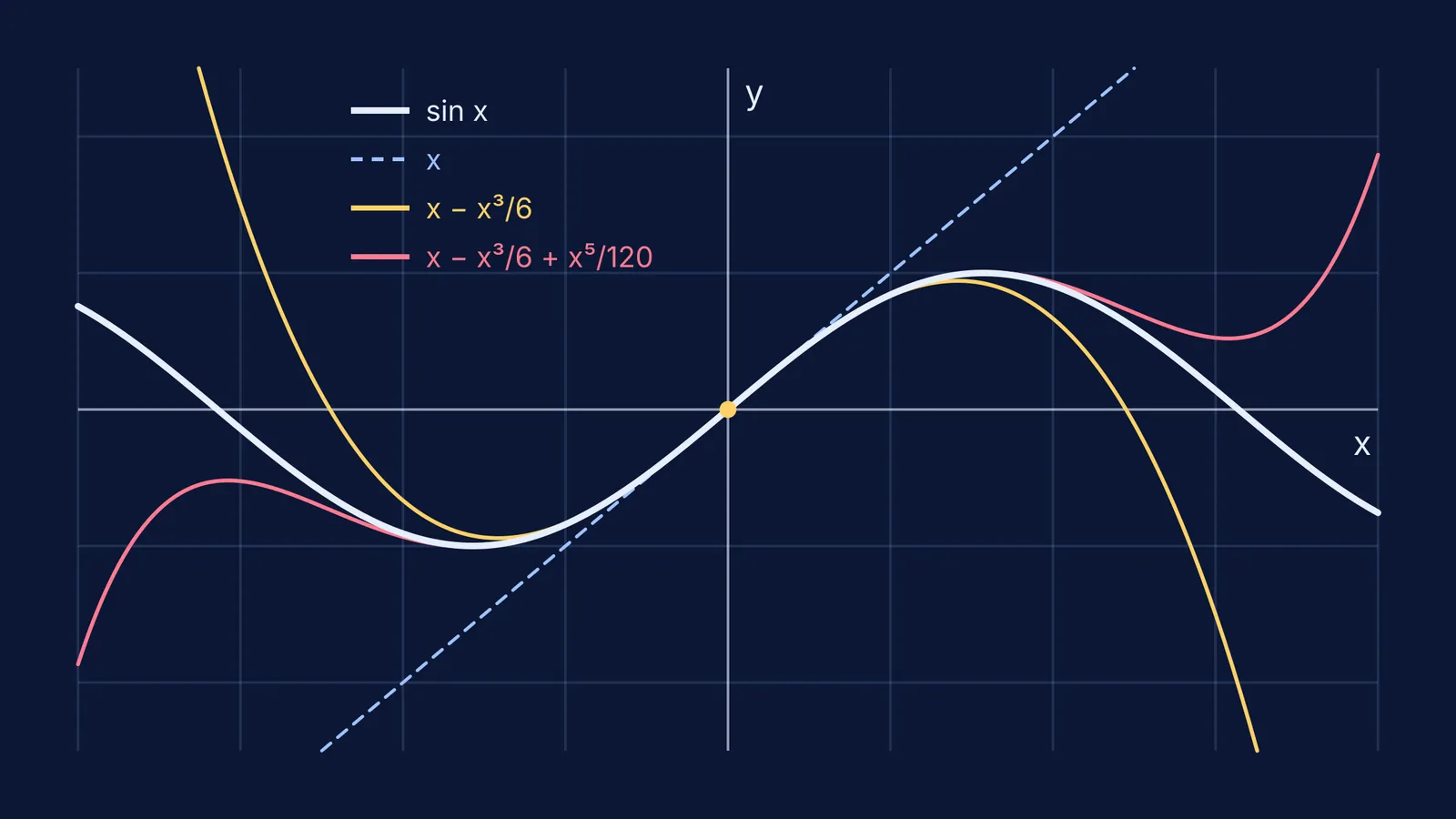
A Maclaurin series is the Taylor series of a function at 0, as defined in OpenStax Calculus Volume 2. Learn these five from the NIST Digital Library of Mathematical Functions (DLMF), a free reference from the US National Institute of Standards and Technology:
sin x = x − x³/3! + x⁵/5! − … (DLMF 4.19.1)
cos x = 1 − x²/2! + x⁴/4! − … (DLMF 4.19.2)
tan x = x + x³/3 + 2x⁵/15 + …, valid for |x| < π/2 (DLMF 4.19.3)
eˣ = 1 + x + x²/2! + x³/3! + … (DLMF 4.2.19)
ln(1 + x) = x − x²/2 + x³/3 − …, valid for −1 < x ≤ 1 (DLMF 4.6.1)
The story behind the name is in Colin Maclaurin and the series expansion at zero. To remember them: sine has only odd powers and cosine only even ones; ln(1 + x) alternates in sign and has no factorials.
How do you evaluate a limit using expansions of sin x and eˣ?
Use the same four steps every time:
Look at the denominator's lowest power of x. Call it xⁿ.
Expand every function in the numerator up to the xⁿ term.
Cancel. If everything below xⁿ cancels, the limit is the coefficient of xⁿ divided by the denominator's coefficient.
If a term below xⁿ survives, the limit is infinite or does not exist.
Example 1. Find the limit of (x − sin x)/x³ as x → 0. The denominator is x³, so expand sin x to x³: x − (x − x³/6) = x³/6. Divide by x³ and the limit is 1/6.
Example 2. Find the limit of (tan x − sin x)/x³. You get (x + x³/3) − (x − x³/6) = x³/3 + x³/6 = x³/2, so the limit is 1/2.
Example 3. Find the limit of (eˣ − 1 − sin x)/x². Here eˣ − 1 = x + x²/2 + …, and subtracting sin x = x − … leaves x²/2. The limit is 1/2.
Example 4. Find the limit of (ln(1 + x) − x)/x². You get (x − x²/2) − x = −x²/2, so the limit is −1/2.
How do you find unknown constants from a limit?
When a question gives the limit and asks for a and b, every power below the denominator's must have coefficient zero, and the matching power must give the stated value.
Example 5. Find a and b if the limit of [x(1 + a cos x) − b sin x]/x³ as x → 0 is 1.
Expand the numerator:
x(1 + a cos x) = x + ax − ax³/2 + …
b sin x = bx − bx³/6 + …
Numerator = (1 + a − b)x + (b/6 − a/2)x³ + …
For the limit to be finite, the x term must vanish: 1 + a − b = 0. For the limit to equal 1, the x³ coefficient must be 1: b/6 − a/2 = 1. Substitute b = 1 + a to get (1 + a)/6 − a/2 = 1, so 1 + a − 3a = 6 and a = −5/2. Then b = −3/2. Check: b/6 − a/2 = −1/4 + 5/4 = 1.
The same idea, written as a shortcut, settles the 1^∞ limits in limits of the form 1^∞ and the e-power shortcut.
If a problem like this goes wrong part-way, the Fermi Problem Library has worked problems with a step-by-step solver that explains the reasoning rather than printing an answer, so you can see which coefficient you dropped.
Why not just use L'Hôpital's rule?
You can, but (x − sin x)/x³ needs three rounds of differentiation, with a 0/0 check each time, and Example 5 means differentiating expressions that still contain a and b. (Where the rule came from is in Guillaume de l'Hôpital and the 0/0 rule.) Series show the whole numerator at once, and that is what unknown-constant questions need.
A five-minute practice set
Try these, then check your answers below:
(1 − cos x)/x²
(x − ln(1 + x))/x²
(tan x − x)/x³
(eˣ − e⁻ˣ − 2x)/x³
Answers: 1/2, 1/2, 1/3 and 1/3. If any of the five series still feels shaky, the Fermi Concept Library has a lesson for each concept in mathematics and shows where it fits in the map. Then redo the set from memory.


