

On this page
Many JEE definite-integral questions hide a repeating function inside a long interval: |sin x| from 0 to 100π, or the fractional part {x} from −2.3 to 2.7. The periodic property turns the job into one short integral and a multiplication.
What does the periodic property of definite integrals say?
A function f is periodic with period T if f(x + T) = f(x) for every x. If f is periodic with period T and integrable, its integral over any interval of length T has the same value, wherever the interval starts (Wikipedia: Periodic function).
Two working rules follow:
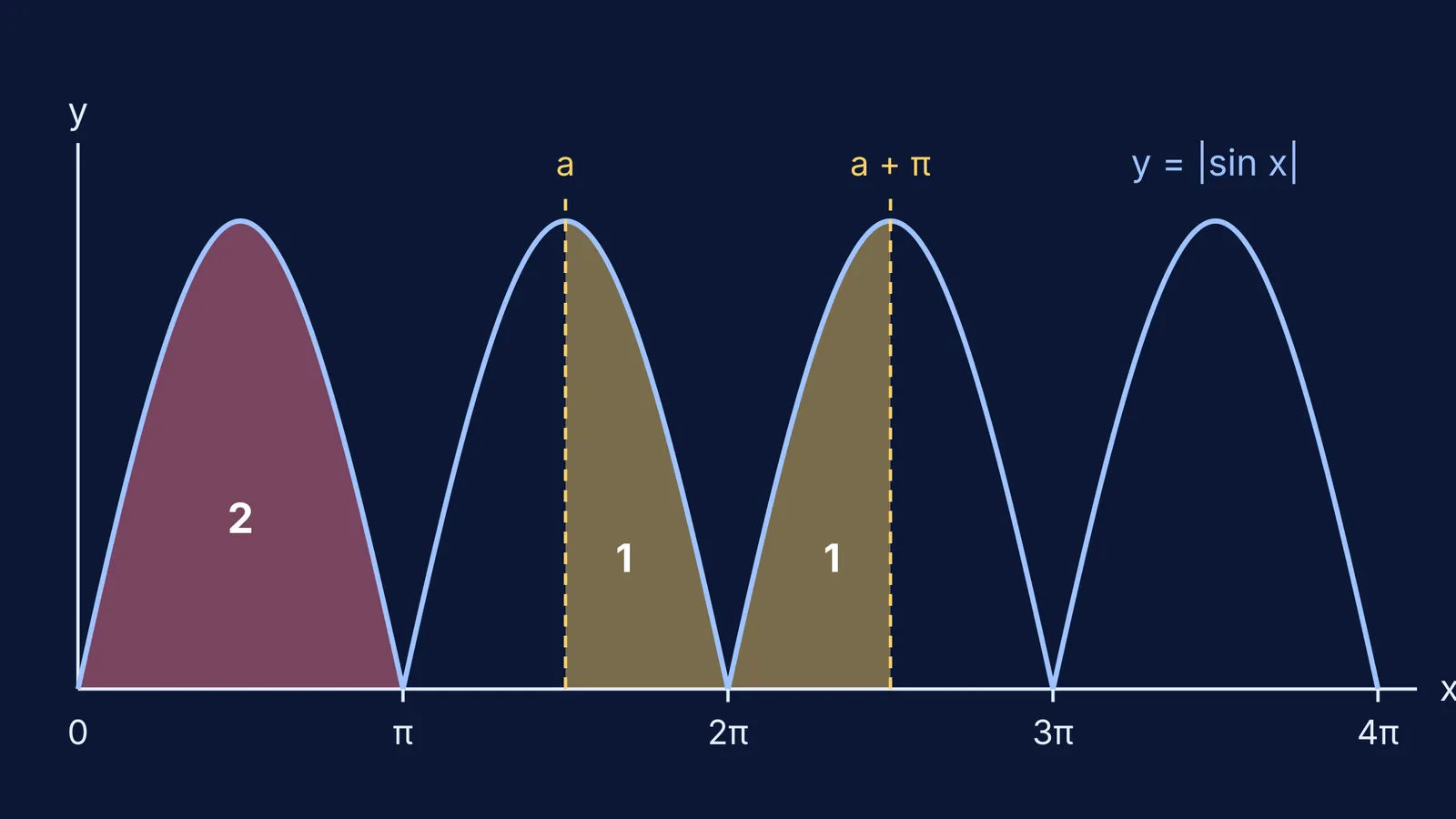
Shift rule: ∫ from a to a + T of f(x) dx = ∫ from 0 to T of f(x) dx, for any real a.
Many-periods rule: ∫ from a to a + nT of f(x) dx = n × ∫ from 0 to T of f(x) dx, for any integer n.
Mathlib, a library of computer-checked mathematics, proves both facts: the shift rule for any periodic function, and the many-periods rule for integrable ones (Mathlib: integrals of periodic functions).
Why does shifting the interval not change the answer?
The proof is a single substitution. PlanetMath sets it out like this (PlanetMath: integral over a period interval):
Split the integral from 0 to T at a: ∫ from 0 to T = ∫ from 0 to a + ∫ from a to T.
Write ∫ from a to T as ∫ from a to a + T, minus ∫ from T to a + T.
In ∫ from T to a + T, put x = t + T. It becomes ∫ from 0 to a of f(t + T) dt, which equals ∫ from 0 to a of f(t) dt because f repeats.
The two ∫ from 0 to a pieces cancel, leaving ∫ from a to a + T = ∫ from 0 to T.
On the graph, picture a window one period wide sliding along the curve. Whatever area it loses at its left edge it gains back at its right edge, because the curve there is the same.
How do you integrate |sin x| over many periods?
sin x has period 2π (Wikipedia: Periodic function), but |sin x| repeats every π, because sin(x + π) = −sin x and the absolute value removes the sign. Over one period, ∫ from 0 to π of sin x dx = [−cos x] from 0 to π = 1 − (−1) = 2.
∫ from 0 to 10π of |sin x| dx: the interval is 10 periods long, so the answer is 10 × 2 = 20.
∫ from π/3 to π/3 + 4π of |sin x| dx: the window starts at an awkward point, but its length is 4 periods, so the answer is 4 × 2 = 8.
∫ from 0 to 2π of sin x dx is 0, but ∫ from 0 to 2π of |sin x| dx is 4. Without the absolute value, the negative half cancels the positive.
How do you integrate the fractional part {x}?
The fractional part is {x} = x − [x], where [x] is the greatest integer function. It has period 1 (Wikipedia: Periodic function). On [0, 1) it is simply x, so ∫ from 0 to 1 of {x} dx = 1/2.
∫ from 0 to 7 of {x} dx: 7 periods, so 7 × 1/2 = 7/2.
∫ from −2.3 to 2.7 of {x} dx: the length is 5, exactly 5 periods, so the answer is 5/2.
∫ from 0 to 5.5 of {x} dx: 5 full periods give 5/2. The leftover piece from 5 to 5.5 slides back to ∫ from 0 to 0.5 of x dx = 1/8. Total: 5/2 + 1/8 = 21/8.
A four-step method for any periodic integral
Find the period T. Check f(x + T) = f(x) with the smallest T that works. For |sin x|, |cos x| and sin²x it is π; for {x} it is 1.
Measure the interval. Divide its length by T to get n full periods and a remainder r.
Integrate one period on whichever window is easiest, usually 0 to T.
Add the leftover. Answer = n × (one-period integral) + the integral over the last r units, slid back by nT to wherever it is easiest to compute.
Where do students lose marks?
Mixing periods: counting periods of 2π but using the area 2 of one π-hump of |sin x|.
Dropping the leftover piece when the length is not a whole multiple of T.
Using the rule on a function that does not repeat, such as x·sin x, whose swings grow, so f(x + T) ≠ f(x).
For other properties, see our Class 12 integrals formulas with examples and integrals key terms, explained simply.
If your answer differs from the key and you cannot see why, the Fermi Problem Library has worked problems with a step-by-step solver that explains the reasoning rather than printing an answer. If periodic functions themselves feel shaky, the Fermi Concept Library gives each concept in mathematics its own lesson.
Try it now: work out ∫ from 0 to 50π of |cos x| dx with the four steps. The answer is 100.


