On this page
Integrals is Chapter 7 of NCERT Mathematics Part II. The CBSE 2026-27 Mathematics curriculum lists substitution, partial fractions, integration by parts, standard forms, the Fundamental Theorem (without proof) and basic properties of definite integrals. It does not list the limit-of-a-sum definition, so that is left out.
Every formula here is from the NCERT chapter and was checked in SymPy. Log is the natural logarithm, as in NCERT; add the constant C to every indefinite integral. For how the chapter is examined, see our Integrals Class 12 board exam guide.
What are the basic integration formulas in Class 12?
∫xⁿ dx = xⁿ⁺¹/(n + 1), n ≠ −1
∫(1/x) dx = log|x|, x ≠ 0
∫eˣ dx = eˣ; ∫aˣ dx = aˣ/log a, a > 0, a ≠ 1
∫cos x dx = sin x; ∫sin x dx = −cos x
∫sec²x dx = tan x; ∫cosec²x dx = −cot x
∫sec x tan x dx = sec x; ∫cosec x cot x dx = −cosec x
∫dx/√(1 − x²) = sin⁻¹x (or −cos⁻¹x), |x| < 1
∫dx/(1 + x²) = tan⁻¹x (or −cot⁻¹x)
∫[k₁f + k₂g] dx = k₁∫f dx + k₂∫g dx, k₁ and k₂ constants
d/dx ∫f(x) dx = f(x); ∫f′(x) dx = f(x) + C
Example: ∫(6√x − 2/x + 3ˣ) dx = 4x^(3/2) − 2 log x + 3ˣ/log 3 + C, for x > 0.
Watch for: the power rule fails at n = −1; ∫x⁻¹ dx is log|x|.
Substitution and trigonometric integrals
If x = g(t), ∫f(x) dx = ∫f(g(t)) g′(t) dt. Let t be the function whose derivative also appears.
∫f′(x)/f(x) dx = log|f(x)|, f(x) ≠ 0
∫tan x dx = log|sec x|; ∫cot x dx = log|sin x|
∫sec x dx = log|sec x + tan x|
∫cosec x dx = log|cosec x − cot x|
Each holds where defined. Rewrite sin²x, cos²x or sin A cos B with an identity first, e.g. sin²x = (1 − cos 2x)/2.
Example: ∫cos x/(4 + sin x) dx. Put t = 4 + sin x, dt = cos x dx, giving log(4 + sin x) + C. No modulus is needed, since 4 + sin x ≥ 3.
Watch for: the inner factor. ∫tan 2x dx = ½ log|sec 2x| + C, not log|sec 2x|.
Integrals of particular functions
For a > 0:
∫dx/(x² − a²) = (1/2a) log|(x − a)/(x + a)|, |x| ≠ a
∫dx/(a² − x²) = (1/2a) log|(a + x)/(a − x)|, |x| ≠ a
∫dx/(x² + a²) = (1/a) tan⁻¹(x/a)
∫dx/√(x² − a²) = log|x + √(x² − a²)|, |x| > a
∫dx/√(a² − x²) = sin⁻¹(x/a), |x| < a
∫dx/√(x² + a²) = log|x + √(x² + a²)|
Quadratic ax² + bx + c (a ≠ 0) in the denominator, with or without a root: complete the square, ax² + bx + c = a[(x + b/2a)² + (c/a − b²/4a²)].
(px + q) over that quadratic or its root: write px + q = A(2ax + b) + B and compare coefficients.
Example: x² + 6x + 13 = (x + 3)² + 2², so ∫dx/(x² + 6x + 13) = ½ tan⁻¹((x + 3)/2) + C.
Watch for: in 2x² + 8x + 26, take the 2 out before completing the square.
How do you integrate using partial fractions?
They need a proper fraction P(x)/Q(x), with the degree of P below the degree of Q. If not, divide first: P/Q = T(x) + P₁/Q. A, B and C are constants.
(px + q)/[(x − a)(x − b)], a ≠ b → A/(x − a) + B/(x − b)
(px + q)/(x − a)² → A/(x − a) + B/(x − a)²
(px² + qx + r)/[(x − a)(x − b)(x − c)] → A/(x − a) + B/(x − b) + C/(x − c)
(px² + qx + r)/[(x − a)²(x − b)] → A/(x − a) + B/(x − a)² + C/(x − b)
(px² + qx + r)/[(x − a)(x² + bx + c)] → A/(x − a) + (Bx + C)/(x² + bx + c), where x² + bx + c cannot be factorised
Example: ∫(x + 7)/[(x − 1)(x + 3)] dx. From x + 7 = A(x + 3) + B(x − 1): x = 1 gives A = 2; x = −3 gives B = −1. Answer: 2 log|x − 1| − log|x + 3| + C.
Watch for: a repeated factor (x − a)² needs both A/(x − a) and B/(x − a)².
What is the integration by parts formula?
∫f g dx = f ∫g dx − ∫[f′ ∫g dx] dx, with f the first function and g the second. Pick a second function you can integrate; NCERT takes inverse trigonometric or log functions first.
∫eˣ[f(x) + f′(x)] dx = eˣ f(x)
∫√(x² − a²) dx = (x/2)√(x² − a²) − (a²/2) log|x + √(x² − a²)|, |x| ≥ a
∫√(x² + a²) dx = (x/2)√(x² + a²) + (a²/2) log|x + √(x² + a²)|
∫√(a² − x²) dx = (x/2)√(a² − x²) + (a²/2) sin⁻¹(x/a), |x| ≤ a
∫√(ax² + bx + c) dx: complete the square, then use the matching form above.
Example: ∫x e³ˣ dx with f = x, g = e³ˣ: x e³ˣ/3 − ∫(e³ˣ/3) dx = e³ˣ(x/3 − 1/9) + C.
Watch for: a lone log x. Use 1 as the second function: ∫log x dx = x log x − x + C.
Definite integrals: Fundamental Theorem and properties
∫(a→b) means lower limit a, upper limit b; f is continuous on the interval.
First theorem: if A(x) = ∫(a→x) f(t) dt, then A′(x) = f(x).
Second theorem: if F′ = f, then ∫(a→b) f(x) dx = F(b) − F(a).
P0: ∫(a→b) f(x) dx = ∫(a→b) f(t) dt
P1: ∫(a→b) f dx = −∫(b→a) f dx; ∫(a→a) f dx = 0
P2: ∫(a→b) f dx = ∫(a→c) f dx + ∫(c→b) f dx
P3: ∫(a→b) f(x) dx = ∫(a→b) f(a + b − x) dx
P4: ∫(0→a) f(x) dx = ∫(0→a) f(a − x) dx
P5: ∫(0→2a) f(x) dx = ∫(0→a) f(x) dx + ∫(0→a) f(2a − x) dx
P6: ∫(0→2a) f dx = 2∫(0→a) f dx if f(2a − x) = f(x); 0 if f(2a − x) = −f(x)
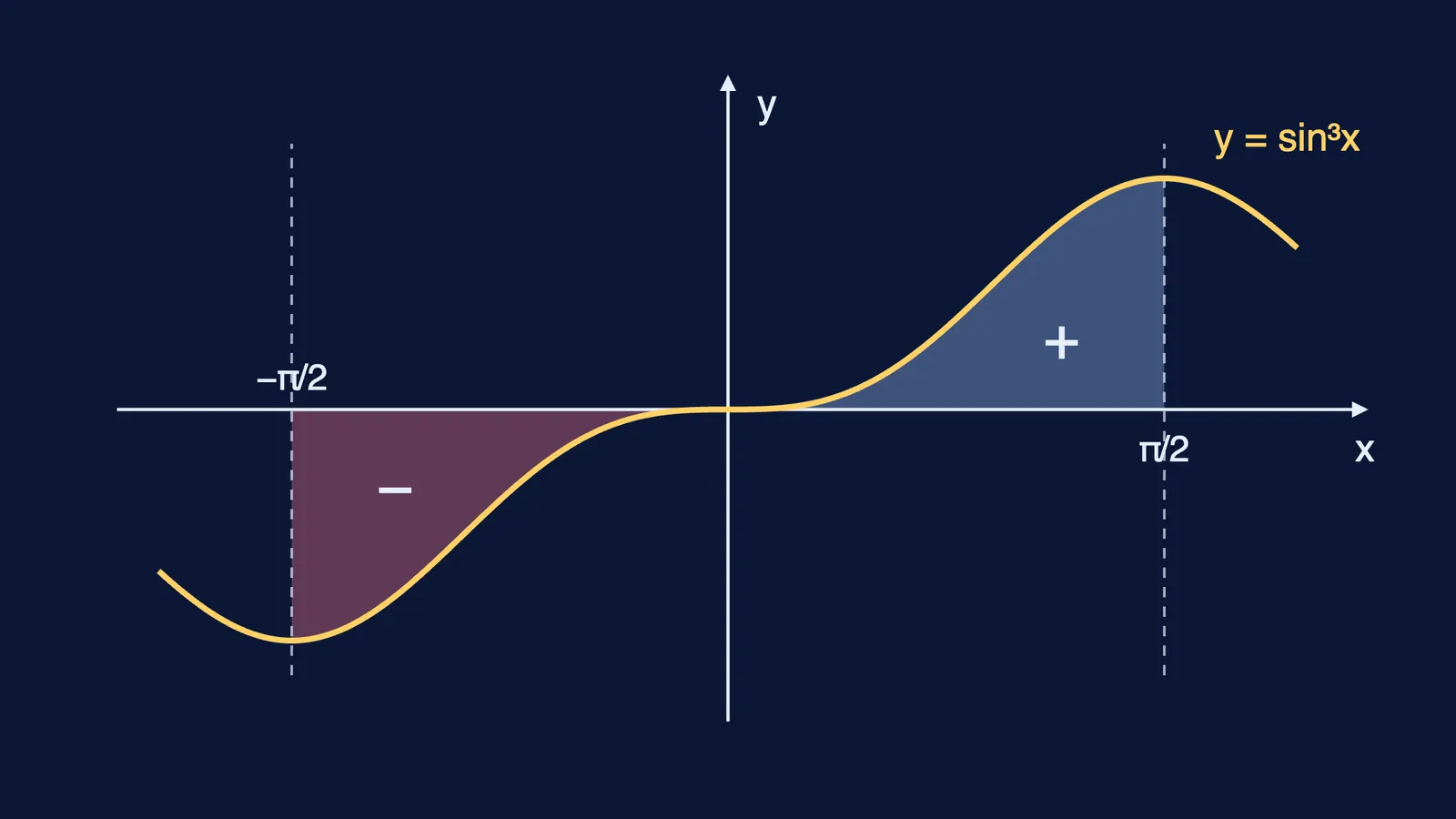
P7: ∫(−a→a) f dx = 2∫(0→a) f dx if f is even, f(−x) = f(x); 0 if f is odd, f(−x) = −f(x)
After a substitution, change the limits too.
Example: ∫(−π/2→π/2) (sin³x + cos x) dx. sin³x is odd, so its part is 0 (the shaded areas in the graph above cancel). cos x is even: 2∫(0→π/2) cos x dx = 2. Answer: 2.
Watch for: test each term. x³ + 1 is neither odd nor even, but its x³ part is odd.
How to revise this formula sheet
Derive the tan, cot, sec and cosec integrals once each by substitution.
Write the three square-root formulas side by side; mark the minus sign and the sin⁻¹.
Take ten integrands from the NCERT Miscellaneous Exercise and name the method before solving.
Before expanding a definite integral, look for P3, P4 or P7.
When a method keeps failing, the Fermi Problem Library has worked problems with a step-by-step solver that explains the reasoning rather than printing an answer. Areas under curves come next: Application of integrals Class 12.