On this page
Integrals is Chapter 7 of the NCERT Class 12 Mathematics Part II textbook (2026-27 reprint) and in Unit III, Calculus, of the CBSE Class XII Mathematics syllabus for 2026-27. Here are 28 of its key terms by topic. For methods and practice, see our Integrals Class 12 board exam guide.
The rationalised chapter only mentions the limit of a sum in passing and the 2026-27 syllabus omits it, so it has no entry.
What is integration, and what is an anti derivative?
Source: NCERT section 7.2.
Integration (anti differentiation): going from a derivative back to the original function. Example: integrating cos x gives sin x.
Anti derivative (primitive): any F with F′(x) = f(x) on an interval. Example: x³/3 and x³/3 + 7 both work for x².
Indefinite integral: ∫ f(x) dx = F(x) + C, the whole family of anti derivatives. Example: ∫ 2x dx = x² + C.
Integrand and variable of integration: in ∫ f(x) dx, f(x) is the integrand and x the variable.
Constant of integration (C): an arbitrary real number, since functions with the same derivative on an interval differ by a constant. Don't confuse with: definite integrals, where C cancels.
Standard formulae: integrals read off known derivatives. Example: ∫ xⁿ dx = xⁿ⁺¹/(n + 1) + C for n ≠ −1, and ∫ (1/x) dx = log |x| + C.
Linearity: integrate term by term; constants come outside. Example: ∫ (3x² + 2) dx = x³ + 2x + C.
Methods of integration: key terms
Source: NCERT sections 7.3, 7.5 and 7.6.
Integration by substitution: change the variable (x = g(t), so dx = g′(t) dt) to reach a known form; it suits a function appearing with its derivative. Example: t = x² + 1 turns ∫ 2x sin(x² + 1) dx into −cos(x² + 1) + C.
Trigonometric identities: rewrite first. Example: cos²x = (1 + cos 2x)/2, so ∫ cos²x dx = x/2 + (sin 2x)/4 + C.
Proper rational function: polynomials P(x)/Q(x), Q(x) ≠ 0, with degree of P below degree of Q. Don't confuse with: improper (degree of P at least that of Q), split by long division: x²/(x² − 1) = 1 + 1/(x² − 1).
Partial fractions: splitting a proper rational function into simpler fractions (Table 7.2). Example: 1/((x − 1)(x + 1)) = (1/2)/(x − 1) − (1/2)/(x + 1).
Integration by parts: ∫ f g dx = f ∫ g dx − ∫ [f′ ∫ g dx] dx. Example: ∫ x cos x dx = x sin x + cos x + C.
First and second function: f is differentiated, g integrated. NCERT: a polynomial usually goes first, but inverse trigonometric or log functions go first. ILATE is a classroom heuristic, not an NCERT rule. Example: ∫ log x dx = x log x − x + C, with 1 second.
The eˣ[f(x) + f′(x)] form: integrates to eˣ f(x) + C. Example: ∫ eˣ(sin x + cos x) dx = eˣ sin x + C.
Which special integrals does the chapter use?
Source: NCERT sections 7.4 and 7.6.2.
Integrals of particular functions: ready formulas for dx/(x² ± a²), dx/(a² − x²), dx/√(a² − x²) and dx/√(x² ± a²), plus √(a² − x²) and √(x² ± a²) dx. Example: ∫ dx/(x² + a²) = (1/a) tan⁻¹(x/a) + C.
Completing the square: rewriting ax² + bx + c to reach those forms. Example: x² + 2x + 5 = (x + 1)² + 4, so ∫ dx/(x² + 2x + 5) = (1/2) tan⁻¹((x + 1)/2) + C.
The (px + q) numerator: px + q = A × d/dx(ax² + bx + c) + B, matching coefficients. Example: x + 3 = (1/2)(2x + 2) + 2.
Definite integrals and the fundamental theorem: key terms
Source: NCERT sections 7.7 to 7.9.
Definite integral: from the lower limit a to the upper limit b, one number; for f(x) ≥ 0, the area under y = f(x) between x = a and x = b. Example: ∫ x² dx from 0 to 1 = 1/3.
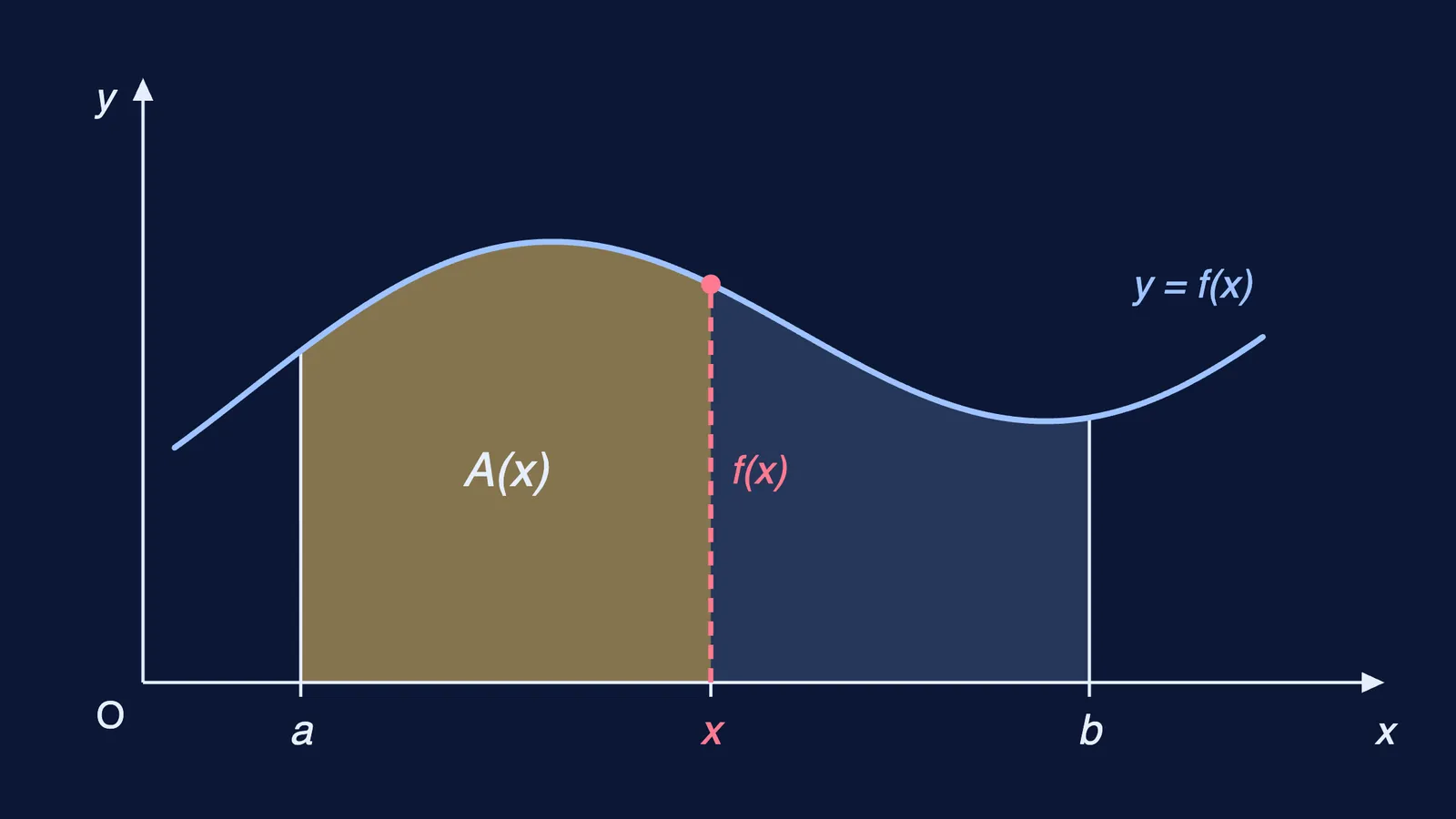
Area function A(x): the area under y = f(x) from a to a moving point x. Example: for f(x) = 2x and a = 0, A(x) = x².
First fundamental theorem: if f is continuous on [a, b], then A′(x) = f(x). Example: A(x) = x² gives A′(x) = 2x.
Second fundamental theorem: for continuous f with anti derivative F, the integral from a to b is F(b) − F(a). Example: ∫ cos x dx from 0 to π/2 = 1. It needs f defined and continuous on all of [a, b].
Substitution with limits: return to x or change the limits. Example: ∫ 2x/(1 + x²) dx from 0 to 1, with t = 1 + x², becomes ∫ dt/t from 1 to 2 = log 2.
Properties of definite integrals: key terms
Source: NCERT section 7.10.
Dummy variable (P0): renaming x as t changes nothing.
Reversing limits (P1): swapping a and b flips the sign; from a to a it is 0.
Splitting the interval (P2): a to b equals a to c plus c to b. Example: ∫ |x| dx from −1 to 2 = 5/2.
The a − x property (P4): from 0 to a, f(x) and f(a − x) give equal integrals; P3 is the a + b − x version. Example: ∫ sin x/(sin x + cos x) dx from 0 to π/2 = π/4.
Even function: f(−x) = f(x); the integral from −a to a is twice that from 0 to a (P7). Example: ∫ x² dx from −1 to 1 = 2/3.
Odd function: f(−x) = −f(x); from −a to a it is 0. Example: ∫ x³ dx from −1 to 1 = 0.
For areas of circles, parabolas and ellipses, read Application of integrals Class 12 guide.
How to learn these terms
Differentiate every indefinite answer to get the integrand back.
Choose the method: derivative present (substitution), rational function (partial fractions), product (parts).
Sketch the area function: shade from a to x; it grows at rate f(x).
If a term stays fuzzy, try the Fermi Concept Library, where each concept has its own lesson and its place in the map.