On this page
These ten original NEET-UG Biology questions follow our first Human Physiology NEET practice set. None of its tested points return.
Which Human Physiology topics does set 2 cover?
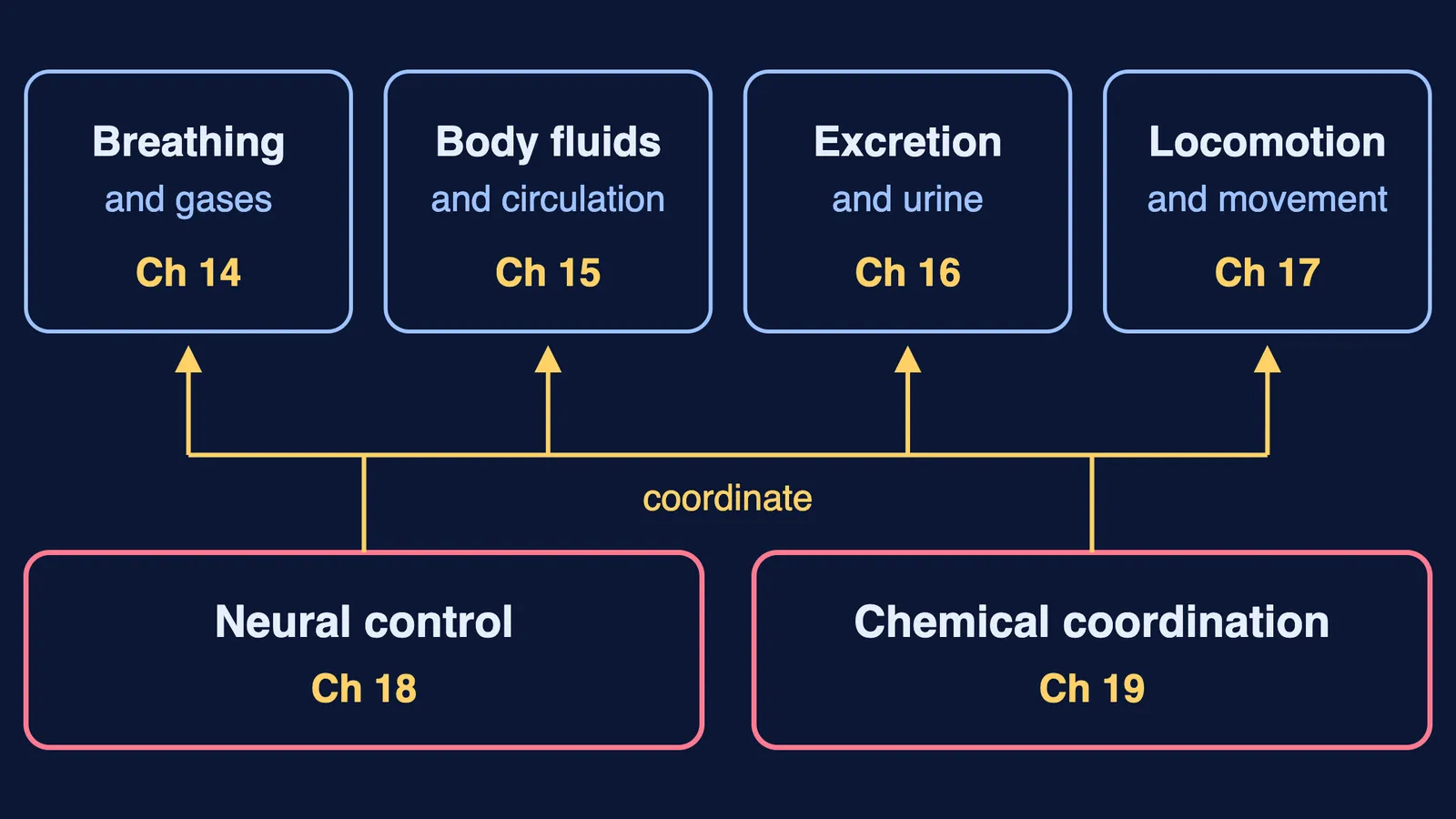
The NEET (UG)-2026 syllabus issued by the National Medical Commission lists all six topics under Biology Unit 5, Human Physiology, matching NCERT Class 11 Biology (Reprint 2026-27) Chapters 14 to 19. Set 1 asked one question each on breathing, locomotion, neural control and hormones, so set 2 leans on those four. New to the unit? Start with how to prepare Human Physiology for NEET first.
How should you use this practice set?
Cover the solutions and allow 12 minutes for all ten.
Mark each answer "sure" or "unsure" before checking.
Read every trap line, and treat a lucky "unsure" as a miss.
Easy: do you know where each fact sits?
Sources: NCERT Chapter 14, Chapter 17 and Chapter 18.
Q1 (easy). NCERT's neural control chapter opens with exercise as its example of coordination. When working muscles need more oxygen, what must change?
(1) Breathing slows to save energy (2) Breathing, heart beat and blood flow all rise (3) Only breathing rises (4) The heart beat slows so blood stays in the muscles
Answer: (2). The Chapter 18 opener: more oxygen needs faster respiration, a faster heart beat and more blood flow, so organs must be coordinated. Why the tempting wrong option fails: (3) changes only the lungs; NCERT's point is that several organs change together.
Q2 (easy). Your lungs sit inside an air-tight thoracic chamber. Why does breathing depend on this?
(1) It keeps the pleural fluid in (2) The lungs expand by their own muscle (3) Lung pressure stays below atmospheric throughout (4) Lung volume cannot be altered directly, so thoracic volume changes pass to the lungs
Answer: (4). Section 14.1.1: any change in thoracic volume shows up in the lungs. Why the tempting wrong option fails: (3) holds only in inspiration; in expiration lung pressure rises slightly above atmospheric (14.2).
Q3 (easy). Why is a single skeletal muscle fibre called a syncytium (NCERT spells it "syncitium")?
(1) Its sarcoplasm contains many nuclei (2) It is enclosed by a plasma membrane, the sarcolemma (3) Its sarcoplasmic reticulum stores calcium ions (4) Many fascicles are held together by a common fascia
Answer: (1). Section 17.2: one fibre is one sarcolemma around sarcoplasm with many nuclei, NCERT's reason for the name. Why the tempting wrong option fails: (4) describes a whole muscle of many fascicles, not one cell.
Medium: can you separate look-alike answers?
Sources: NCERT Chapter 14, Chapter 16 and Chapter 19.
Q4 (medium). The skin gets rid of some substances through sebum. Which ones does NCERT list?
(1) NaCl, small amounts of urea and lactic acid (2) Bilirubin, biliverdin and cholesterol (3) Sterols, hydrocarbons and waxes (4) Carbon dioxide and water
Answer: (3). Section 16.7 lists these three for sebaceous glands. Why the tempting wrong option fails: (1) is sweat, also from the skin, whose main job is cooling the body surface.
Q5 (medium). A blood sample holds 500 haemoglobin molecules and is 75 per cent saturated with oxygen. How many O2 molecules are bound?
(1) 375 (2) 1,500 (3) 750 (4) 2,000
Answer: (2). Section 14.4.1: each haemoglobin molecule carries at most four O2 molecules, so full saturation is 500 × 4 = 2,000, and 75 per cent of that is 1,500. Why the tempting wrong option fails: (1) assumes one O2 per haemoglobin molecule.
Q6 (medium). The neural system already gives rapid point-to-point coordination. Why, per NCERT, does the body also need hormones?
(1) Neural coordination is slow but long-lasting (2) Nerve impulses cannot reach involuntary organs (3) Nerve fibres do not supply every cell, and cell functions need continuous regulation (4) Hormones act faster than nerve impulses
Answer: (3). The Chapter 19 opener gives exactly this reason, so the neural and endocrine systems regulate body functions jointly. Why the tempting wrong option fails: (1) flips NCERT, which calls neural coordination fast but short-lived.
Q7 (medium). Aldosterone acts mainly at the renal tubules. Which ions does NCERT say it increases the excretion of?
(1) K+ and phosphate (2) Na+ and K+ (3) Na+ and phosphate (4) Ca2+ and K+
Answer: (1). Section 19.2.7: aldosterone makes the tubules take back Na+ and water but pass out K+ and phosphate. Why the tempting wrong option fails: (2) Na+ is reabsorbed under aldosterone, not excreted.
Hard: can you combine two facts?
Sources: NCERT Chapter 15, Chapter 17 and Chapter 19.
Q8 (hard). Which hormones does NCERT credit with all four: regulating basal metabolic rate, supporting RBC formation, controlling carbohydrate, protein and fat metabolism, and influencing water and electrolyte balance?
(1) Glucocorticoids (2) Thyrocalcitonin (3) Thyroid hormones, T4 and T3 (4) Mineralocorticoids
Answer: (3). Section 19.2.4 lists all four roles for the hormones of the thyroid follicular cells. Why the tempting wrong option fails: (1) cortisol does stimulate RBC production (19.2.7), but NCERT never links glucocorticoids to basal metabolic rate.
Q9 (hard). A practice blood count reads 7,000 WBCs per mm³: neutrophils 64 per cent, lymphocytes 24, monocytes 8, eosinophils 3 and basophils 1. How many phagocytic WBCs is that per mm³?
(1) 4,480 (2) 4,760 (3) 6,160 (4) 5,040
Answer: (4). Section 15.1.2 names neutrophils and monocytes as the phagocytic cells, so (64 + 8) per cent of 7,000 = 5,040. Why the tempting wrong option fails: (2) adds the three granulocytes, but monocytes are agranulocytes and still phagocytic.
Q10 (hard). Using NCERT's counts, how many bones make up the appendicular skeleton, and how many of them form the two girdles?
(1) 120 and 6 (2) 126 and 6 (3) 130 and 10 (4) 124 and 4
Answer: (2). Section 17.3: four limbs × 30 bones = 120, plus two clavicles, two scapulae and two coxal bones (6) = 126. NCERT never prints 126, but its 206 total minus 80 axial gives the same. Why the tempting wrong option fails: (3) counts the ilium, ischium and pubis separately, but they fuse into one coxal bone.
Study summary, not medical advice: Q9 uses a made-up count.
What should you do after this set?
Group your misses by chapter, reread that NCERT section and retry those questions tomorrow.
Unsure where your gaps in this unit are? Fermi's AI tutor works out what you already know and builds a plan for the session.