On this page
This set follows our Plant Physiology NEET practice questions, set 1 and repeats none of its tested points.
Which Plant Physiology topics does set 2 cover?
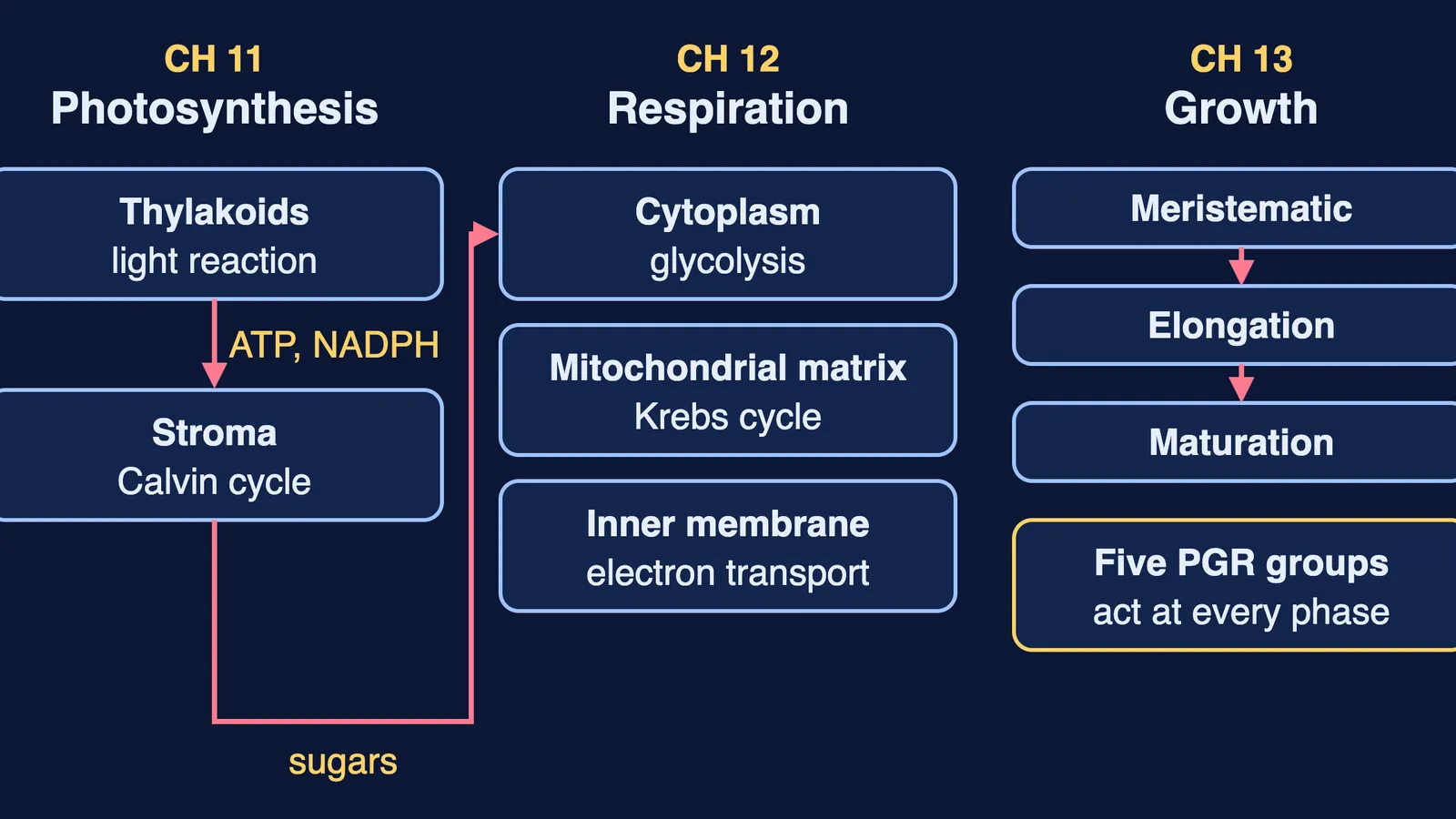
The NEET (UG)-2026 syllabus notice from NTA places Plant Physiology in Biology Unit 4. Its three topics match NCERT Class 11 Biology chapters 11 (Photosynthesis in Higher Plants), 12 (Respiration in Plants) and 13 (Plant Growth and Development).
Set 1 drew 3, 3 and 2 questions from these chapters. Set 2 tilts towards Chapter 13 (four questions), then Chapter 11 (three) and Chapter 12 (two). New to the unit? Read our Plant Physiology preparation guide for NEET first.
How should you use this practice set?
Give yourself 12 minutes for all nine.
After checking, say why each wrong option fails, and redo misses two days later.
Easy: can you recall the NCERT detail?
Q1 (easy). Which enzyme does NCERT describe as the most abundant enzyme in the world?
(1) PEP carboxylase (2) RuBisCO (3) ATP synthase (4) NADP reductase
Answer: (2). Section 11.9 of NCERT Chapter 11 gives RuBisCO this label. It fixes CO2 onto RuBP in the Calvin cycle, which runs in all photosynthetic plants (11.7.2).
Why the tempting wrong option fails: PEPcase fixes CO2 only in C4 mesophyll cells.
Q2 (easy). Which growth-measurement pairing does NCERT give?
(1) Pollen tube: increase in surface area (2) Dorsiventral leaf: increase in surface area (3) Pollen tube: increase in cell number (4) Dorsiventral leaf: increase in length
Answer: (2). Section 13.1.2 of NCERT Chapter 13 measures a pollen tube's growth as length and a dorsiventral leaf's as surface area, since protoplasm itself is hard to measure.
Why the tempting wrong option fails: (4) gives the leaf the pollen tube's parameter, length.
Q3 (easy). Besides its low energy yield, what drawback of lactic acid and alcoholic fermentation does NCERT note?
(1) Both need a supply of oxygen (2) Both form a hazardous product, acid or alcohol (3) Neither can turn NADH + H+ back into NAD+ (4) Both take place inside mitochondria
Answer: (2). Section 12.3 of NCERT Chapter 12 calls both fermentations hazardous because acid or alcohol is produced.
Why the tempting wrong option fails: (3) is false, since NADH + H+ is reoxidised to NAD+ in both routes.
Medium: can you apply the rule?
Q4 (medium). A destarched leaf is partly sealed in a test tube with KOH-soaked cotton, which absorbs CO2; the rest stays in air. After hours in light it is tested for starch. Which result and conclusion fit NCERT?
(1) Only the part in air tests positive; CO2 is needed for photosynthesis (2) Only the part in the tube tests positive; KOH supplies CO2 (3) Both parts test positive; only light is needed (4) Neither part tests positive; KOH stops photosynthesis in the whole leaf
Answer: (1). Section 11.1 of NCERT Chapter 11: only the exposed part makes starch, so CO2 is required.
Why the tempting wrong option fails: (3) ignores that KOH removes the enclosed part's CO2.
Q5 (medium). Which coenzymes does NCERT say pyruvic dehydrogenase needs to convert pyruvic acid to acetyl CoA?
(1) NAD+ and coenzyme A (2) FAD+ and coenzyme A (3) NADP+ and coenzyme A (4) NAD+ and FAD+
Answer: (1). Section 12.4 of NCERT Chapter 12 names NAD+ and coenzyme A (with Mg2+); the products are acetyl CoA, CO2 and NADH + H+.
Why the tempting wrong option fails: FAD+ is reduced later, when succinate is oxidised in the Krebs cycle.
Q6 (medium). Which statement about the conditions a seedling needs for growth matches NCERT?
(1) Water is needed only as raw material for protoplasm. (2) Nutrients give energy but never build protoplasm. (3) Any temperature suits growth if water is present. (4) Oxygen helps release the metabolic energy growth uses.
Answer: (4). Section 13.1.5 of NCERT Chapter 13 gives oxygen this role.
Why the tempting wrong option fails: NCERT ties water to cell enlargement, turgidity and a medium for enzymes.
Hard: can you reason across sections?
Q7 (hard). On a cold morning, a C3 leaf gets light well past saturation and CO2 at a level that no longer limits it, yet it barely photosynthesises. By Blackman's law of limiting factors, which change raises its rate?
(1) Doubling the light intensity (2) Raising CO2 further (3) Warming the leaf towards its optimum temperature (4) Adding a second light source of another colour
Answer: (3). Section 11.10 of NCERT Chapter 11 gives Blackman's 1905 law: the factor nearest its minimal value sets the rate. Here only temperature is sub-optimal.
Why the tempting wrong option fails: (1) adds light past saturation while temperature limits.
Q8 (hard). NCERT lists events shaped by more than one PGR together. Which is on that list?
(1) Abscission (2) Speeding up malting in brewing (3) Parthenocarpy in tomatoes (4) More female flowers in cucumbers
Answer: (1). At the end of section 13.4 of NCERT Chapter 13, the list is dormancy in seeds and buds, abscission, senescence and apical dominance.
Why the tempting wrong option fails: NCERT credits the cucumber result to ethephon alone; malting (GA3) and parthenocarpy (auxins) are also single-PGR uses.
Q9 (hard). Which statement matches NCERT's account of how plant growth and development are controlled?
(1) PGRs are the only intrinsic control. (2) Light and temperature are intrinsic because they act through PGRs. (3) Light and temperature can steer vernalisation, dormancy and seed germination through PGRs. (4) Light and temperature affect flowering only directly.
Answer: (3). The close of section 13.4 in NCERT Chapter 13 says temperature and light often work via PGRs, for example in vernalisation, dormancy and seed germination. Genomic control is also intrinsic.
Why the tempting wrong option fails: section 13.3 lists light and temperature as extrinsic, whatever route they act through.
What should you do after set 2?
If Chapter 13 cost you two or more across both sets, reread the PGR effects in our Class 11 notes on plant growth and development.
Unsure where your revision should start? Fermi's AI tutor works out what you already know and builds a plan for the session.