On this page
These ten original MCQs follow our first Diversity in Living World practice set and test none of the same points.
Which chapters does set 2 cover?
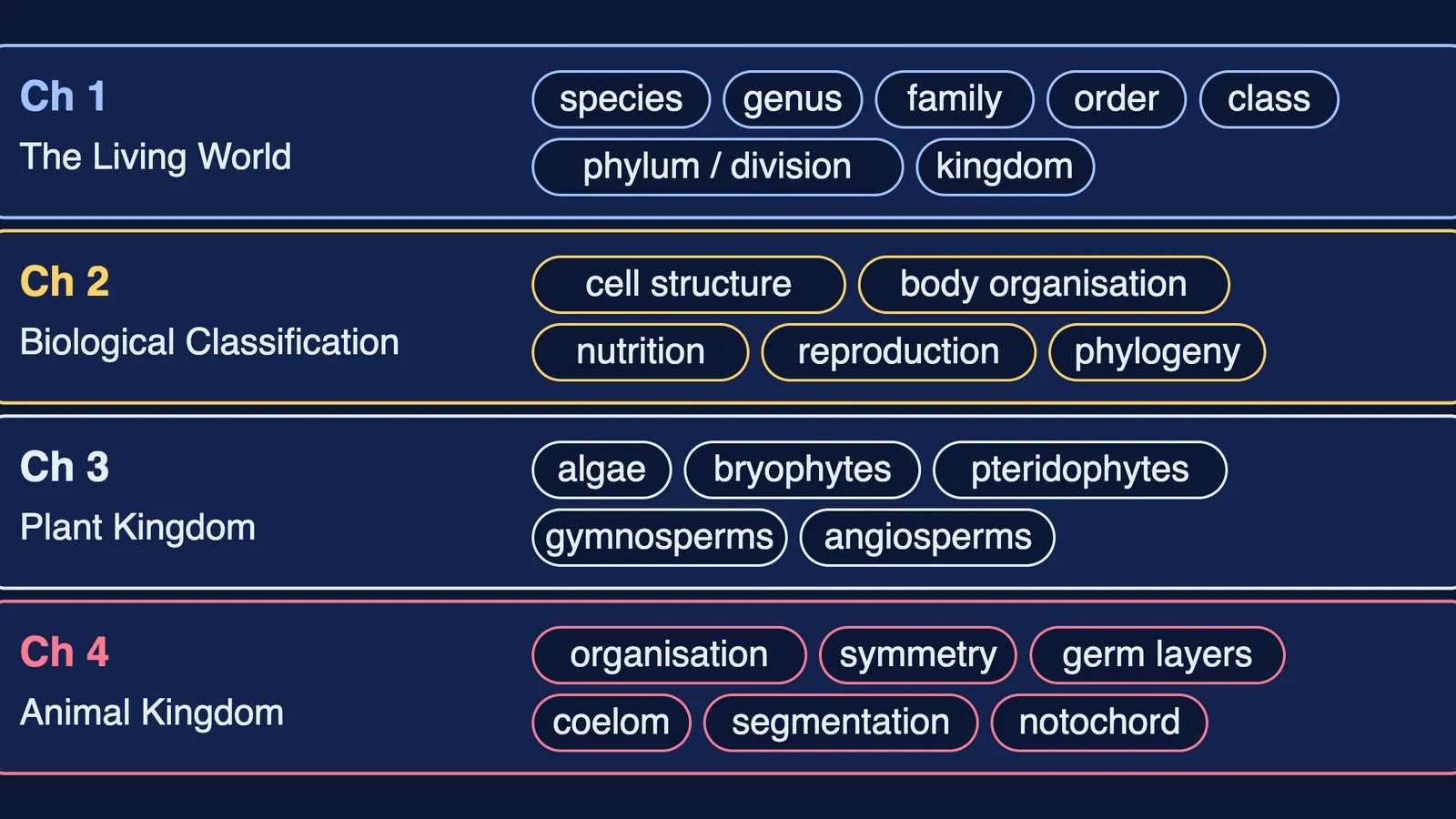
The NMC's NEET (UG) 2026 syllabus puts this material in Biology Unit 1, Diversity in Living World. In NCERT Class 11 Biology (Reprint 2026-27), that unit is Chapters 1 to 4: The Living World, Biological Classification, Plant Kingdom and Animal Kingdom.
Set 1 drew four of its ten questions from Animal Kingdom and only one from The Living World. Set 2 rebalances: two questions from Chapter 1, three from Chapter 2, three from Chapter 3 and two from Chapter 4. To revise plants group by group, start with our NEET guide to the Plant Kingdom.
How should you attack single-correct MCQs?
Cover the solutions; allow about ten minutes.
Before reading the options, name the chapter and group the stem points to.
Strike out options that belong to a neighbouring group, then choose.
Read every "tempting wrong option" line afterwards.
Easy: do you know where each fact lives?
Q1 (easy). NCERT names Aristotle as the first to try a more scientific classification. How did he divide animals?
(1) By whether they had a notochord (2) By whether they had red blood (3) Into trees, shrubs and herbs (4) Into unicellular and multicellular forms
Answer: (2). The opening of Chapter 2 says Aristotle used simple morphological characters. He sorted animals into two groups by the presence or absence of red blood.
Why the tempting wrong option fails: (3) is also Aristotle's, but it is how he sorted plants, not animals.
Q2 (easy). What is the lowest taxonomic category that contains both a gibbon and a tiger?
(1) Order Primata (2) Family Felidae (3) Class Mammalia (4) Phylum Chordata
Answer: (3). Section 1.2.5 places order Primata (monkey, gorilla, gibbon) in class Mammalia beside order Carnivora, which holds the tiger.
Why the tempting wrong option fails: (4) is shared too, but phylum sits above class, so it is not the lowest.
Q3 (easy). Which list does NCERT give for the respiratory organs of arthropods?
(1) Gills, book gills, book lungs or a tracheal system (2) Feather-like gills inside a mantle cavity (3) Four pairs of gills under an operculum (4) Gills, lungs and the skin
Answer: (1). Section 4.2.7 lists all four for Arthropoda.
Why the tempting wrong option fails: (2) describes molluscs (4.2.8), whose mantle-cavity gills also handle excretion.
Medium: can you separate close neighbours?
Q4 (medium). According to NCERT, how do members of Kingdom Animalia store food reserves?
(1) As starch in pyrenoids (2) As floridean starch (3) As glycogen or fat (4) As laminarin or mannitol
Answer: (3). Section 2.5 describes animals as heterotrophic eukaryotes that digest food in an internal cavity and keep their reserves as glycogen or fat.
Why the tempting wrong option fails: (2) sounds animal-like, but floridean starch is the red algal store (3.1.3, Table 3.1).
Q5 (medium). How do mosses reproduce vegetatively?
(1) By gemmae formed in gemma cups (2) By fragmentation and by budding in the secondary protonema (3) By flagellated zoospores (4) By conidia formed on conidiophores
Answer: (2). Section 3.2.2 gives fragmentation and budding in the secondary protonema as the vegetative routes in mosses.
Why the tempting wrong option fails: (1) is the other bryophyte group; gemmae and gemma cups belong to liverworts (3.2.1).
Q6 (medium). How does NCERT describe the chloroplasts of green algae?
(1) Always cup-shaped, each with a single pyrenoid (2) Different in shape from species to species, from discoid to ribbon-shaped (3) Absent, with the pigments spread through the cytoplasm (4) Coloured red by r-phycoerythrin
Answer: (2). Section 3.1.1 places the chlorophyll a and b of green algae in definite chloroplasts. NCERT lists six shapes across species: discoid, plate-like, reticulate, cup-shaped, spiral and ribbon-shaped.
Why the tempting wrong option fails: (1) picks one shape out of six, and NCERT says most members carry one or more pyrenoids.
Q7 (medium). Why does NCERT say chemosynthetic autotrophic bacteria matter in nature?
(1) They make methane from the dung of cattle (2) They fix nitrogen in heterocysts (3) They recycle nutrients such as nitrogen, phosphorus, iron and sulphur (4) They form blooms in polluted water
Answer: (3). Section 2.1.2 says these bacteria oxidise inorganic substances to make ATP. NCERT credits them with a large role in recycling those nutrients.
Why the tempting wrong option fails: (1) belongs to methanogens, which are archaebacteria (2.1.1); (2) and (4) are cyanobacteria.
Hard: can you reason across a table or a chapter?
Q8 (hard). Artificial systems gave vegetative and sexual characters equal weight. Why does NCERT reject this?
(1) Sexual characters ignore evolutionary relationships (2) Vegetative characters are more easily affected by the environment (3) Vegetative characters are too many to code on computers (4) Sexual characters vary more between individuals
Answer: (2). The introduction to Chapter 3 says equal weighting is not acceptable because vegetative characters change more readily with the environment.
Why the tempting wrong option fails: (3) borrows from numerical taxonomy, which deliberately gives every character equal importance and runs on computers.
Q9 (hard). Using Table 1.1, what is the lowest category that mango and wheat share?
(1) Order (2) Class (3) Division Angiospermae (4) Kingdom only
Answer: (3). Mango is in order Sapindales and class Dicotyledonae; wheat is in Poales and Monocotyledonae. Both sit in Angiospermae, in the Phylum/Division column of Table 1.1.
Why the tempting wrong option fails: (2) feels right because both are flowering plants, but their classes differ.
Q10 (hard). Which group and feature match NCERT?
(1) Chondrichthyes: four pairs of gills under an operculum (2) Echinodermata: statocysts as balancing organs (3) Cyclostomata: skin with placoid scales (4) Osteichthyes: skin with cycloid or ctenoid scales
Answer: (4). Section 4.2.11.3 gives bony fishes cycloid or ctenoid scales. Statocysts are listed for arthropods (4.2.7), and cyclostomes have no scales (4.2.11.1).
Why the tempting wrong option fails: (1) is a real bony-fish feature; cartilaginous fishes have separate gill slits with no operculum (4.2.11.2).
What should you do after set 2?
Sort each miss: wrong chapter, a fact moved to the wrong group, or a misread "lowest". Reread the cited section, write the fact in your own words, and log set 1 and set 2 misses together by chapter. The chapter with the most entries is your next revision block.
Unsure where your weakest chapter is? Fermi's AI tutor works out what you already know and builds a plan for the session.