On this page
Look closely at the numbers in your Class 11 breathing chapter and something seems wrong. Oxygen has a large pressure difference pushing it into the blood. Carbon dioxide has a tiny one pushing it out. Yet carbon dioxide is the gas that crosses the alveolar membrane more easily. Here is why, with the arithmetic you can write in an exam.
Why does CO2 diffuse faster than oxygen in the lungs?
Start with the partial pressures in NCERT Class 11 Biology, Chapter 14, Breathing and Exchange of Gases. Alveolar air has a pO2 of 104 mm Hg and a pCO2 of 40 mm Hg. Deoxygenated blood arriving at the lungs has a pO2 of 40 mm Hg and a pCO2 of 45 mm Hg.
So oxygen is pushed into the blood by a difference of 64 mm Hg, while carbon dioxide is pushed out by only 5 mm Hg. The open textbook OpenStax Anatomy and Physiology gives the same two figures. We have collected all these pressures in one place in our partial pressure table for gas exchange.
The answer is solubility. NCERT states that the solubility of CO2 is 20 to 25 times higher than that of O2, so far more CO2 crosses the membrane for each mm Hg of pressure difference (NCERT, Chapter 14). OpenStax puts the factor at about 20.
What actually sets how fast a gas diffuses?
Fick's law says the rate of diffusion across a membrane grows with the membrane's area and the pressure difference, and falls as the membrane gets thicker. The last factor is a property of the gas itself: a gas that dissolves more easily in body fluids diffuses more easily, and a heavier gas tends to diffuse more slowly (Respiratory Therapy Zone on Fick's law).
Area and thickness are the same for both gases, because they cross the same three thin layers described in our post on the layers of the alveolar diffusion membrane. So the comparison comes down to three things: gradient, solubility and molar mass.
If Henry's law feels shaky, our explainer on Henry's law and gas solubility covers it from the chemistry side.
How do the gradient and solubility compare? A worked example
Use the NCERT figures and compare the two gases side by side (NCERT, Chapter 14).
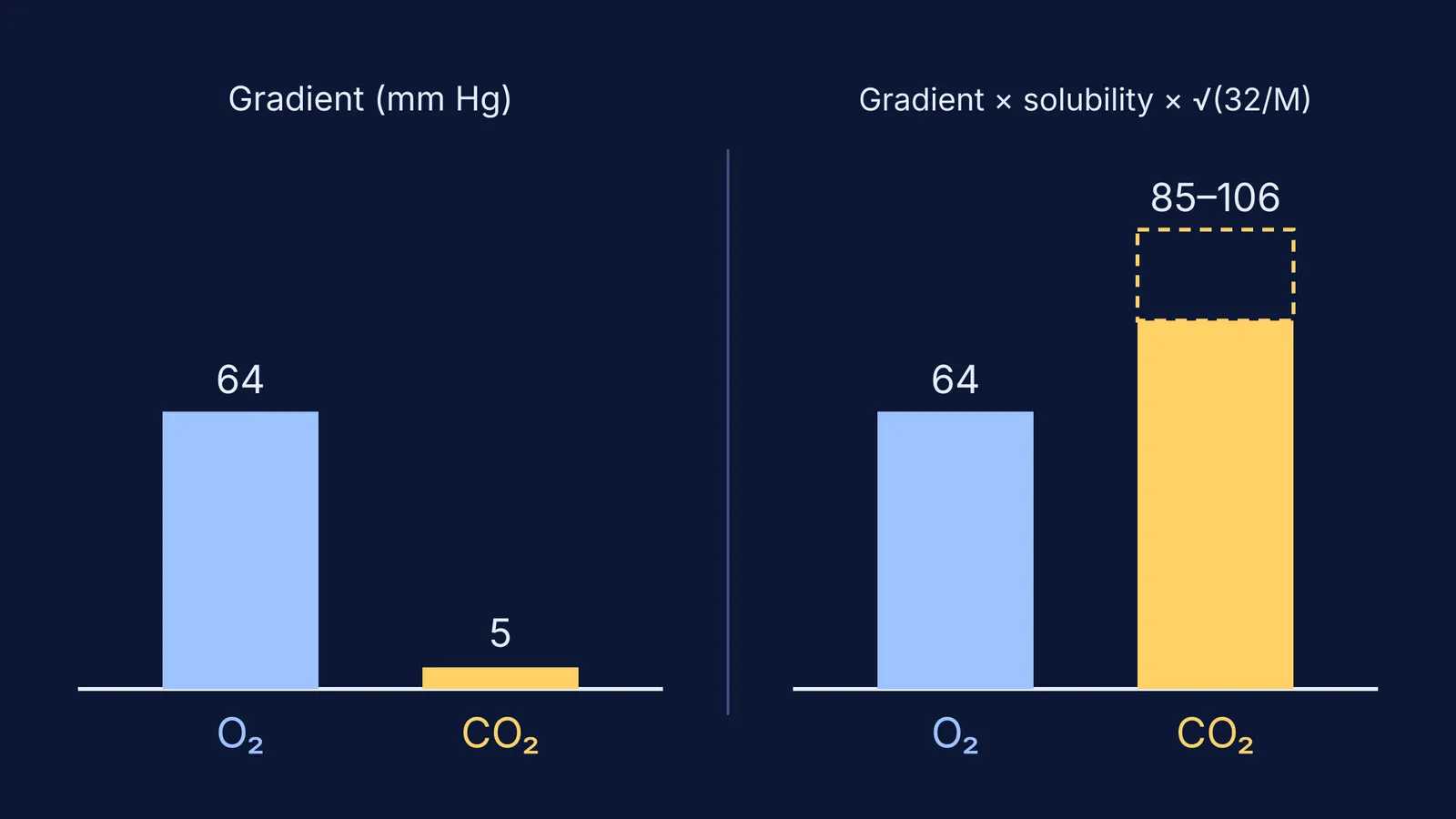
Gradient: oxygen 64 mm Hg, carbon dioxide 5 mm Hg. Oxygen's push is about 13 times larger.
Solubility, taking oxygen as 1: carbon dioxide is 20 at the low end of NCERT's range and 25 at the high end.
Molar mass: O2 is 32 g/mol and CO2 is 44 g/mol. By Graham's law the heavier gas is slowed by a factor of the square root of 32/44, which is 0.85.
Multiply for oxygen: 64 × 1 × 1 = 64 units.
Multiply for carbon dioxide: 5 × 20 × 0.85 = 85 units, or 5 × 25 × 0.85 = 106 units at the top of the range.
For the same pressure difference, 20 × 0.85 gives 17 and 25 × 0.85 gives about 21. That matches the usual statement that carbon dioxide diffuses about 20 times faster than oxygen (Respiratory Therapy Zone).
So a gradient about 13 times smaller is more than made up for. With these starting numbers, carbon dioxide's driving term ends up in the same range as oxygen's, which fits the OpenStax statement that the relative concentrations of the two gases diffusing across the membrane are similar (OpenStax, section 22.4).
Two limits to keep in mind. These are relative units for comparison, not millilitres per minute. And the gradients are the ones at the start of the capillary; both shrink as blood picks up oxygen and gives up carbon dioxide.
How should you write this in an exam answer?
A clear three-sentence answer, built on the NCERT wording (Chapter 14), looks like this:
The partial pressure gradient for CO2 (45 to 40 mm Hg) is much smaller than for O2 (104 to 40 mm Hg).
However, the solubility of CO2 is 20 to 25 times higher than that of O2.
So the amount of CO2 that can diffuse per unit difference in partial pressure is much higher, and CO2 crosses the membrane readily despite the small gradient.
Three mistakes to avoid:
Saying CO2 is lighter. It is heavier (44 against 32 g/mol); molar mass works slightly against it.
Saying CO2 has the bigger gradient. It has the smaller one.
Mixing up the direction. Oxygen moves from alveoli to blood; carbon dioxide moves from blood to alveoli.
If the multiplication step is where you lose the thread, the Fermi Problem Library has worked problems with a step-by-step solver that explains the reasoning rather than printing an answer. If the gap is Henry's law or partial pressure itself, the Fermi Concept Library gives each concept in physics, chemistry and biology its own lesson.
Next time you see the 5 mm Hg gradient, ask what it gets multiplied by.