

On this page
Your lungs contain millions of tiny air sacs called alveoli. When you inhale, oxygen fills these sacs and must cross into your bloodstream, while carbon dioxide must exit the blood to be exhaled. The structure that separates the air from the blood is called the diffusion membrane (or the respiratory membrane).
Because diffusion relies on gases moving naturally from an area of high pressure to low pressure, the distance they travel dictates how fast the exchange happens. To keep you alive, this barrier has to be incredibly thin.
What are the layers of diffusion membrane in alveoli?
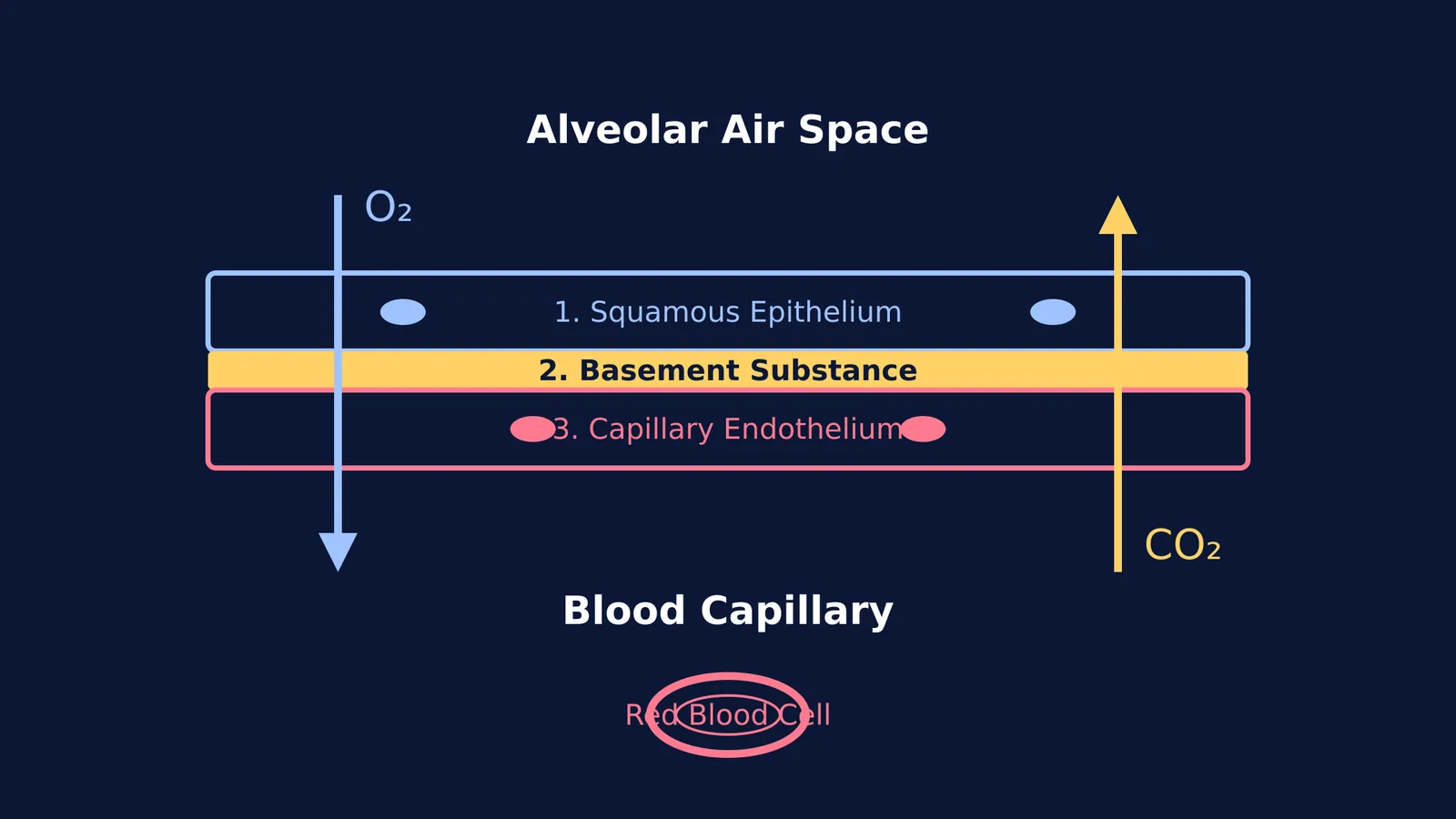
If you zoom in on the wall of an alveolus and the blood capillary wrapped around it, you will see that gases do not cross an empty space. They pass through a specific cellular sequence.
According to the NCERT biology syllabus, the diffusion membrane is made up of three major layers:
Thin squamous epithelium of alveoli: This is the innermost lining of the air sac. It is made of a single layer of extremely thin, flat cells that offer minimal resistance to gas flow.
Endothelium of alveolar capillaries: This is the single layer of cells that forms the wall of the blood vessel holding the red blood cells.
Basement substance: Located between the first two layers, this supporting matrix holds the epithelial and endothelial cells together. It consists of the basement membranes from both cell layers, effectively fused into one continuous substance. This thin non-cellular layer provides structural integrity without adding unnecessary distance for the gases to travel, maintaining the lung's delicate architecture.
Oxygen from the alveolar air crosses the squamous epithelium, the basement substance, and the endothelium to enter the blood. Carbon dioxide travels the exact reverse path.
How thick is the diffusion membrane?
Despite having three distinct layers, the diffusion membrane is "much less than a millimetre" thick, as stated in NCERT textbooks. This incredibly thin profile is what makes the lungs so efficient at oxygenating the blood continuously.
In physiological terms, the thin portion of the human air-blood barrier is less than 0.5 micrometres (µm) thick. To put that in perspective, a single millimetre is 1000 micrometres, meaning this barrier is a tiny fraction of a hair's breadth. The membrane's microscopic size allows oxygen to fully saturate a red blood cell in just a fraction of a second as it speeds through the pulmonary capillary network. The vast surface area of all these alveoli combined ensures that your body meets its oxygen demands even during intense exercise.
The rate of diffusion is inversely proportional to the thickness of the membrane. This relationship means that even a minor increase in the barrier's width can severely impair breathing.
When diseases like pneumonia or pulmonary fibrosis cause fluid buildup or scarring, this membrane thickens. If the distance increases, gas diffusion slows down drastically, leading to respiratory distress.
Visualising human physiology
Memorising biological layers from text alone can be difficult. The Fermi Concept Library contains every concept in physics, chemistry, biology, mathematics and computing, each with its own lesson and its place in the map. If you are struggling to picture how the alveoli connect to the capillary network, stepping back to view the whole map helps anchor the details.
Checklist: Solving exam questions on the diffusion membrane?
Questions on this topic are frequent in competitive exams like NEET. Use this checklist to avoid common traps:
Count the layers: The standard answer for the number of major layers is *three*. Do not count the alveolar cavity (the empty space) or the red blood cell as part of the membrane itself. Some questions might try to trick you by including the surfactant fluid layer or the capillary plasma, but strictly functionally for textbook purposes, the barrier itself comprises three main structural layers.
Identify the specific tissues: Remember that the alveolus is lined by *squamous* epithelium, while the blood vessel is lined by *endothelium*. Examiners often swap these terms to test your precision.
Factor in solubility: While the membrane's thickness is a physical constraint, carbon dioxide is about 20 to 25 times more soluble than oxygen, allowing a much higher amount to diffuse per unit difference in pressure. Exam questions frequently test this specific detail.
Check the thickness units: If a question asks for the thickness, look for options describing it as a fraction of a millimetre (e.g., "less than a millimetre" or "< 1 mm"). Be wary of options that use whole millimetres or centimetres.
By mastering the anatomy of this barrier, you build a solid foundation for understanding related topics, such as the formed elements of blood: RBCs, WBC types and platelets for NEET that carry these gases, or how respiration as an amphibolic pathway uses the oxygen you breathe in.


