On this page
A clownfish does not settle its sex the way you do. It starts adult life as a male, and whether it ever becomes female depends on where it stands in a small queue inside a sea anemone. Biologists call this sequential hermaphroditism: one individual works as one sex first and the other sex later. Clownfish go male first, which is called protandry. The reverse, female first, is called protogyny.
For a wider tour of animals that carry both sexes, see our post on hermaphrodite animals such as sponges and tapeworms.
How do clownfish change sex from male to female?
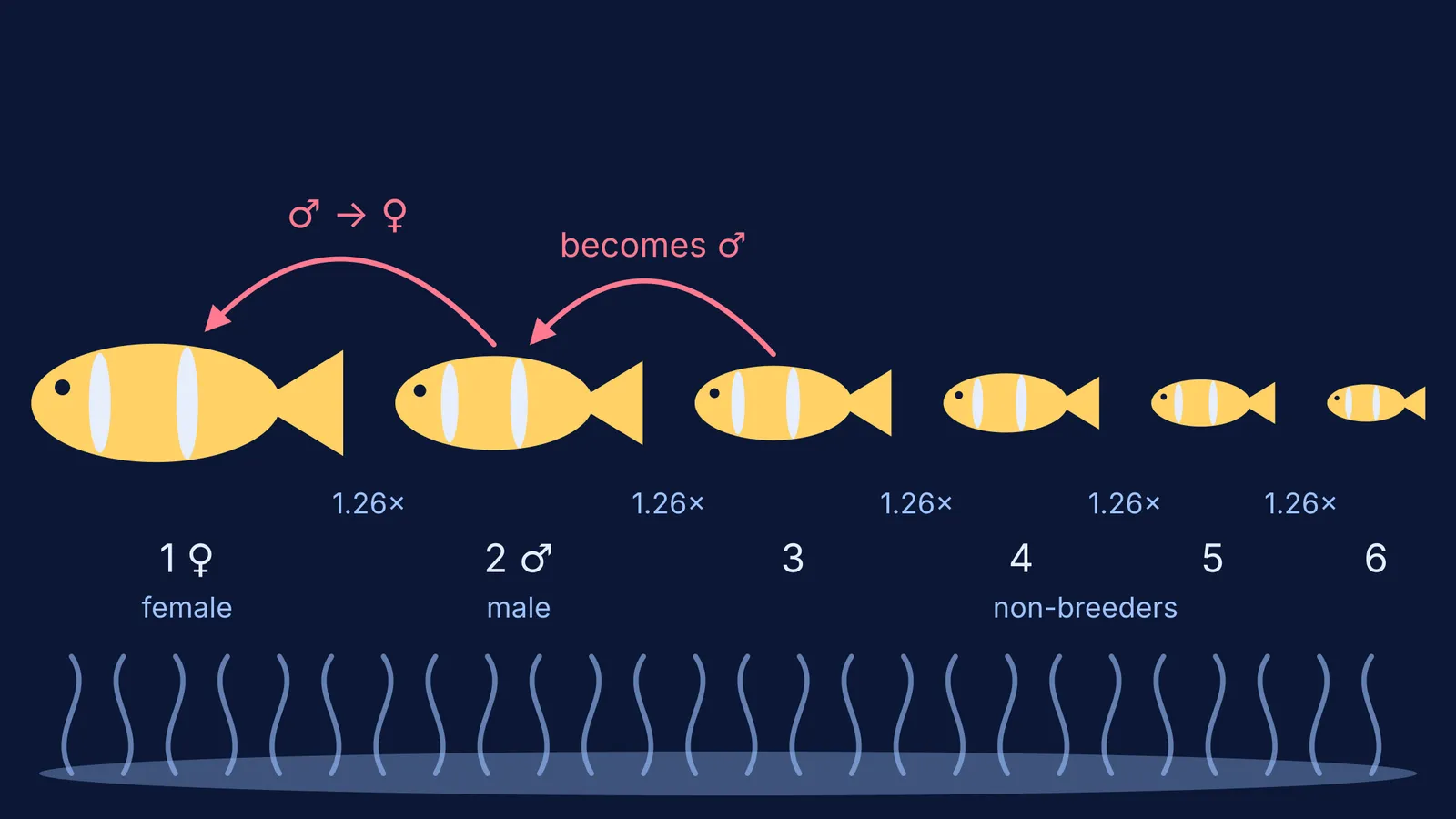
The trigger is social, not age. In the clown anemonefish *Amphiprion percula*, studied in Madang Lagoon, Papua New Guinea, each anemone holds one group: a breeding pair plus zero to four non-breeders (Buston and Cant, Oecologia, 2006). The female is the largest fish (rank 1), the male is second (rank 2), and the non-breeders get smaller down to rank 6, according to the same study.
Each fish ends up about 1.26 times the size of the fish ranked just below it (Buston and Cant, 2006).
That size gap is a queue. Subordinate clownfish slow their growth to stay small and keep their place (Reed et al., Biology Letters, 2019). If the female dies, the male changes sex and takes her position, and the largest non-breeder moves up to become the breeding male, the same paper explains.
Which hormones switch a clownfish from male to female?
Two sex steroids carry most of the story. In protandrous anemonefish, functional males have high 11-ketotestosterone (11-KT) and low oestradiol (E2), while functional females have low 11-KT and high E2 (Nakamura et al., Zoological Letters, 2015).
Aromatase is the enzyme that makes oestradiol, so it sits at the switch. In that study, five functional females of *Amphiprion clarkii* were fed an aromatase inhibitor for 80 days. Their E2 fell, their 11-KT rose, and three of the five grew sperm-making cells inside their ovaries. Blocking oestrogen pushed females part of the way back towards male.
In the wild, the change starts in the head. Researchers tagged 16 clownfish families of the Red Sea species *Amphiprion bicinctus* on the reef and removed the female (Casas et al., Scientific Reports, 2016). The male's brain showed a gene-activity response two weeks later, and clear changes in the gonads followed after three to four weeks. Aromatase genes were central in both the brain and the gonads, and their activity rose as fish moved towards female.
Does the brain change before the body?
Yes, and sometimes by a long way. A lab team paired male *Amphiprion ocellaris* together so one would turn female, then sampled them at 3 weeks, 6 months, 1 year and 3 years (Dodd et al., Hormones and Behavior, 2019). The preoptic area, a brain region that controls reproduction, reached female-like cell numbers within several months to a year. The gonads and blood hormone levels changed later, on a variable timescale of up to years.
In the University of Illinois release on the study, the team reported that only 3 of the 17 dominant fish went all the way to reproductive females, with viable eggs, within three years. Justin Rhodes, the psychology professor who led the research, said: "It's a very clear demonstration that brain sex and gonadal sex can be uncoupled."
The wild Red Sea fish moved faster than the lab fish. Species, setting and the cues around the fish all differ, so treat "weeks" and "years" as findings from specific studies, not one fixed clock.
Worked example: one anemone loses its female
Use the 1.26 ratio from the Oecologia study. Suppose the female is 10 cm long. Divide by 1.26 for each step down.
Before: female 10 cm, male about 7.9 cm, first non-breeder about 6.3 cm, second about 5.0 cm.
The female dies. The 7.9 cm male is now the top fish.
His brain shifts first: aromatase gene activity rises and the balance tips from 11-KT towards oestradiol.
His testes turn into ovaries over weeks to years.
The 6.3 cm non-breeder becomes the breeding male. Notice that 7.9 divided by 6.3 is still about 1.26, so the queue already fits its new ranks.
How do you write this in an exam answer?
A strong short answer covers five points:
Name: sequential hermaphroditism, protandrous (male first).
Trigger: loss of the dominant female, a social cue rather than age.
Hormones: 11-KT high in males, oestradiol high in females.
Enzyme: aromatase, which makes oestradiol, rises during the change.
Order: brain first, gonads later.
Contrast it with humans, where chromosomes fix sex at fertilisation; our guide to XO, XY and ZW sex determination lays out those systems. To revise what androgens and oestrogens do in your own body, read the functions of androgens, oestrogens and progesterone.
If terms like steroid, enzyme and gonad still blur together, the Fermi Concept Library gives every biology concept its own lesson and its place in the map, so you can see how hormones connect to the glands you study in Class 11.
Next time you see a clownfish, check which one is biggest. That is the female, and the one just behind her is next in line.