

On this page
When studying human biology, it is tempting to label androgens as the male hormones and oestrogens and progesterone as the female ones. In reality, all three operate in everyone. They belong to a closely related family of steroid hormones that shape sexual development, drive the reproductive cycle and govern long-term health. The differences between sexes come down to the amounts produced and the tissues that respond to them.
What do androgens do?
Androgens, primarily testosterone and dihydrotestosterone (DHT), are the main drivers of male development. Before birth, they signal the embryo to develop male primary sex organs. During puberty, they trigger the secondary sexual characteristics: a deeper voice, facial and body hair, and increased muscle mass and bone density.
In men, androgens are produced mainly in the testes and are essential for spermatogenesis, the process of making sperm. But they are not exclusive to men. In women, the ovaries and adrenal glands produce smaller amounts of androgens. They help maintain bone density and muscle mass, and crucially, they serve as the chemical starting material for making oestrogen. Both sexes experience a gradual drop in these hormones over time. A major study by the Baltimore Longitudinal Study of Aging found that free testosterone levels in healthy men decline by about 1.2% per year.
What are the functions of oestrogens?
Oestrogens, such as oestradiol, are the primary regulators of the female reproductive system. They coordinate the menstrual cycle and stimulate the growth of the uterine lining (the endometrium) each month. During puberty, they bring about female secondary sexual characteristics, including breast development and the widening of the hips.
However, oestrogen is just as vital for men, particularly for the skeleton. A 2003 endocrinology review showed that oestrogen regulates bone resorption in men just as it does in women; men lacking oestrogen receptors develop severe osteoporosis even with normal testosterone00087-7). Because the male body does not have ovaries, it makes its own oestrogen by converting testosterone using an enzyme called aromatase. In fact, a significant portion of circulating oestradiol in normal men is derived directly from this conversion.
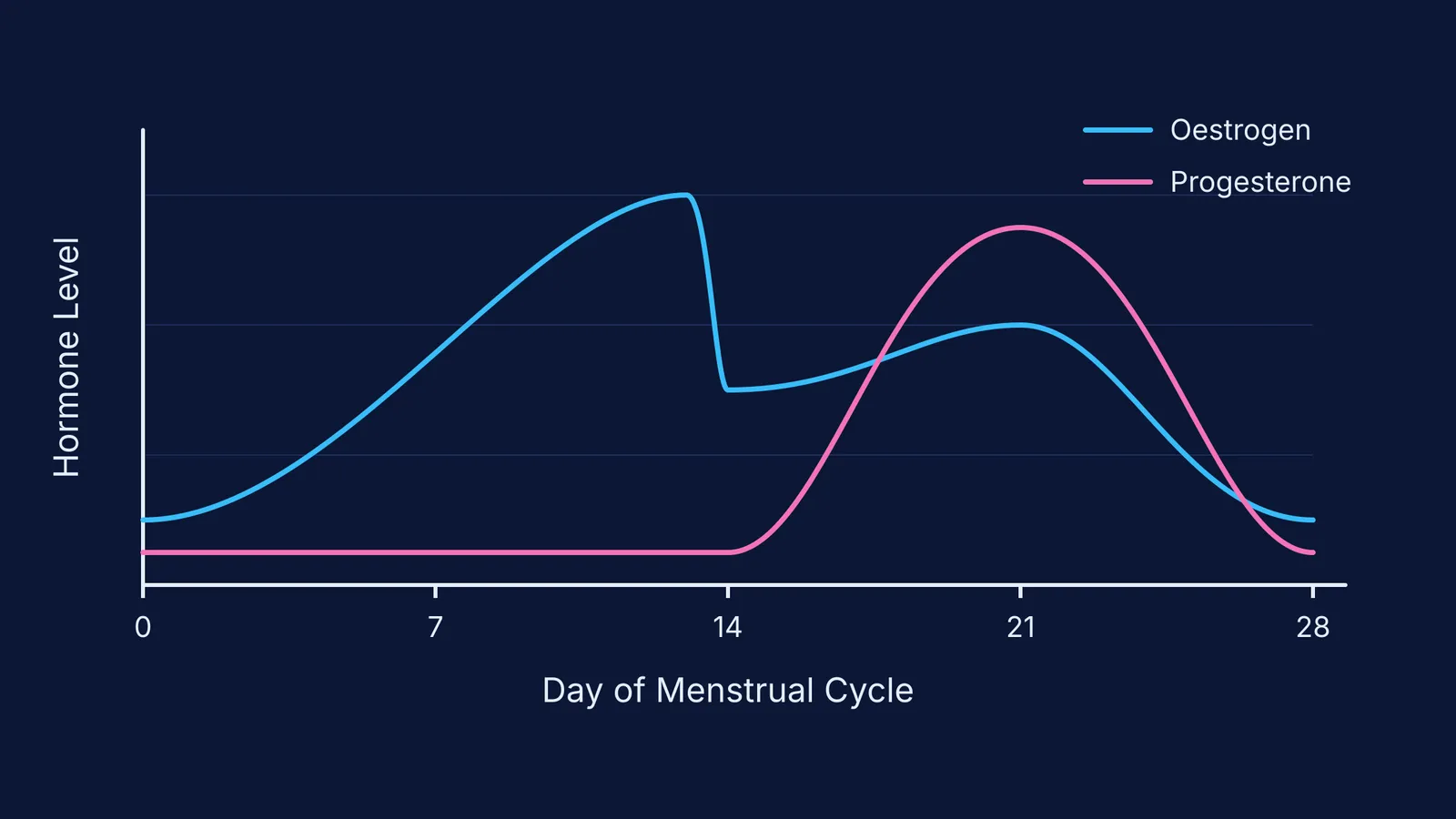
To see how these hormone levels rise and fall across 28 days, you can explore the biological pathways in the Fermi Concept Library.
What is the role of progesterone?
Progesterone is named for its primary function: promoting gestation (pregnancy). After ovulation, the ruptured follicle in the ovary becomes the corpus luteum, which pumps out progesterone. This surge halts further egg maturation and transforms the uterine lining into a rich, welcoming environment for a fertilised egg to implant. If pregnancy occurs, progesterone levels stay high through the first week of pregnancy and beyond to prevent the uterus from contracting. A 2002 biological review affirmed progesterone as essential for the recognition and maintenance of pregnancy. At the end of gestation, the balance shifts dramatically to trigger the hormones behind birth and milk production.
Beyond pregnancy, progesterone acts as a universal precursor in the steroid pathway. Your body uses it as the raw material to manufacture other vital hormones, including cortisol (for stress response), aldosterone (for blood pressure), and even testosterone.
How do these hormones interact?
The brain regulates all three hormones through a tight feedback loop. The hypothalamus releases hormones that tell the pituitary gland to signal the gonads (testes or ovaries). Because they are lipid-soluble steroid hormones, they pass directly through cell membranes to bind with intracellular receptors and change gene expression. If hormone levels in the blood rise too high, the brain senses this and dials back the signal.
Tracing these biosynthetic pathways and feedback loops is a common exam requirement. When you get stuck on a difficult question about endocrinology, the Fermi Problem Library has a step-by-step solver that explains the reasoning rather than printing an answer.
Exam checklist: Key pathways to remember
To keep the androgens, oestrogens and progesterone functions straight for exams, use this quick checklist:
Precursors: Progesterone is the upstream precursor for androgens.
Aromatisation: Testosterone converts directly into oestradiol via the aromatase enzyme.
Feedback loop: Hypothalamus (GnRH) → Pituitary (LH/FSH) → Gonads (steroids).
Receptor type: All three are steroid hormones that use intracellular, not membrane-bound, receptors.
Understanding these hormones as shared biological tools, rather than strictly male or female traits, is the key to mastering human physiology.


