On this page
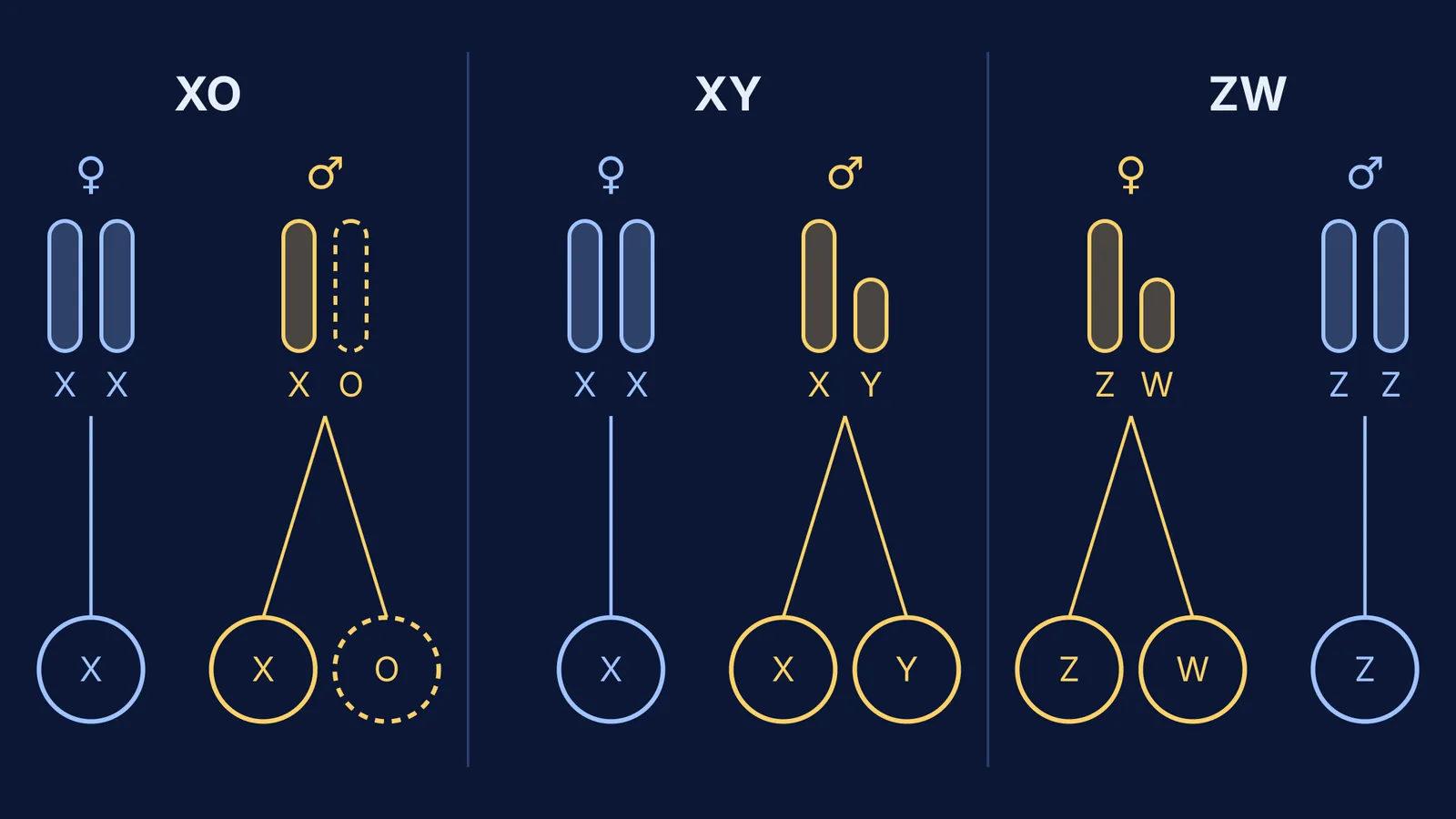
Biology textbooks teach three ways a pair of sex chromosomes can work, and exam questions love to mix them up. Grasshoppers use XO, humans use XY and birds use ZW. Once you know which parent makes two kinds of gametes, every cross in this topic turns into the same four-step job.
What are the three types of sex determination?
In 1891 the German biologist Hermann Henking marked an extra chromatin element in firebug sperm nuclei with an "x", and Clarence McClung later saw that half of grasshopper sperm carried a similar chromosome, which he called the "accessory chromosome", as The Scientist recounts. That "x" is where the name X chromosome comes from.
XO (grasshoppers): females carry two X chromosomes; males carry one X with no partner, written O. In two Schistocerca grasshopper species, males have 2n = 23 with a single X and females have 2n = 24 with XX, according to a chromosome study in Genetics and Molecular Biology.
XY (humans and most other mammals): "Females have two X chromosomes in their cells, while males have one X and one Y," says the US National Human Genome Research Institute. Humans have 23 pairs of chromosomes, 46 in total, according to the NHGRI chromosomes fact sheet.
ZW (birds): the pattern flips. Males are ZZ and females are ZW, as set out in a 2009 Nature study on chicken sex determination.
What is male and female heterogamety?
The heterogametic sex is the one whose two sex chromosomes differ, so it makes two kinds of gametes; the homogametic sex makes only one kind. The chicken study states it directly: male birds are ZZ (homogametic) and females are ZW (heterogametic), per Smith and colleagues in Nature.
Male heterogamety: XO grasshoppers and XY humans. Sperm come in two types; every egg is the same.
Female heterogamety: ZW birds. Eggs come in two types; every sperm carries a Z.
The genes doing the work differ too. In humans, a Y-chromosome gene named SRY was identified in 1990 and proposed as a candidate for the testis-determining factor by Sinclair and colleagues in Nature. In chickens, lowering the Z-linked gene DMRT1 in ZZ embryos feminised their developing gonads, which supports the idea that male birds need two doses of it (Smith and colleagues).
How do you solve a sex determination cross?
Use the same four steps for every system.
Write each parent's sex chromosomes, female first and male second.
List the gametes. The homogametic parent gives one type; the heterogametic parent gives two, in equal numbers.
Pair every egg type with every sperm type.
Read off the offspring and the ratio.
How does a grasshopper cross work out?
Take the Schistocerca numbers from the Genetics and Molecular Biology study: a female with 2n = 24, which is 22 autosomes + XX, and a male with 2n = 23, which is 22 autosomes + X.
Female gametes: all 11 + X.
Male gametes: half 11 + X, half 11 + O.
An 11 + X egg with an 11 + X sperm gives 22 + XX, a female with 24 chromosomes.
An 11 + X egg with an 11 + O sperm gives 22 + XO, a male with 23 chromosomes.
The expected ratio is 1 female to 1 male, and the sperm decides which one you get.
Run the human cross (every egg 22 + X; sperm either 22 + X or 22 + Y) and you get the same 1:1, again decided by the sperm. Run the bird cross (ZZ father, ZW mother) and the answer flips: the egg decides, because only the mother makes two kinds of gametes.
How can you check your answer quickly?
Run this checklist.
Do the letters match the organism? X with Y or O for grasshoppers and mammals, Z and W for birds.
Is the heterogametic parent the one with two gamete types?
Do the chromosome counts add up? Each gamete carries half the autosomes plus one sex chromosome, or none in an XO male's O sperm.
Is your expected ratio 1:1? For these three simple systems it should be.
Not every animal fits these three patterns. Honey bees set sex by whether an egg is fertilised, not by a pair of sex chromosomes, which we explain in how haplodiploidy works in honey bees. For the people behind the discovery, read how Nettie Stevens counted the chromosomes that set sex, then move on to solving X-linked crosses for colour blindness and haemophilia.
If a cross still trips you up, the Fermi Problem Library has worked problems with a step-by-step solver that explains the reasoning rather than printing an answer. If words like gamete or autosome are the shaky part, the Fermi Concept Library gives every biology concept its own lesson, so you can fix the gap before the next cross.