

On this page
A hermaphrodite is an organism that possesses both male and female reproductive organs. In the animal kingdom, this is a brilliant evolutionary adaptation for species that cannot easily move to find a mate, or that live in extreme isolation.
However, students often confuse the anatomical structure with the reproductive function. Having both sets of reproductive organs does not automatically mean an animal will reproduce with itself. In fact, most hermaphrodite animals go out of their way to avoid self-fertilisation to maintain genetic diversity.
Here is a look at how sponges, tapeworms, and earthworms handle being hermaphrodites, and why their reproductive strategies look so different.
What are some hermaphrodite animals examples?
The animal kingdom is full of hermaphrodites, particularly among invertebrates. The most common examples studied in high school biology are:
Sponges (Porifera): Aquatic animals that sit permanently attached to the sea floor.
Tapeworms (Platyhelminthes): Parasitic flatworms that live inside a host's digestive tract.
Earthworms (Annelida): Soil-dwelling worms that burrow through the earth.
Leeches (Annelida): Parasitic or predatory worms found mostly in freshwater.
While all these animals carry both male and female reproductive systems, they fall into two distinct behavioural camps: those that self-fertilise, and those that cross-fertilise.
Do hermaphrodite animals self-fertilise?
Sometimes, but only when they have to. Self-fertilisation—where an animal's own sperm fertilises its own eggs—is generally a last resort. Mixing DNA with another individual (cross-fertilisation) creates genetic variation, which helps populations survive diseases and changing environments.
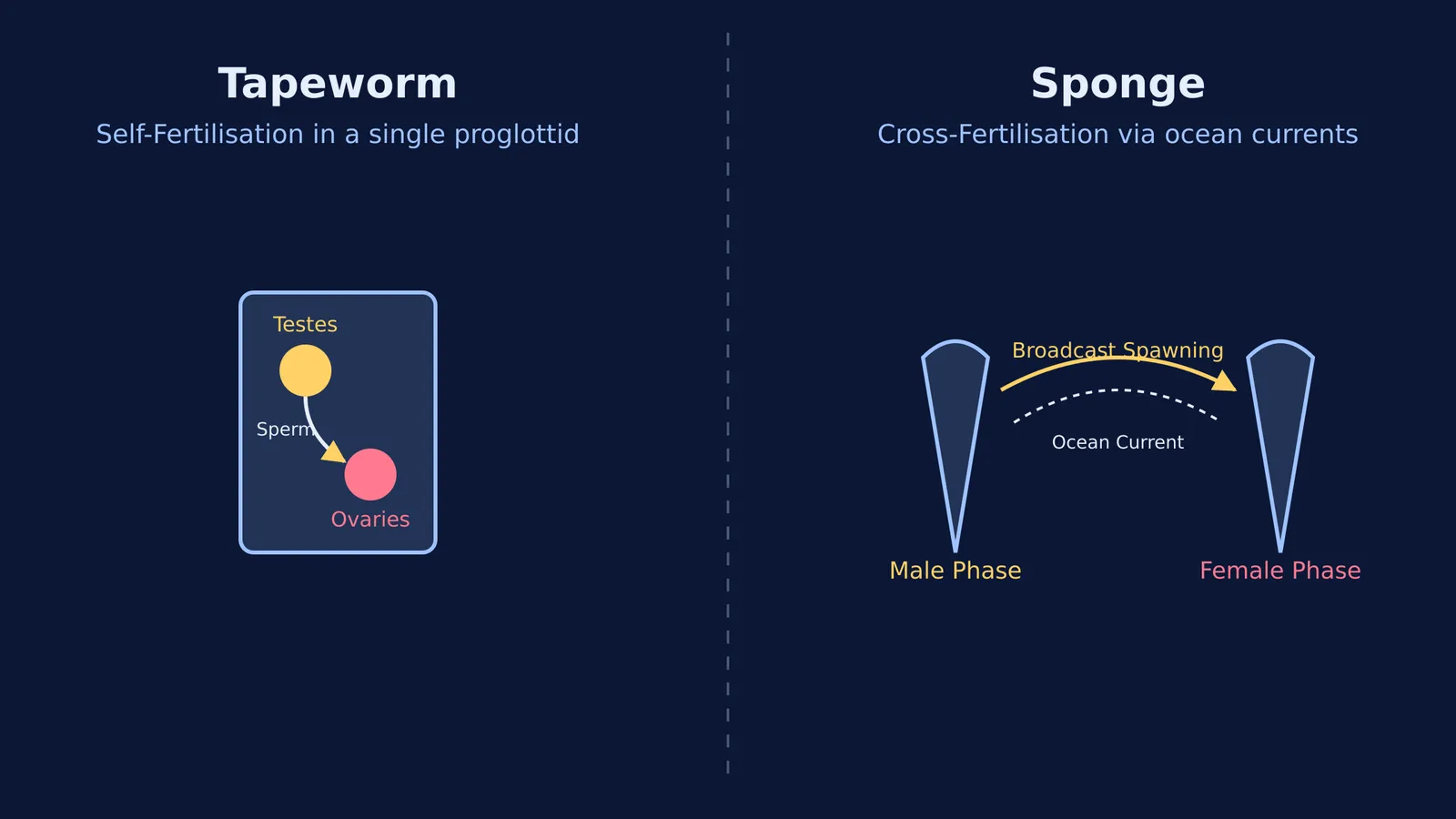
However, for a parasite like the pork tapeworm (*Taenia solium*), cross-fertilisation is rarely an option. A tapeworm typically lives completely alone inside the human small intestine. If it waited for a mate to arrive, it would never reproduce.
To solve this, the tapeworm is a simultaneous hermaphrodite that routinely self-fertilises. An adult *T. solium* is an egg factory: it has an average of 1,000 segments, called proglottids. Each of these proglottids contains both testes and ovaries. The worm simply folds its long body to allow sperm from one proglottid to fertilise the eggs in another, or it fertilises within the exact same segment. Each mature proglottid can produce around 50,000 eggs. For the tapeworm, self-fertilisation is a highly successful survival strategy in total isolation.
How do sponges avoid self-fertilisation?
Unlike the tapeworm, a sea sponge lives in the ocean surrounded by other sponges. While it cannot walk over to a mate, the moving water provides a transport system for its gametes. Most sponges are hermaphrodites, but they generally avoid self-fertilising.
They achieve this through sequential hermaphroditism. Instead of having mature sperm and eggs at the exact same time, a sponge will produce eggs in one phase and sperm in another.
When the sponge is acting as a male, it releases its sperm directly into the ocean currents—a process called broadcast spawning. The water carries the sperm away until it is filtered out of the water by a neighbouring sponge that is currently acting as a female. The receiving sponge then transports the captured sperm to its internally held eggs. By staggering the timing of their reproductive organs, sponges guarantee that they mix their genes with their neighbours.
Why do earthworms cross-fertilise if they are simultaneous hermaphrodites?
Earthworms present a fascinating middle ground. Like tapeworms, they are simultaneous hermaphrodites, possessing mature testes and ovaries at the same time. However, like sponges, they almost exclusively cross-fertilise.
Earthworms prevent self-fertilisation through a structural mismatch and a timing mechanism called protandry, where the male gametes mature slightly before the female gametes. When two earthworms meet, they align their bodies side-by-side in opposite directions. They then exchange sperm and store it in specialised sacs called spermathecae. They do not fertilise their eggs in that moment.
Days later, the earthworm secretes a mucus ring from its clitellum. As this ring slides down its body, the worm deposits its own eggs into the ring, followed by the stored sperm it received from its partner. Fertilisation finally occurs externally inside this protective cocoon.
By understanding the pressures these animals face—the tapeworm's isolation, the sponge's aquatic currents, and the earthworm's mobility in soil—you can see why they use their shared biology so differently. If you need to map out how different phyla adapt to their environments, the Fermi Concept Library has every concept in biology, each with its own lesson and its place in the map. Connecting the anatomy to the habitat makes remembering the facts much easier.
Read more about how biology classifies outliers in our guide to viruses, viroids and lichens, or see how an animal's environment shapes its biology by comparing ammonotelic, ureotelic and uricotelic animals.


