On this page
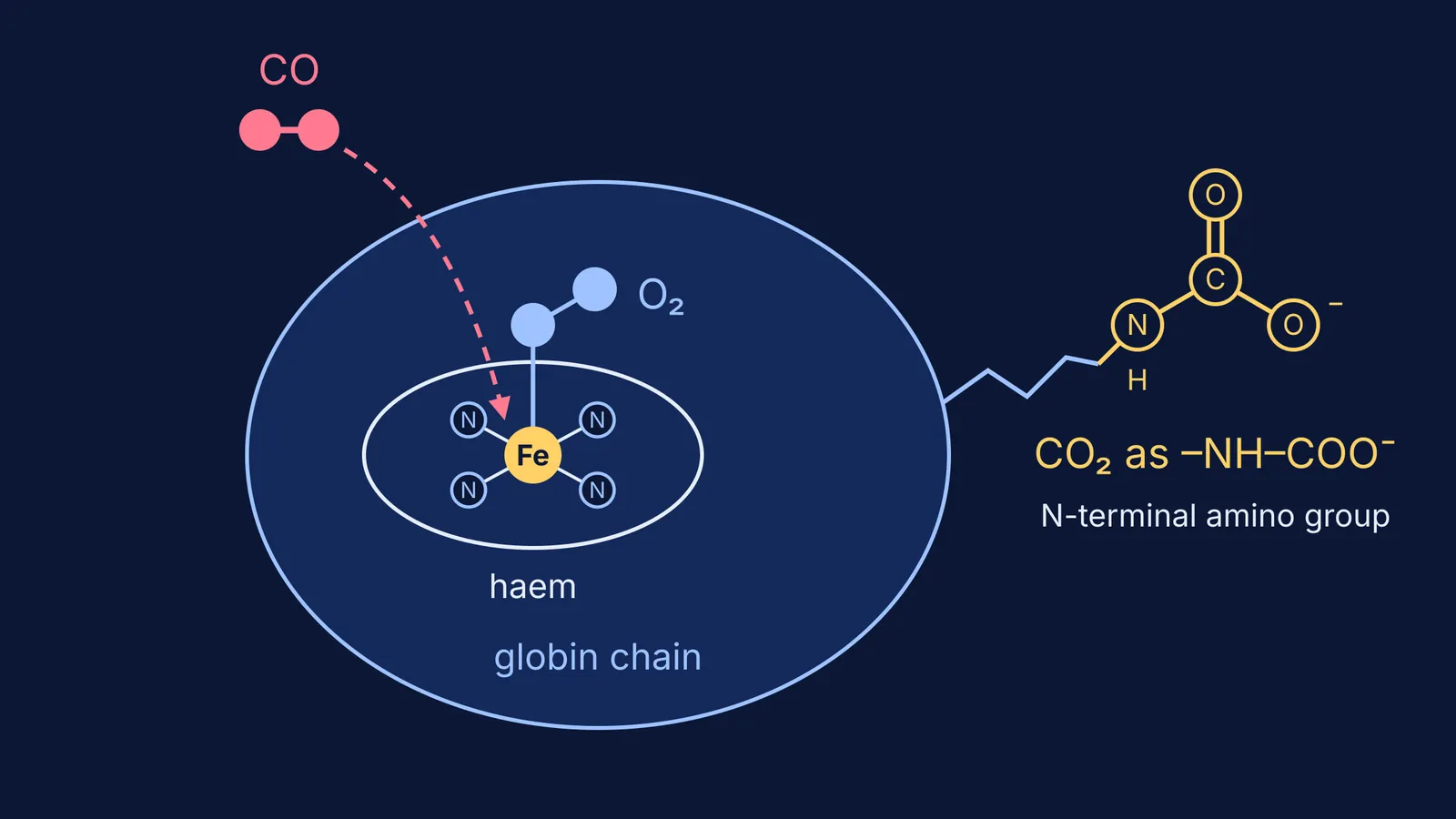
Many students picture haemoglobin as a bus with four seats, every seat on an iron atom, and every gas fighting for them. That is right for oxygen and carbon monoxide and wrong for carbon dioxide, which sits on the free amino groups at the ends of the protein chains. Exam questions are built to catch exactly that mistake.
Where does oxygen bind on haemoglobin?
According to OpenStax Anatomy and Physiology, each haemoglobin molecule contains four iron-containing haem groups, so one haemoglobin molecule can carry up to four oxygen molecules. That iron is in the ferrous (Fe2+) state, and each ferrous ion can bind either oxygen or carbon monoxide, as a 2026 PLOS One paper on carbon monoxide and haemoglobin explains.
The product is oxyhaemoglobin. The binding is reversible: haemoglobin loads oxygen in the lungs and releases it in the tissues.
Does CO2 bind the same site as oxygen?
No. OpenStax states it plainly: carbon dioxide does not bind to iron as oxygen does; it binds amino acid groups on the globin part of haemoglobin to form carbaminohaemoglobin (OpenStax Anatomy and Physiology).
The main site is the free amino group (-NH2) at the start, or N-terminal end, of each globin chain. A 2022 review in Frontiers in Molecular Biosciences by Lynsay Blake and Martin Cann describes experiments confirming carbamate formation at the N-terminal valines of all four chains of human deoxyhaemoglobin. The reaction, written simply, is Hb-NH2 + CO2 ⇌ Hb-NH-COO⁻ + H⁺.
The same review notes that this reaction stabilises the deoxygenated form of haemoglobin. That links to the Haldane effect: haemoglobin that is saturated with oxygen does not readily bind carbon dioxide (OpenStax). So in the tissues, where haemoglobin gives up oxygen, it picks up more CO2; in the lungs the reverse happens. Different seats, influencing each other. For the other half of that partnership, see our piece on the Bohr effect and how CO2 helps haemoglobin release oxygen.
Carbaminohaemoglobin is only part of the CO2 story. OpenStax Anatomy and Physiology gives about 70 percent of CO2 carried as bicarbonate, about 20 percent bound to haemoglobin and 7 to 10 percent dissolved in plasma. Textbooks differ here: OpenStax Biology 2e puts the haemoglobin-bound share at about 10 percent. Learn the figure your own syllabus textbook uses. The bicarbonate route depends on an enzyme, explained in how carbonic anhydrase helps your blood carry carbon dioxide.
Why does carbon monoxide compete with oxygen when CO2 does not?
Because carbon monoxide goes to the iron. It binds the ferrous iron of the haem, the same site oxygen uses. The affinity of carbon monoxide for haemoglobin is approximately 230 times greater than that of oxygen (Lee and Chen, PLOS One, 2026). The same paper notes that once CO binds, haemoglobin's oxygen affinity rises, which limits oxygen unloading in the tissues. Our explainer on why carbon monoxide is poisonous to haemoglobin goes further into the chemistry.
Oxygen, CO2 and CO: how do the three gases compare?
Here is the comparison in one place, using the sources above (OpenStax, Blake and Cann, Lee and Chen).
Oxygen: binds the haem iron (Fe2+); forms oxyhaemoglobin; up to four per haemoglobin; reversible.
Carbon dioxide: binds the N-terminal amino groups of the globin chains; forms carbaminohaemoglobin; favoured when haemoglobin is deoxygenated; reversible; about 20 percent of CO2 transport by the OpenStax figure.
Carbon monoxide: binds the haem iron, the same site as oxygen; forms carboxyhaemoglobin; about 230 times oxygen's affinity; occupies iron sites oxygen would use and limits oxygen unloading.
How do you answer the exam question without falling for the trap?
Try this statement-type question before reading the answer.
Which statement is correct? (a) CO2 and O2 compete for the haem iron. (b) CO2 binds amino groups of globin to form carbaminohaemoglobin. (c) CO binds the amino groups of globin. (d) CO2 binding to haemoglobin is irreversible.
Work through it with three checks:
Iron or protein? O2 and CO go to iron; CO2 goes to the protein's amino groups. That rules out (a) and (c).
Compete or cooperate? O2 and CO2 influence each other through the Haldane effect, but they do not fight for one site.
Reversible? Carbaminohaemoglobin forms in the tissues and breaks down in the lungs, so (d) is wrong.
The answer is (b). Most slips happen at check 1, so name the site for each gas before choosing.
If haem and globin still feel blurry, the Fermi Concept Library gives each biology and chemistry concept its own lesson and its place in the map. For statement questions like this one, the Fermi Problem Library has a step-by-step solver that explains the reasoning rather than printing an answer.
Next time you revise transport of gases, write the three-gas list from memory, then check it against this page.