On this page
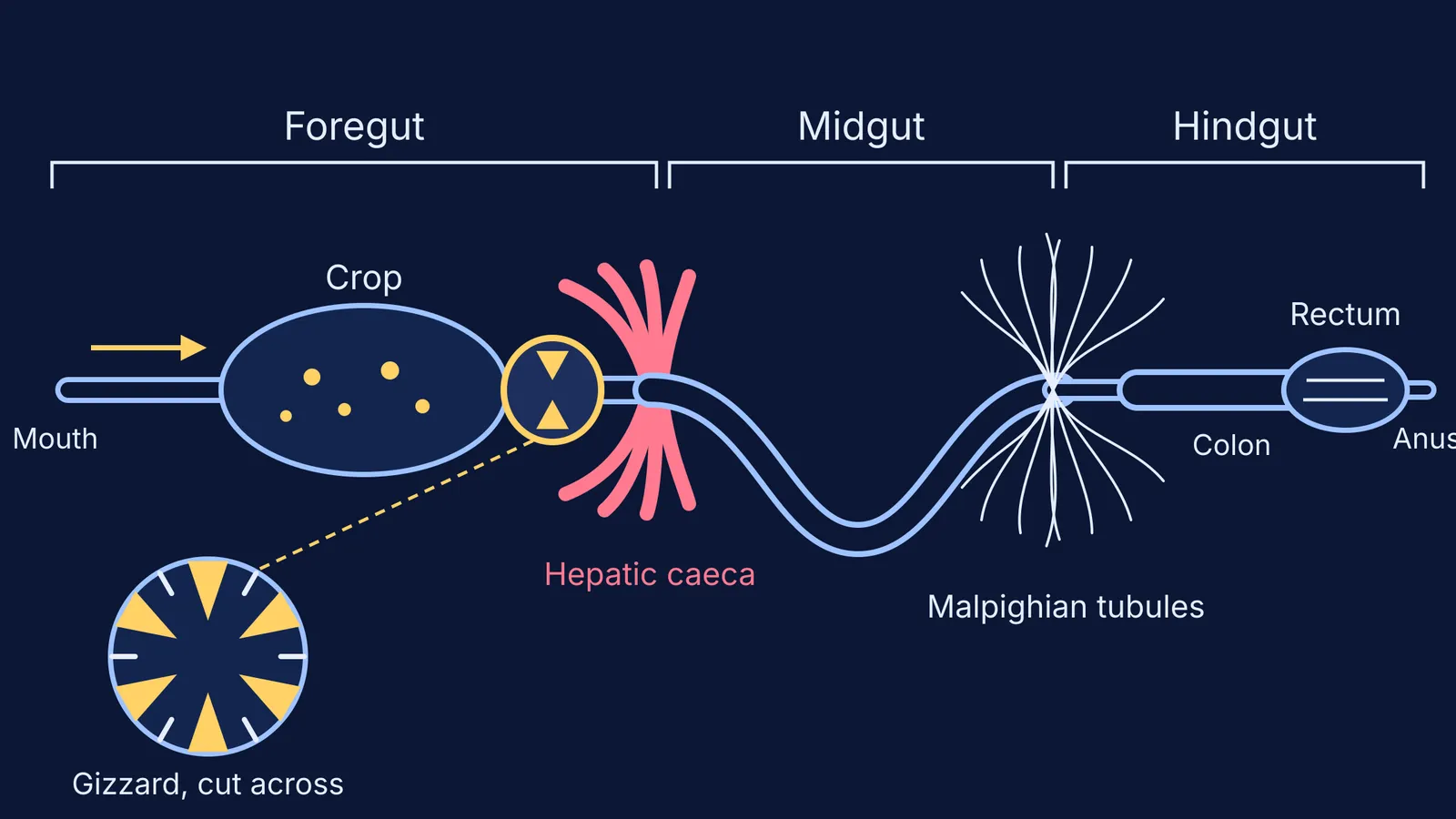
Drop a crumb of chapati on the kitchen floor at night and a cockroach will find it. Inside, the food passes along a three-stage line: the foregut stores and grinds, the midgut digests and absorbs, and the hindgut pulls water back out. Students often mix up the gizzard and the hepatic caeca, so we follow one crumb through and stop at each part.
A syllabus check first: the current NCERT Class 11 Biology chapter on structural organisation in animals (2026-27 reprint) describes only the frog, so confirm the cockroach is on your own board's syllabus before going deep.
What happens in the cockroach foregut?
The foregut runs from the mouth through the pharynx, oesophagus and crop to the proventriculus, also called the gizzard, according to the Periplaneta americana anatomy guide by Richard Fox of Lander University. In insects, the foregut and hindgut are both lined with a thin, protective layer of cuticle (NC State University, General Entomology).
Digestion starts before swallowing. Fox notes that a pair of salivary glands sits along the oesophagus and that the saliva contains amylase, the enzyme that begins breaking down starch.
The crop is a thin-walled, stretchy storage sac that, when full, can fill the body cavity of the rear thorax and front abdomen. Fox writes that almost all hydrolysis, the chemical splitting of food, happens in the crop, using salivary amylase plus enzymes from the digestive caeca that move forward from the midgut. So the crop is both a storage bag and a mixing tank.
What is the function of the gizzard in a cockroach?
The gizzard (proventriculus) grinds food: it is short, muscular and thick-walled, with heavily hardened teeth in its cuticle lining that continue the mechanical breakdown the mouthparts began (Fox, Lander University). Fox describes this "gastric mill" as sets of plates in the gizzard wall: six toothed plates, each with a large complex tooth, and six ridged plates with parallel ridges.
The gizzard is also a sieve. A further whorl of six plates supports soft cushions with fine bristles, which Fox says presumably keep large particles out of the midgut. Only well-ground food moves on.
What do the hepatic caeca do in a cockroach?
The hepatic caeca, also called gastric or digestive caeca, are finger-like blind tubes at the start of the midgut, just behind the gizzard. In the American cockroach there is a ring of eight of them (Fox, Lander University). Insects usually have from 2 to 10 (NC State).
Their job is extra surface area: the caeca add area for secreting digestive enzymes and for absorbing the small molecules that digestion produces (Fox). A 2016 study of the American cockroach midgut in PLOS ONE, by Jianhua Zhang and colleagues, notes that earlier studies proposed these enzymes are mainly secreted in the midgut or gastric caeca and carried forward to the foregut by counter-current flows and peristalsis. That is how enzymes made behind the gizzard end up working in the crop.
What happens in the midgut and hindgut?
The midgut is the main site of enzyme digestion and nutrient absorption (NC State). In the cockroach, food inside it is held within a loose, transparent peritrophic membrane (Fox).
Where the midgut meets the hindgut sit the Malpighian tubules, the excretory organs; Fox counts 60 to 150 of them in this species. To compare them with nephridia and flame cells, see excretory organs matched to each animal group.
The hindgut has three parts: ileum, colon and rectum. The rectum wall carries six rectal pads that pull water out of the forming faeces, so a cockroach short of water can make dry, hard pellets (Fox). Across insects, these rectal pads remove more than 90% of the water from a faecal pellet (NC State).
How do you write this in an exam answer?
Trace one crumb, one line per stop. The same order works for a five-mark answer or a labelled diagram:
Mouth and salivary glands: saliva with amylase starts on starch.
Crop: stores food; salivary amylase and enzymes flowing forward from the midgut do most of the chemical breakdown here.
Gizzard: toothed plates grind; bristled cushions filter out large pieces.
Hepatic caeca: a ring of blind tubes at the foregut-midgut junction that secrete enzymes and absorb.
Midgut: digestion and absorption, with food held inside the peritrophic membrane.
Hindgut: ileum, colon and rectum; rectal pads reclaim water.
Before you hand it in, check for the three classic slips:
Saying the gizzard secretes enzymes. It grinds and filters.
Putting the hepatic caeca at the midgut-hindgut junction. That ring is the Malpighian tubules.
Saying no digestion happens before the midgut. Saliva and forward-flowing enzymes work in the crop.
If the foregut, midgut and hindgut split still feels shaky, the Fermi Concept Library gives every biology concept its own lesson and its place in the map. Fermi's AI tutor can also draw the figure with you and check your understanding as you label each part.
Next, read how a cockroach lives without its head or revise the cockroach organ numbers in NCERT.