On this page
Take the head off a cockroach and the body may keep walking. A cockroach's head is not in charge of the jobs that keep it alive from minute to minute, which makes it a clear lesson in how insects breathe.
How can a cockroach live without its head?
Three features do the work. A 2007 Scientific American explainer, which interviewed physiologist Joseph Kunkel of the University of Massachusetts Amherst, sets them out:
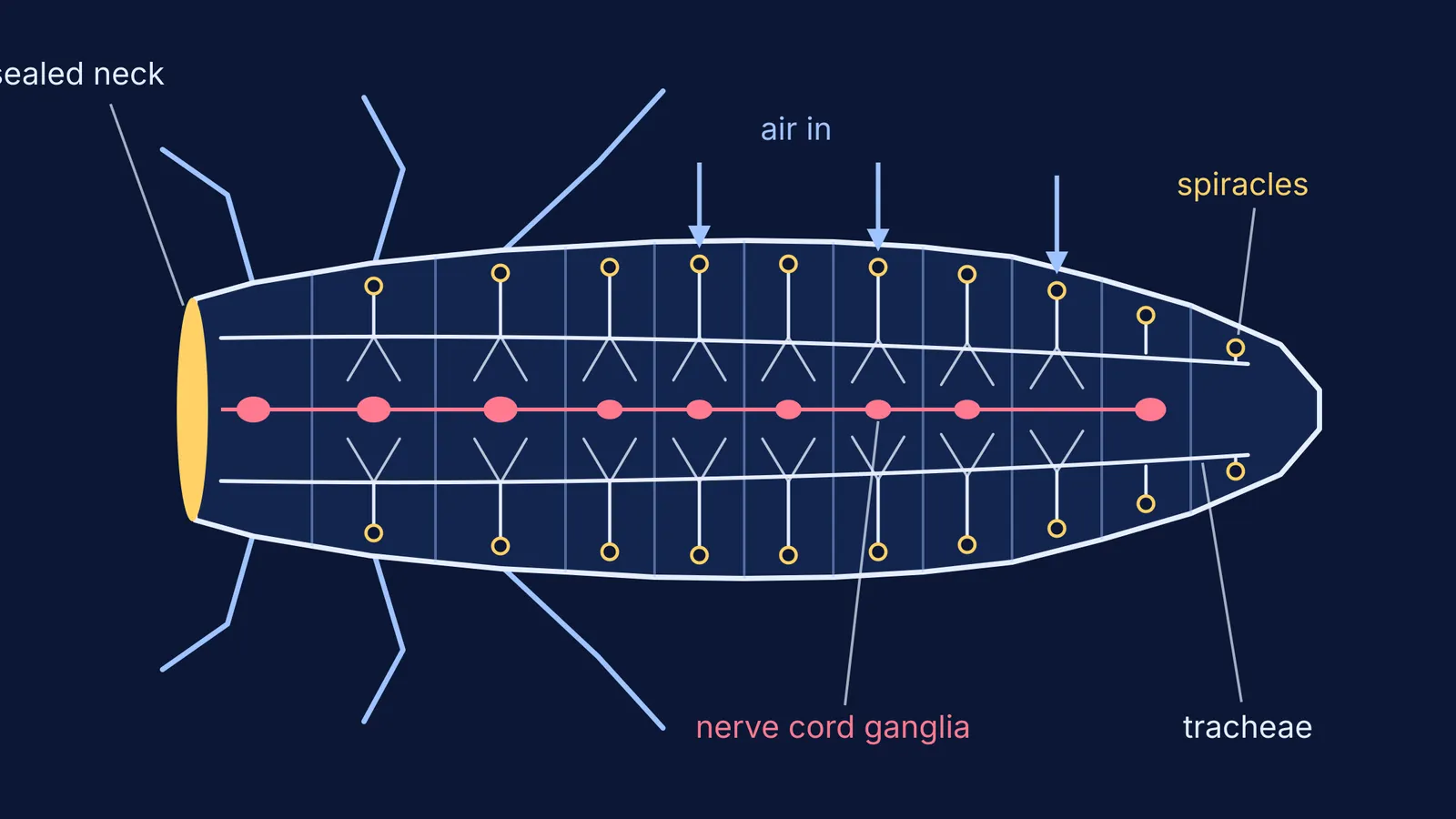
Breathing happens along the body. Cockroaches breathe through spiracles, small holes in each body segment, and the roach brain does not control this breathing.
The blood system runs at low pressure. "They have an open circulatory system, which there's much less pressure in," Kunkel told the magazine, and the cut neck often seals by clotting.
Nerve control is spread out. Insects have clusters of nerve tissue called ganglia in each body segment, so basic reflexes keep working without the brain.
The same article reports that headless roaches "are capable of living for weeks", and that entomologist Christopher Tipping, who decapitated American cockroaches and sealed the wounds with dental wax, kept a couple alive for several weeks in a jar.
Does a cockroach need its head to breathe?
No. You breathe through your nose and mouth, and your brain sets the rhythm. A cockroach has neither arrangement.
Tracheae are branching air tubes that open at the spiracles, and their finest branches, the tracheoles, bring air directly to each cell (Wikipedia's cockroach entry). In a cockroach, blood does not carry oxygen around the body (Scientific American). So cutting off the head removes the mouth and the brain, but none of the spiracles the body breathes through.
Insect breathing is not purely passive, either. Using synchrotron X-ray video of living insects, Mark Westneat and colleagues reported in Science in 2003 that beetles, crickets and ants rapidly compress and expand their tracheae in the head and thorax, a mechanism they compared to the inflation and deflation of vertebrate lungs. Our explainer on how insects breathe through spiracles, tracheae and tracheoles goes through the system step by step.
Why doesn't a headless cockroach bleed to death?
In humans, Scientific American notes, decapitation causes blood loss and a drop in blood pressure that hampers the transport of oxygen and nutrients to vital tissues. A cockroach's haemolymph is not pumped at high pressure through closed vessels, and very often the cut neck simply clots. "There's no uncontrolled bleeding," Kunkel said. For why that blood is colourless, see our explainer on insect haemolymph and the tracheal system.
What can the body do without a brain?
In a classic experiment,G. A. Horridge (Proceedings of the Royal Society B, 1962) suspended headless cockroaches and locusts so that a leg got an electric shock whenever the foot dropped below a set position. Over about half an hour the animals held the leg up for longer. After a 40 to 45 minute training period, the trained insects received fewer shocks on retesting than partners that had got the same shocks regardless of where their leg was. His conclusion: without a brain, the ventral ganglia could link a leg position with punishment.
So how long does it really last?
The honest answer is "days to weeks", with care. A headless cockroach cannot eat or drink, but "an insect can survive for weeks on a meal they had one day," Kunkel told Scientific American, because cold-blooded animals need much less food than you do. Unless a predator eats it, he said, what ends it is an infection by mould, bacteria or a virus. Treat precise popular figures with caution: Wikipedia's cockroach entry notes that popular claims about headless longevity do not appear to rest on published research.
How should you write this as an exam answer?
This is a classic "give reasons" question. The current NCERT Class 11 chapter, Structural Organisation in Animals, uses the frog as its example, so you will mostly meet the cockroach in older books and question banks. Our list of cockroach organ numbers that come up in exams helps with recall. Use this four-step frame:
State the fact: the body survives because the head does not control breathing or circulation.
Respiration: air enters spiracles on the body segments, tracheae and tracheoles deliver it straight to cells, and haemolymph carries no oxygen.
Circulation: an open, low-pressure system, so the neck usually clots and there is no uncontrolled bleeding.
Nervous control: ganglia in each segment run simple reflexes, standing and movement without the brain.
Then add the contrast: a human's brain controls breathing, and decapitation means fatal blood loss.
If open and closed circulation still blur together, the Fermi Concept Library gives every biology concept its own lesson and its place in the map. And when a branching air-tube network is hard to picture from a flat textbook drawing, the Fermi Simulation Lab has interactive simulations for ideas that are easier to see than to read.