

On this page
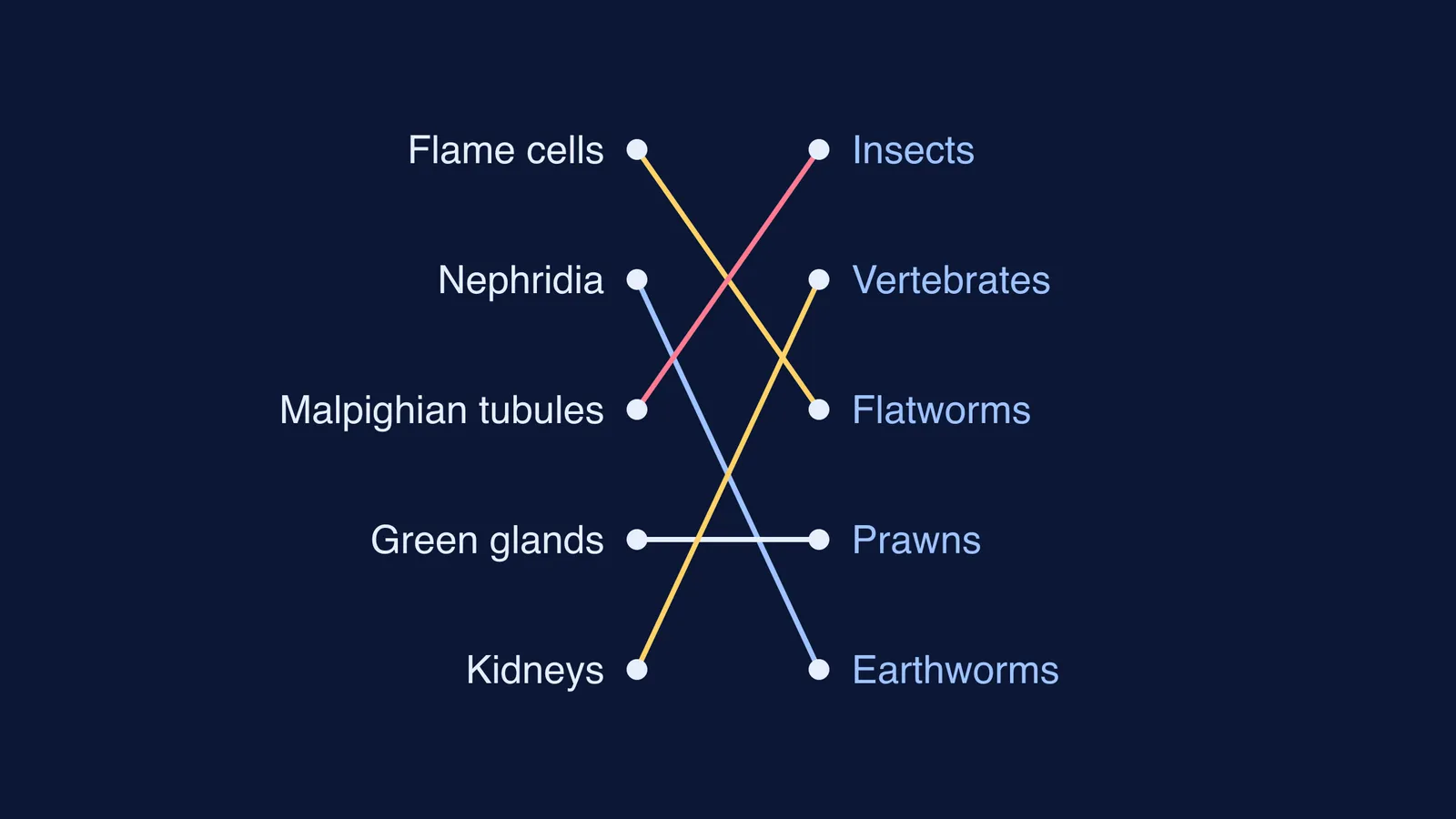
Five structures, five animal groups: that is the whole excretory-structures paragraph in NCERT Class 11 Biology, Chapter 16, and it lends itself to match-the-column questions. Examiners can test it by shuffling the columns and adding look-alike names. Here is the match, how each structure works, and a method for the question.
Which excretory structure belongs to which animal group?
NCERT's chapter Excretory Products and their Elimination says most invertebrates have simple tubular excretory structures, while vertebrates have complex tubular organs called kidneys. Here is the full match from that chapter, with the main job of each structure:
Protonephridia (flame cells): Platyhelminthes such as Planaria, rotifers, some annelids and the cephalochordate Amphioxus. Main job: osmoregulation, that is, ionic and fluid volume regulation.
Nephridia: earthworms and other annelids. Main job: removing nitrogenous wastes and keeping fluid and ionic balance.
Malpighian tubules: most insects, including cockroaches. Main job: removing nitrogenous wastes and osmoregulation.
Antennal glands, also called green glands: crustaceans such as prawns. Main job: excretion.
Kidneys: vertebrates. Each human kidney has nearly one million nephrons, its functional units.
What is the difference between flame cells, nephridia and Malpighian tubules?
All three are tubes. The difference is how fluid gets in and what happens to it on the way out. The OpenStax textbook Biology 2e, section on excretion systems describes each one.
Flame cells have a cluster of cilia that looks like a flickering flame; the cilia push waste down the tubules and out through excretory pores on the body surface.
Nephridia sit in pairs, one pair in each segment of an earthworm. They draw fluid from the coelom into the tubule, nutrients and other solutes are reabsorbed by capillaries along the way, and the rest leaves through a nephridiopore.
Malpighian tubules line the gut and are bathed in haemolymph. Pumps move ions into the tubule and water follows to form urine; when water is scarce, water and electrolytes are reabsorbed, and uric acid leaves as a thick paste or powder.
The short contrast: flame cells are driven by cilia and mainly balance water; nephridia collect coelomic fluid and reabsorb from it; Malpighian tubules make urine by secretion rather than filtration and work alongside the gut instead of opening straight to the outside. If the cockroach counts also trip you up, see our list of cockroach organ numbers in NCERT, including Malpighian tubules.
How do green glands and kidneys work?
The antennal gland is one of a pair of ducts in a crustacean that opens at the base of the second antenna and works as an osmoregulatory organ, according to the A Dictionary of Biology entry on Encyclopedia.com. Inside, an end sac works like a vertebrate glomerular nephron, a coiled labyrinth moves ions and reabsorbs proteins, and a bladder stores urine, as the Wikipedia article on coxal and antennal glands summarises.
The kidney takes the same logic further: filter first, then adjust the filtrate in a long tubule. In NCERT's description, each nephron has a glomerulus and a renal tubule that begins as Bowman's capsule. Our guide to the functions of the PCT and DCT in the nephron follows that tubule section by section.
How do NEET-UG match-the-column questions test this?
A typical version pairs Column I (structure) with Column II (animal), and some add a third column for the nitrogenous waste. NCERT ties waste to habitat: many bony fishes, aquatic amphibians and aquatic insects are ammonotelic; mammals, many terrestrial amphibians and marine fishes are ureotelic; reptiles, birds, land snails and insects are uricotelic (NCERT Chapter 16). Why marine and freshwater fish handle salt and water so differently is explained in osmoregulation in freshwater vs marine fish.
Worked example
Column I: (A) Flame cells, (B) Nephridia, (C) Malpighian tubules, (D) Green glands. Column II: (i) Prawn, (ii) Cockroach, (iii) Planaria, (iv) Earthworm.
Lock the most distinctive pair first. Green glands go only with crustaceans, so D matches (i).
Next, the insect: C matches (ii). Insects are uricotelic, which helps if a waste column appears.
Then the two worms. Planaria is a flatworm, so A matches (iii); the earthworm is an annelid, so B matches (iv).
Scan the options for A-iii, B-iv, C-ii, D-i. If two options share your first two locks, compare only the remaining pairs.
Traps to check before you mark
Flame cells are not only in flatworms: NCERT also lists rotifers, some annelids and Amphioxus, so an option pairing flame cells with Amphioxus is correct.
Nephridia (earthworm) and nephron (vertebrate kidney) look alike on a fast read.
Insects as a group are uricotelic, but NCERT lists aquatic insects as ammonotelic.
Antennal gland and green gland are two names for the same organ.
If a match question exposes a gap, such as where Amphioxus sits among chordates, the Fermi Concept Library has every concept in biology with its own lesson and its place in the map.
Tonight, write the five-line match from memory, then check it against page 206 of the NCERT chapter.


