On this page
A goldfish and a tuna have the same problem from opposite ends. Both keep their blood at roughly the same saltiness, but one lives in water with almost no salt and the other in water much saltier than its blood. Osmoregulation is how each fish stops itself from swelling up or drying out, a classic comparison in school biology and NEET-UG.
What is osmoregulation in fish?
Osmoregulation is keeping the water and salt content of the body steady when the surroundings are different. Water always moves by osmosis from the side with fewer dissolved particles to the side with more; if that idea is shaky, read our explainer on osmosis vs diffusion first.
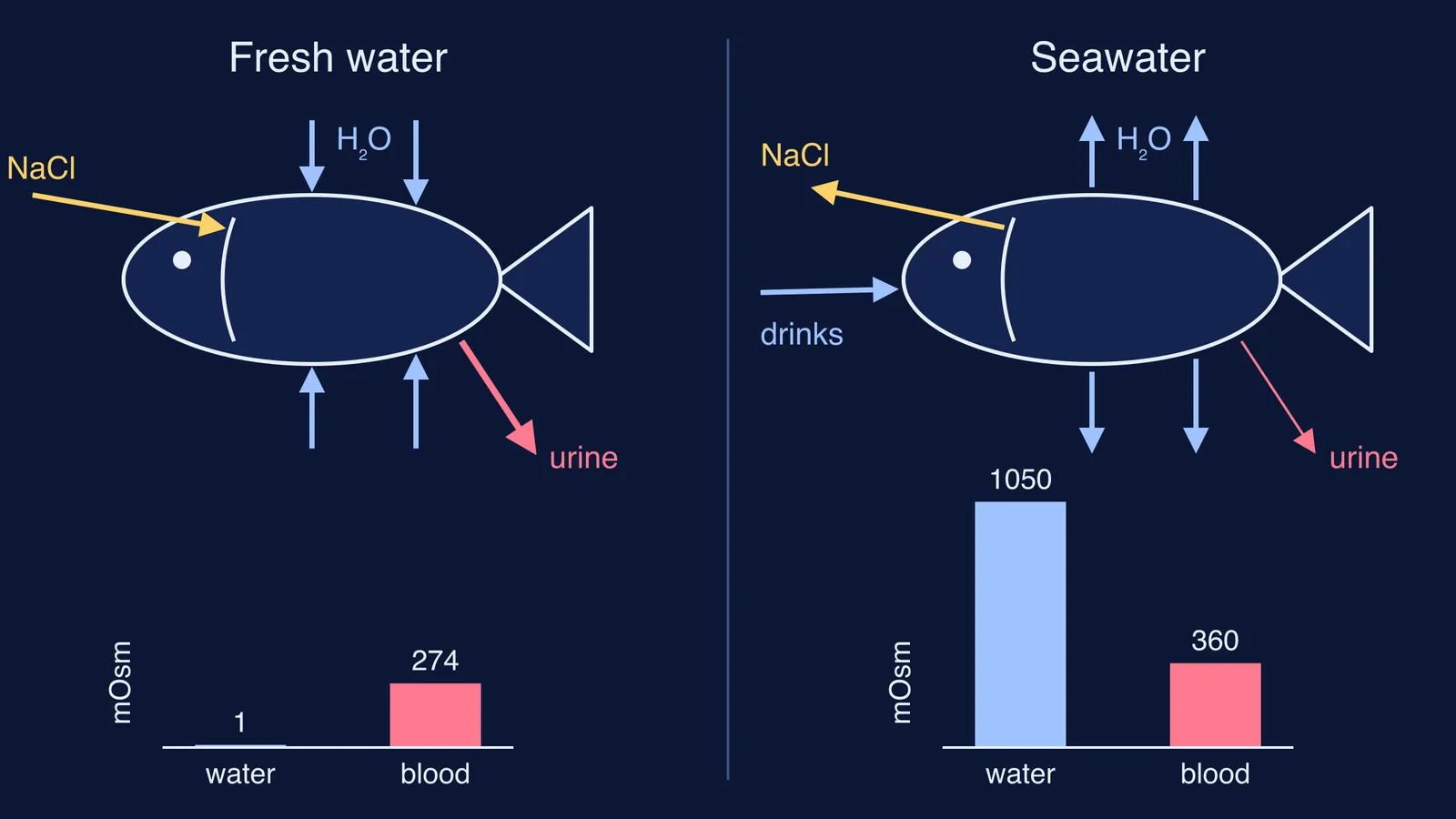
The numbers make the problem clear. In a 2021 review in Frontiers in Physiology, Takvam, Wood, Kryvi and Nilsen list typical values: fresh water about 1 mOsm/kg and seawater about 1050 mOsm/kg, against blood plasma of 274 mOsm/L in freshwater fish and 360 mOsm/L in marine fish. A freshwater fish is therefore hyperosmotic to its surroundings and a marine fish is hyposmotic to them. As David Evans wrote in 2008, physiologists in the 1930s already knew this meant freshwater fish risk losing salt and marine fish risk dehydration.
How do freshwater fish osmoregulate?
In fresh water, the fish is the salty side, so water keeps flowing in through the gills and skin while salts leak out. The fish answers with three moves.
Gets rid of water through the kidneys. Takvam and colleagues report urine flow rates of 1–6 ml per kg of body mass per hour in fresh water, with dilute urine of 20–50 mOsm/L.
Keeps the salt it filters. A 2022 review by Kato and colleagues describes freshwater fish kidneys producing urine whose salt concentration is 1/10 to 1/20 of that of the body fluid.
Takes salt in at the gills. Freshwater fish extract NaCl from the water, as 1930s studies by August Krogh, Homer Smith and Ancel Keys showed, Evans recounts. The work happens in gill cells Keys first described, now called mitochondrion-rich cells.
Freshwater fish do not need to drink. Water is already arriving faster than they want it.
Why do marine fish drink seawater?
In the sea, the water is the salty side, so the fish loses water across its gills all the time. So it drinks the sea.
Drinks, then desalts. The 2021 review by Yoshio Takei explains that the gut first removes sodium and chloride in the oesophagus, then precipitates calcium and magnesium as carbonates, so the intestine can absorb water. About 70–85% of the swallowed seawater is absorbed.
Pushes extra salt out at the gills. Marine fish excrete the excess NaCl through gill transport, a finding that Evans also traces to those 1930s studies.
Makes very little urine. Takvam and colleagues give urine flow of 0.2–0.3 ml per kg per hour, roughly isotonic with the blood at 300–410 mOsm/L, carrying away magnesium and sulphate.
Freshwater vs marine fish: how big is the difference?
Here is a worked example using the urine flow rates from Takvam and colleagues for a 1 kg fish over one day (24 hours).
Freshwater fish: 1 to 6 ml per hour times 24 gives 24 to 144 ml of dilute urine a day.
Marine fish: 0.2 to 0.3 ml per hour times 24 gives 4.8 to 7.2 ml of urine a day.
Comparison: even the lowest freshwater figure (24 ml) is more than three times the highest marine figure (7.2 ml).
In short, the freshwater fish is bailing water out, the marine fish is saving every drop.
How do you answer this in an exam?
Use this four-step method for any "compare freshwater and marine fish" question.
Compare the concentrations. Blood at about 274 to 360 mOsm versus water at about 1 or 1050 mOsm (Takvam et al.).
Decide which way water moves. Into the freshwater fish; out of the marine fish.
Decide which way salt leaks. Out of the freshwater fish; into the marine fish.
Go organ by organ. Gills (salt in, or salt out), gut (no drinking, or drinking), kidney (lots of dilute urine, or a little isotonic urine).
Common mistakes to check for:
Writing that marine fish "avoid drinking". They drink seawater on purpose.
Writing that freshwater fish make concentrated urine. Theirs is the more dilute of the two.
Forgetting that these figures describe bony fish (teleosts), which is what the reviews above studied.
The same logic of hypotonic and hypertonic surroundings applies to single cells; our guide to isotonic, hypotonic and hypertonic solutions shows what happens to red blood cells and plant cells.
If osmosis, tonicity or the nephron still feels patchy, the Fermi Concept Library has a lesson for every concept in biology, each with its place in the map. When you want to test yourself on exam-style questions, the Fermi Problem Library has worked problems with a step-by-step solver that explains the reasoning rather than printing an answer.