

On this page
If you open a bottle of perfume, the scent eventually reaches the other side of the room. If you drop a wrinkled raisin into a glass of water, it plumps up overnight. Both are examples of particles moving to balance a concentration difference, but they rely on two distinct rules of biology and physics.
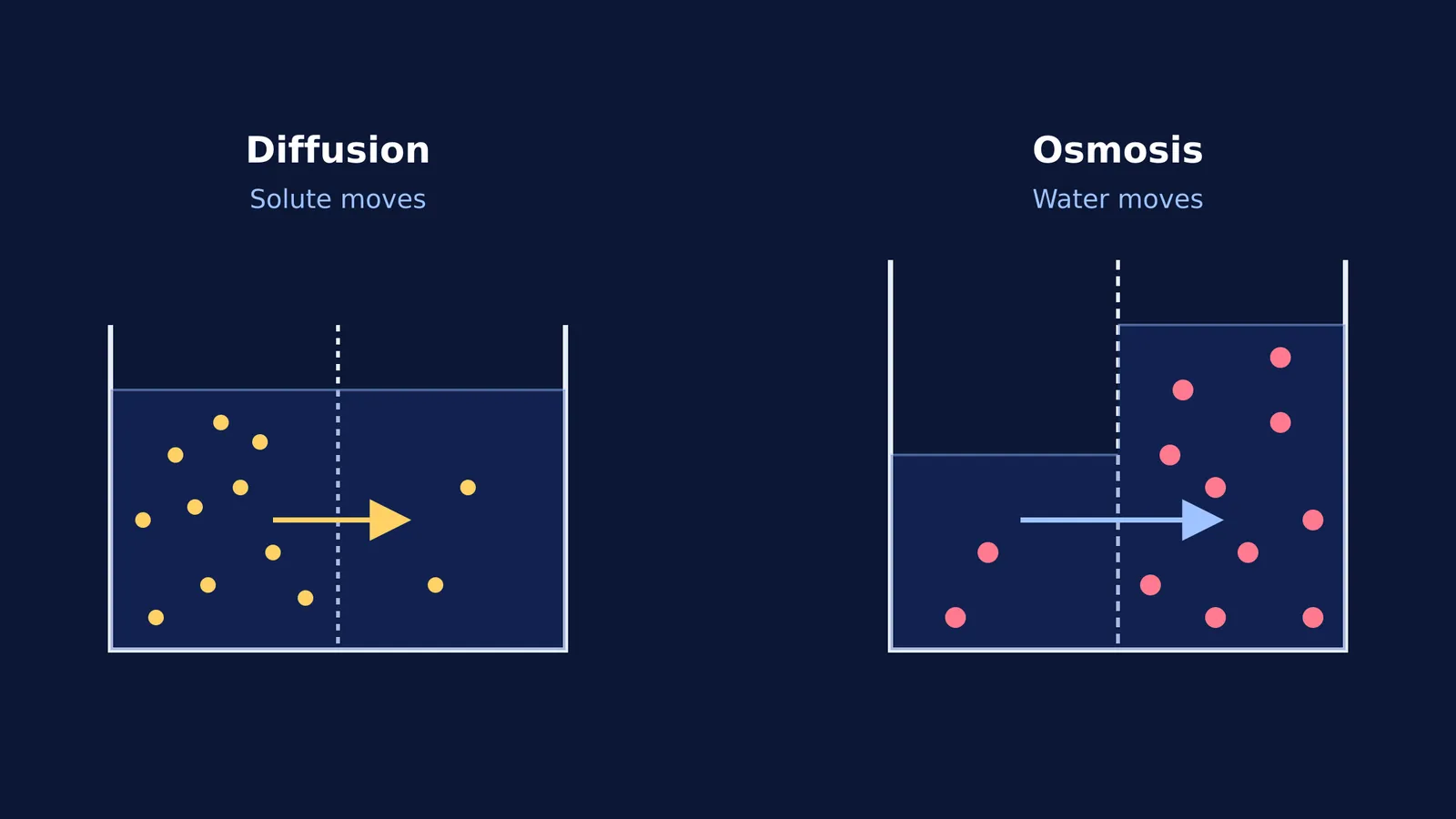
The perfume relies on diffusion: the net movement of particles from a region of higher concentration to a region of lower concentration. The raisin relies on osmosis: a specific type of diffusion where only water moves across a semipermeable membrane.
Here is how the two compare, and why the difference matters for biology.
What is diffusion?
Diffusion is the general tendency of any substance — whether a gas, a liquid, or a dissolved solid — to spread out evenly into the available space. It is driven by the random, thermal motion of molecules.
When you spray perfume, the scent molecules are highly concentrated in one spot. Over time, their constant, random collisions cause them to wander into the surrounding air where the concentration is lower (OpenStax Biology 2e).
However, "pure" diffusion is incredibly slow over macroscopic distances. Although an individual scent molecule moves extremely fast, it constantly collides with air molecules. These collisions force it into a random walk. If you relied only on pure diffusion, a scent could take hours to cross a room. Why do you smell the perfume in seconds? In reality, room air is never perfectly still. Convection currents caused by body heat, drafts, and movement sweep the scent across the room much faster than diffusion alone. However, at the microscopic level — such as oxygen entering a red blood cell — pure diffusion is highly effective.
What speeds up or slows down diffusion?
Whether it is perfume in the air or nutrients in a cell, several factors dictate how fast diffusion happens (OpenStax Biology 2e):
Concentration gradient: The greater the difference in concentration between two areas, the faster the molecules spread. As the molecules distribute and the gradient drops, the process slows down.
Mass of the molecules: Heavier molecules move more slowly than lighter ones.
Temperature: Higher temperatures increase the thermal energy of the system. Molecules vibrate and bounce faster, which speeds up diffusion.
Solvent density: As the density of a solvent increases, the diffusion rate decreases because molecules have a harder time pushing through.
What is osmosis?
Osmosis is a special case of diffusion. It is the net movement of a solvent (usually water) through a selectively permeable membrane from an area of higher water concentration to an area of lower water concentration (OpenStax Biology 2e).
Biological membranes are picky. They easily let water pass, but they block larger or charged molecules like sugars and salts. When a cell has a high concentration of dissolved sugar inside it, the water concentration inside is effectively lower than the pure water outside. Because the sugar cannot leave the cell to balance the gradient, the water must move in.
Water molecules cross these membranes at astonishing speeds. They often use specialised protein channels called aquaporins. In 2003, the Nobel Prize in Chemistry was awarded to Peter Agre for his discovery of these channels. His work showed that a single aquaporin channel can transport about 3 billion water molecules per second (Nobel Lecture, 2003).
What is the core difference between osmosis and diffusion?
To tell the two apart, look for what is moving and what is standing in the way:
What moves: In diffusion, both the solvent and the solute can move to reach equilibrium. In osmosis, only the solvent (water) moves.
The membrane: Diffusion can happen in an open room or a beaker of water. Osmosis strictly requires a selectively permeable membrane.
The goal: Diffusion spreads particles out. Osmosis dilutes a concentrated solution when the dissolved particles are trapped.
The classic example of osmosis is a raisin in water. The skin of the raisin acts as a semipermeable membrane. Inside, the raisin is packed with natural sugars and salts. When you drop it in a cup of pure water, it enters a hypotonic environment — meaning the surrounding fluid has a lower solute concentration than the inside of the raisin. Water rushes in to dilute the high sugar concentration in a process called endosmosis. The raisin's cells become turgid, and it swells up to look like a grape again. Conversely, if you placed a grape in heavily salted water (a hypertonic solution), water would leave the grape through exosmosis, causing it to shrivel.
How should you study this concept for exams?
When studying transport mechanisms for exams, do not just memorise the definitions. Draw the membrane.
Sketch a U-tube with a dashed line in the middle. Draw a few solute particles on the left and many on the right. If the membrane allows the solute to pass (diffusion), draw arrows showing the solute moving left. If the membrane blocks the solute (osmosis), draw arrows showing the water moving right, and mark the rising water level.
If you are struggling to picture the driving force behind this, the Fermi Concept Library maps out every concept in biology and physics, showing how ideas like diffusion and osmotic pressure connect. You can also explore how protons use a similar gradient to generate energy in the cell, a process known as chemiosmosis.


