

On this page
Every day, your kidneys filter around 180 litres of fluid from your blood, yet produce only about 1.5 litres of urine. The functional unit behind this massive fluid recovery is the nephron. While the glomerulus acts as the initial sieve, the real work of deciding what stays in your body and what leaves happens in the tubules.
If you are revising Urine formation step by step: filtration, reabsorption, secretion, you need to know exactly how the proximal convoluted tubule (PCT) and distal convoluted tubule (DCT) divide this labour.
What happens in the Proximal Convoluted Tubule?
Located in the renal cortex, the PCT is the first segment of the tubule and the nephron's heavy lifter. Its primary job is mass reabsorption.
Because it handles such a massive volume, the PCT is lined with simple cuboidal epithelial cells that have a dense "brush border" of microvilli. This dramatically increases the surface area available for transporting molecules back into the bloodstream.
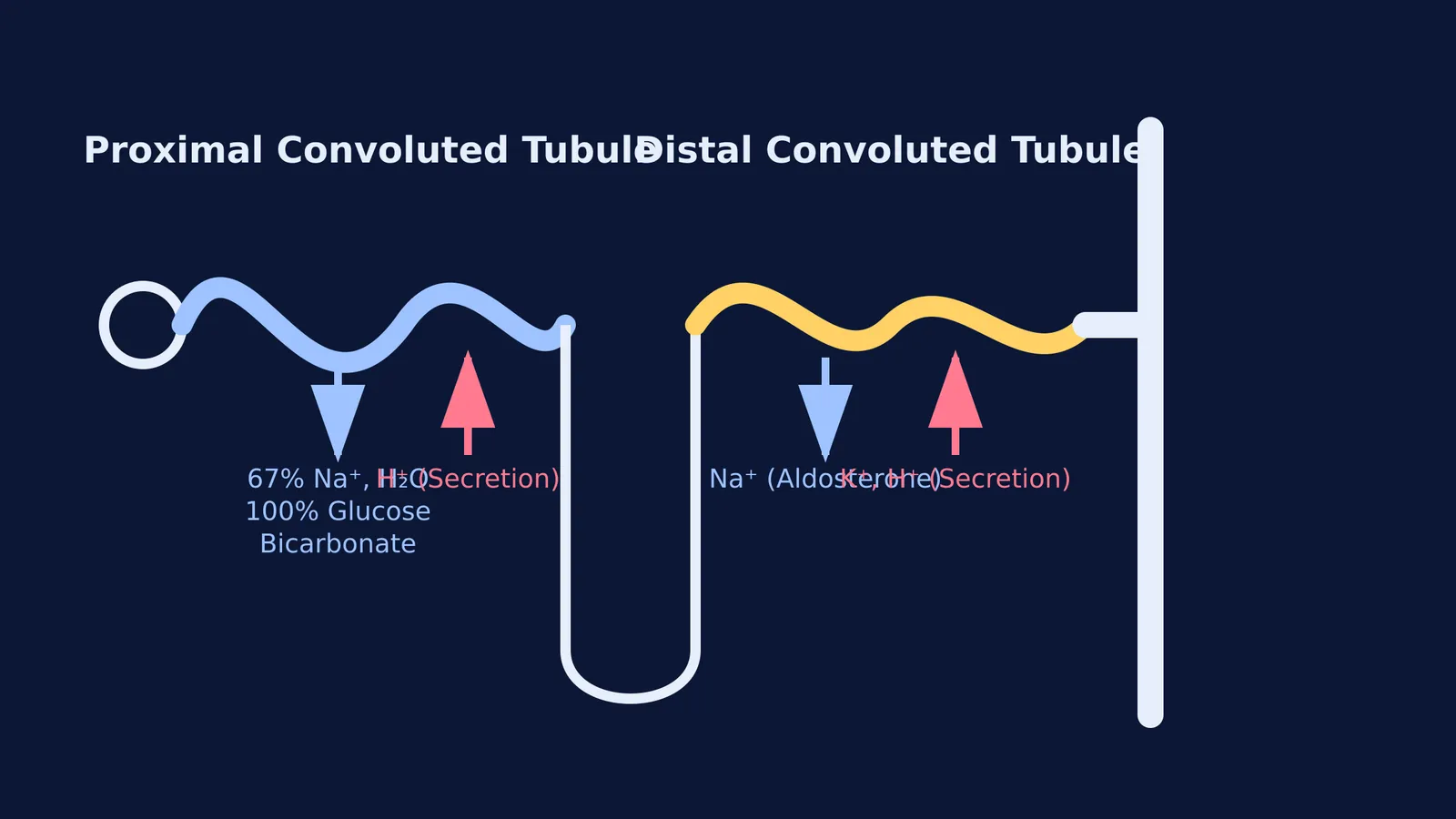
Bulk water and sodium: The PCT reabsorbs roughly two-thirds (60–70%) of the filtered sodium and water. Sodium reabsorption here is primarily driven by the Na⁺/K⁺-ATPase pump on the basolateral membrane and the sodium/hydrogen antiporter (NHE3) on the apical side.
Nutrients: It reabsorbs 100% of vital nutrients like glucose and amino acids under normal physiological conditions. This happens via secondary active transport, which relies on the sodium gradient established by the pumps.
Bicarbonate: The PCT is a major site for the reabsorption of filtered bicarbonate, with approximately 80% being reclaimed in this segment, which is essential for maintaining your blood's pH.
But the PCT does not just take things back; it also actively secretes waste. It utilizes pH sensors to maintain homeostasis and secretes hydrogen ions (H⁺) into the tubular fluid. Furthermore, the proximal tubule generates ammonium (NH₄⁺) through the breakdown of the amino acid glutamine, which significantly aids in acid excretion.
If you have concept gaps in human physiology, the Fermi Concept Library maps out every concept in biology with its own lesson.
How does the Distal Convoluted Tubule differ?
By the time the fluid passes through the Loop of Henle and reaches the DCT, most of the valuable substances have already been reclaimed. The DCT handles a much smaller fraction of the filtered sodium and water. It is also located in the renal cortex but is structurally different from the PCT, lacking the prominent brush border since it does not need to reabsorb massive volumes.
Its role is fine-tuning. Unlike the PCT, which constantly reabsorbs at a fixed rate, the DCT adjusts its reabsorption and secretion based on your body's immediate needs, largely under the influence of hormones.
Sodium and Potassium: Aldosterone acts on the distal segments to increase sodium retention while simultaneously secreting potassium (K⁺) into the urine. Sympathetic innervation can also specifically promote sodium retention in this segment.
Calcium: The DCT is heavily involved in the regulation of calcium. Parathyroid hormone (PTH) regulates this, stimulating the DCT to reabsorb more calcium when blood levels are low.
pH regulation: Like the PCT, the DCT secretes hydrogen ions to further acidify the urine. A defect in the distal tubule's ability to secrete hydrogen ions or reabsorb bicarbonate properly leads to Type I Renal Tubular Acidosis, characterized by a narrow anion gap.
For a deeper dive into the hormones that control this segment, read Regulating kidney function: ADH, the RAAS and ANF explained.
How do tubules maintain acid-base balance?
Both the PCT and DCT play crucial roles in keeping your blood pH tightly regulated around 7.4. When the body becomes too acidic, the renal system ameliorates metabolic acidosis by excreting ammonium (NH₄⁺) into the urine. This renal metabolic compensation is highly effective but relatively slow, typically taking a few days to fully manifest compared to rapid respiratory responses.
Clinicians even use a formula called the Urine Anion Gap, calculated as (Na⁺ + K⁺) − Cl⁻, to estimate this ammonium secretion. A normal gap is between 20 and 90 mEq/L. In the context of metabolic acidosis, a positive gap suggests a renal cause, such as Type I RTA. Conversely, a negative gap (typically between -20 to -50 mEq/L) suggests high ammonium excretion to compensate for acid buildup due to an extrarenal cause, such as prolonged severe diarrhea.
If you are preparing for exams, remember this distinction: the PCT does the heavy, obligatory lifting (roughly two-thirds of water and sodium), while the DCT does the precise, hormone-driven fine-tuning. For more worked examples on how the nephron concentrates waste, see Excretion for NEET: the nephron, GFR and counter-current, worked.


