On this page
"Cockroach has mosaic vision" is a line students memorise without picturing. Here is what it means, why it trades sharpness for catching movement, and a short pencil exercise that makes it stick.
One note: the current NCERT Class 11 chapter on structural organisation in animals (reprint 2026-27) describes only the frog, so you will meet the cockroach mainly in reference books.
What is mosaic vision in a cockroach?
Each of a cockroach's two compound eyes is built from small units called ommatidia, packed side by side like floor tiles. Each ommatidium has its own tiny lens and points in a slightly different direction.
Each compound eye of the American cockroach (Periplaneta americana) has up to 2,000 ommatidia, each containing eight receptor cells, according to a microscopy study by Willi Ribi (Tissue and Cell, 1977).
An ommatidium does not form a detailed picture. It reports roughly how bright its small patch of the world is: one spot. The brain sets the spots side by side, and the result is a mosaic. For scale, 2,000 spots is about a 45 by 45 grid (45 × 45 = 2,025).
Why is the image less sharp?
A review by Michael Land in the Annual Review of Entomology (1997) explains that compound-eye sharpness is set by the angles between neighbouring ommatidia, the quality of their optics and the size of their light-sensing parts.
Those angles range from tens of degrees in some wingless insects to as little as 0.24° in dragonflies, and finer resolution is not possible in a compound eye of realistic size (Land, 1997). Detail smaller than one ommatidium's patch is averaged into a single spot and lost. For why facets cannot just be made smaller, see why a bee sees in 1° blocks because of facet size and diffraction.
Cockroaches live mostly in dim light, which pushes the trade further. A study by Heimonen and colleagues (Journal of Neuroscience, 2006) notes that the cockroach eye's anatomy suggests 6 to 20 photoreceptor signals are pooled into one cell at the first synapse. The authors propose that this population-style coding helps the eye make sense of unreliable signals in dim light. Pooling catches more light but blurs detail: more sensitivity, less resolution.
Why is mosaic vision good at detecting movement?
When an object moves, its edge crosses from one ommatidium's patch into the next. Spots switch on and off in sequence, and that sequence is a strong signal even when the shape is blurry.
In a 2017 paper, Honkanen and colleagues summarise their earlier finding that the cockroach's optomotor reaction (turning to follow a moving pattern) persists down to the light of a moonless night sky, equivalent to less than 0.1 photons per second absorbed by each compound eye photoreceptor.
If motion across a grid of receptors is hard to picture, the Fermi Simulation Lab has interactive simulations for ideas that are easier to see than to read.
How can you picture mosaic vision with a grid?
You need paper, tracing paper, a ruler and two coloured pencils.
Draw a filled circle 5 cm across and, beside it, a thin vertical line about 8 cm long.
On tracing paper, rule a 10 by 10 grid of 1 cm squares. Each square is one ommatidium.
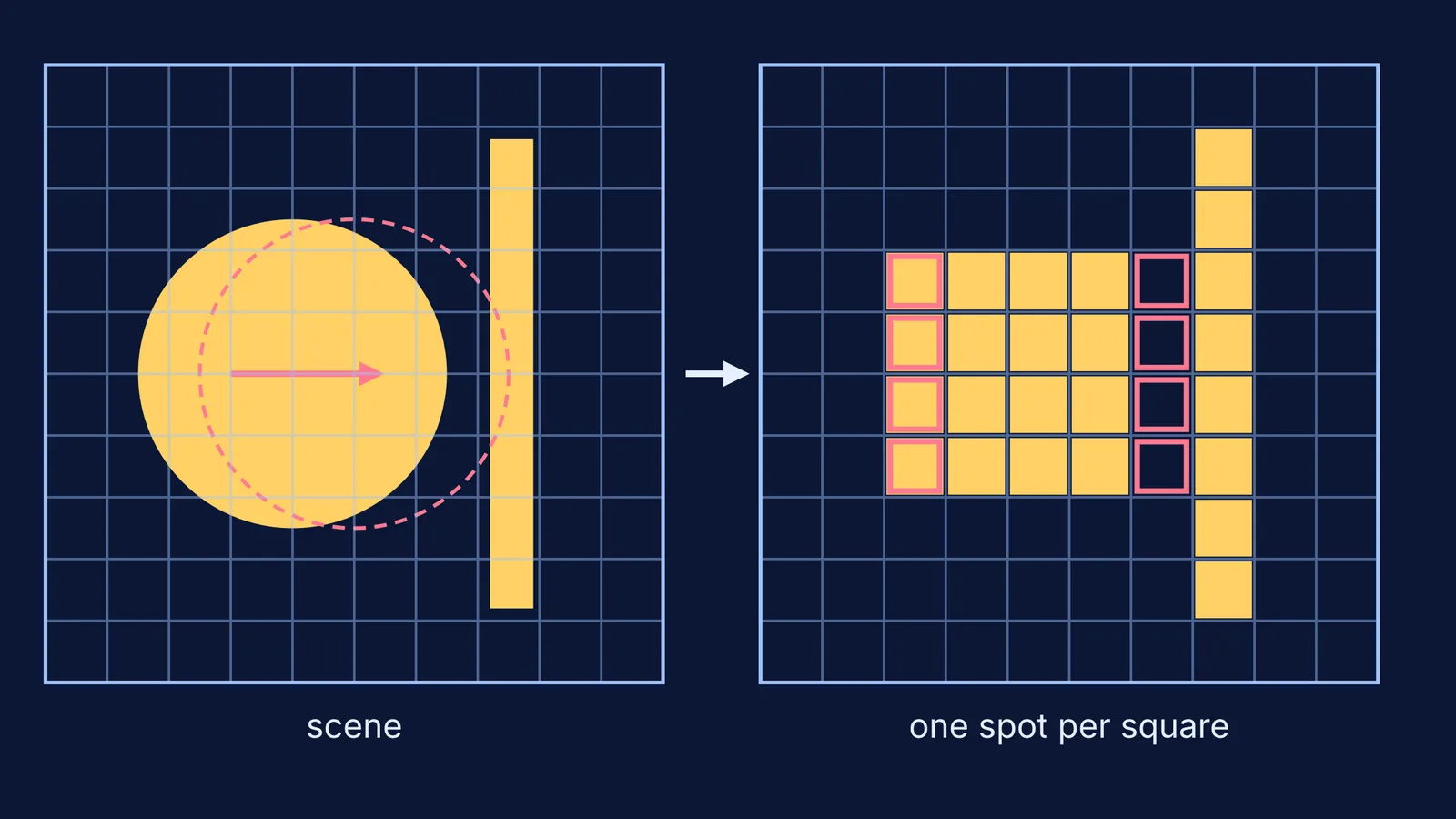
Lay the grid over the drawing. Shade a square only if its centre falls inside a shape: one square, one spot, all or nothing.
Look at the grid alone. The circle has turned blocky; the thin line is now a column one square wide.
Slide the drawing 1 cm right, shade the new pattern in your second colour, and mark every square that changed.
Repeat with a 0.5 cm grid and compare.
Worked example. Put the circle's centre on a grid corner. With the centre rule, the 5 cm circle lights 16 squares in a 4 by 4 block: your round object now looks square. Slide it 1 cm right and 4 squares on the left switch off while 4 on the right switch on. Only 8 of 100 squares changed, yet they tell you at once that something moved, and which way.
Halving the square size gives four times as many squares, and the circle starts to look round again. More, finer ommatidia mean sharper vision.
What should you remember for exams?
Each ommatidium sees one spot; the brain assembles the spots into a mosaic.
Each cockroach compound eye has up to 2,000 ommatidia (Ribi, 1977).
Detail smaller than one ommatidium's patch is lost, so the image is coarse.
Pooled signals help in dim light, and moving objects switch neighbouring spots on and off.
In the human eye, by contrast, one lens focuses a single image onto the retina.
For the single-lens side of that comparison, the Fermi Concept Library has a lesson for every concept in physics, chemistry, biology, mathematics and computing. For the animal the current NCERT chapter does cover, see our Class 11 guide to the frog's structural organisation.
Tonight, draw the grid, slide the circle, and count the squares that change.