On this page
Watch a cockroach cross a kitchen floor at night and its two antennae sweep ahead, tapping the floor, the wall, the edge of a cupboard. They are long because the insect uses them as fingers and nose at once, in places where its eyes are of little use.
How long are a cockroach's antennae?
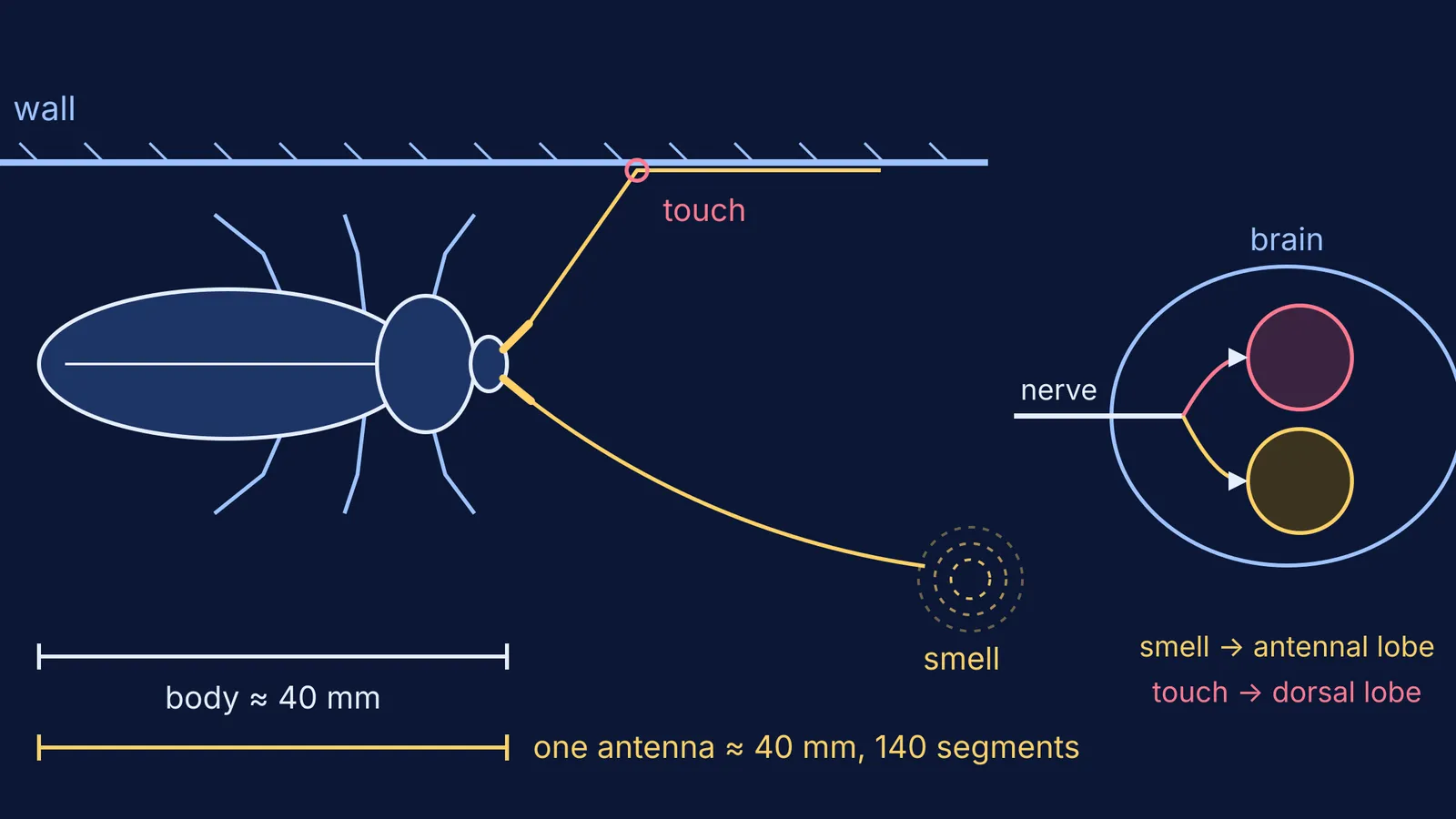
In the American cockroach, *Periplaneta americana*, each antenna is about as long as the body, roughly 40 mm, and has about 140 segments, according to a Scholarpedia review by Jiro Okada of Nagasaki University. The review names three parts:
Scape: the first segment, joined to the head.
Pedicel: the second segment.
Flagellum: all the remaining segments, the long whip.
Only the two joints at the base, head to scape and scape to pedicel, are moved by muscles; the flagellum bends passively when it meets something. So the cockroach points the antenna, and the world bends it.
What do cockroach antennae sense?
A cockroach antenna produces the senses of smell, taste, touch, temperature and humidity, the Okada review explains. These come from tiny sensory units called sensilla. Many hairs on the flagellum do double duty: each holds one touch receptor plus several chemical receptors, with a pore at the tip that lets molecules in. A single tap can tell the insect both that something is there and something about what it is made of.
Why length matters: most cockroach species are nocturnal, and the review notes that touch through the antenna is likely essential for judging the position, shape and texture of objects in the dark. A longer antenna reaches further ahead, which should mean earlier warning before the head hits anything.
How do the antennae connect to the brain?
Signals from each antenna travel along the antennal nerve to the middle region of the insect brain, the deutocerebrum, where they split by type (Okada review):
Smell signals go to the antennal lobe, the first smell centre. In *P. americana* it has 205 small processing units called glomeruli in both sexes and at every nymph stage, report Tateishi and colleagues in Scientific Reports (2020).
Touch signals go to the dorsal lobe, also called the antennal mechanosensory and motor centre, and some reach as far as the suboesophageal ganglion.
The branches of the motor neurons that steer the antenna also gather in the dorsal lobe, close to the touch inputs.
Some antennal touch signals also reach large descending neurons that run from the brain towards the body's ganglia, and these may help control escape running.
What do experiments show about antennae in the dark?
Two studies in the Journal of Experimental Biology measured this directly.
Following walls. Camhi and Johnson found that running cockroaches could make up to 25 body turns per second for short periods to follow bumps in a wall, and the faster they ran, the closer they stayed to it (Camhi and Johnson, 1999). The turns appeared to be driven by the flagellum, not the base: where along the antenna it touched the wall seemed to work like a ruler for how far away the wall was.
Avoiding obstacles. Baba, Tsukada and Comer filmed cockroaches running from a threat towards obstacles. Intact insects collided on only about 10% of trials, vision played little or no role, and shortening the antennae or cutting the main antennal nerve made collisions more frequent (Baba and colleagues, 2010). In tests with tethered insects, touching an obstacle with both antennae at almost the same moment was needed to make a cockroach stop.
Try it: a 15-minute antenna observation
You need a dim torch, a notebook and a clock. Do not handle a cockroach with bare hands: watch it where it is, or under a clear glass for a few minutes, then let it go outdoors. Wash your hands afterwards.
Part A, watch:
After dark, switch on a dim light in the kitchen and stay still.
For two minutes, note whether the antennae sweep together or separately.
When it walks along a wall, which antenna stays in touch with the wall?
At a corner or object, does it stop, turn, climb or back away?
Write three columns: what the antenna touched, what the body did next, and whether the reaction was instant or slow.
Part B, be the cockroach:
Hold a 30 cm ruler lightly by one end, close your eyes, and walk slowly along a corridor wall with the far end touching it. Have a partner walk beside you.
Notice that contact near the tip means the wall is far, and contact near your hand means it is close. That is similar to the ruler-like map Camhi and Johnson proposed.
Repeat with a 15 cm ruler. Which length gave you more warning?
Finish with two lines linking your notes to sensilla, the flagellum and the dorsal lobe. If the path from sense organ to brain still feels abstract, the Fermi Concept Library gives every biology concept its own lesson and its place in the map.
Next, read how a cockroach lives without its head, how its exoskeleton and jointed legs move it, and the cockroach organ numbers students are asked about.