

On this page
When a cockroach scuttles across a room, its movement is rapid and remarkably stable. Unlike vertebrates that move using muscles wrapped around internal bones, a cockroach relies on an external skeleton. In CBSE Class 6 science, the chapter on body movements highlights the cockroach as a prime example of an animal with an outer skeleton. Understanding how this chitinous framework coordinates with jointed legs and muscles reveals how arthropods achieve high-speed locomotion.
What makes up a cockroach's exoskeleton?
A cockroach's body is enclosed by a hard outer skeleton made of chitin crosslinked with hardened proteins. In the NCERT Class 6 Science curriculum, this exoskeleton is described as distinct units joined together to permit movement. In higher-level biology, these hardened plates are known as sclerites: dorsal tergites, ventral sternites, and lateral pleurites.
To permit movement, each sclerite connects to adjacent plates through a thin, flexible articular membrane called the arthrodial membrane. This elastic cuticle acts as a joint hinge, letting thoracic and abdominal segments pivot and compress. While axial and appendicular human bones meet at lubricated joint cavities, an insect joint is an internal fold of the cuticle itself.
How do muscles move legs from inside a hard shell?
Because arthropods lack internal bones, their muscular system is housed inside the exoskeleton's hollow tubes. Muscles attach to internal cuticular ridges called apodemes, which project inward from sclerites to act as mechanical levers. When a muscle contracts, it pulls on an apodeme across a joint hinge, rotating the leg segment.
In NCERT Class 11 Biology morphology, the cockroach thorax is divided into three segments—prothorax, mesothorax, and metathorax—each bearing one pair of jointed walking legs (three pairs in total). As detailed in the text, each leg has five articulated segments:
Coxa: the broad basal segment articulating with the thorax
Trochanter: a small pivoting segment
Femur: the stout, muscular segment
Tibia: the slender segment equipped with spines
Tarsus: five subsegments ending in claws and an adhesive arolium pad
Muscles operate in antagonistic pairs: flexors bend the leg inward, while extensors straighten it outward. As covered in locomotion and sliding filament mechanics, muscle tension transfers directly to cuticular levers. In the Fermi Simulation Lab, interactive simulations let you see ideas that are easier to see than to read, showing how internal lever arms and muscle attachment angles alter the mechanical advantage of exoskeleton joints.
How does the alternating tripod gait work?
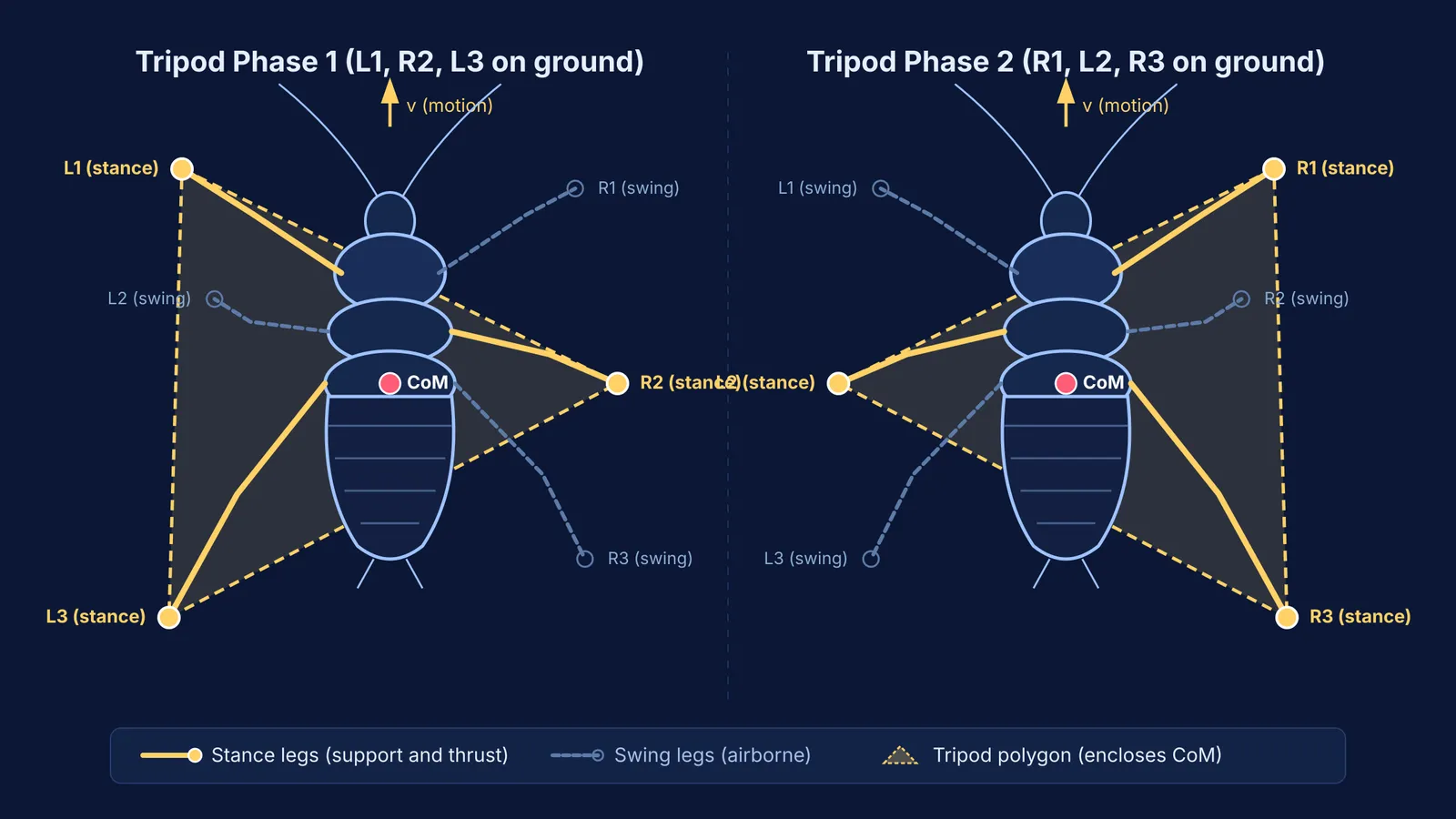
Cockroaches do not move their six legs randomly; they coordinate them using an alternating tripod gait. At any given moment, three legs remain planted on the ground in the stance phase: the front and hind legs on one side, and the middle leg on the opposite side (such as left-front L1, right-middle R2, and left-hind L3). These three contact points form a support triangle whose area encloses the animal's centre of mass.
While this tripod propels the body, the remaining three legs (right-front R1, left-middle L2, right-hind R3) swing forward in the air. Once they touch down, the roles invert. In a landmark study in the *Journal of Experimental Biology*, researchers Robert J. Full and Michael S. Tu (1990) showed that six-legged runners behave like bouncing spring-mass systems, maintaining consistent ground reaction forces with a mass-specific mechanical energy of 0.9 J/(kg·m).
In measurements on the American cockroach (*Periplaneta americana*), Full and Tu (1991) observed the alternating tripod gait at speeds up to 1.0 metre per second, where three contact points provide passive dynamic stability across uneven floors. At top running speeds between 1.0 and 1.5 metres per second—roughly 50 body lengths per second—high-speed recordings showed that the insects pitch upward and transition to quadrupedal and bipedal running, driven by stride frequencies up to 27 Hz.
How do cockroaches use their wings to fly?
According to NCERT Class 11 Biology, adult cockroaches also possess two pairs of wings attached to the thorax:
Forewings (tegmina): Arising from the mesothorax, these are opaque, dark, and leathery. They do not provide flight lift; instead, they protect the hindwings at rest.
Hindwings: Arising from the metathorax, these are transparent and membranous, unfolding to generate aerodynamic lift.
Wing motion is driven by distinct thoracic breast muscles. Direct muscles adjust wing pitch, while indirect flight muscles deform the thoracic sclerites to oscillate the wings up and down. Although cockroaches are built primarily for running, these wings provide rapid flutter bursts to escape ground threats.
Exoskeleton vs endoskeleton: what should you remember for exams?
When preparing for school exams or studying NCERT lines closely for NEET-UG biology, keep this comparative framework in mind:
Skeleton placement: Invertebrate arthropods have an external chitinous shell; vertebrates have an internal bone and cartilage framework.
Muscle attachment: Cockroach muscles pull inside hollow cuticular tubes via apodemes; vertebrate muscles wrap outside bones via tendons.
Joint flexibility: Insects articulate through thin arthrodial membranes; vertebrates use synovial joints and ligaments.
Gait dynamics: Cockroaches use an alternating tripod gait with three simultaneous ground contacts; bipeds and quadrupeds rely on active neural balancing.
In the Fermi Concept Library, every concept in biology and biomechanics has its own lesson and its place in the map. When working through questions on animal movement or mechanics, the Fermi Problem Library has worked problems with a step-by-step solver that explains the reasoning rather than printing an answer.


