

On this page
Carbon monoxide (CO) is a colourless, odourless gas that is notoriously lethal. It earns its reputation as a "silent killer" because of a single, devastating chemical reaction: it binds to the iron in our red blood cells and refuses to let go.
To understand why this happens, we have to look at the mathematics of binding affinity and the shape of the oxygen dissociation curve.
Why is carbon monoxide poisonous to haemoglobin?
Red blood cells carry oxygen using a protein called haemoglobin, which contains four iron-based haem groups. When you breathe in, oxygen molecules bind reversibly to these iron atoms, hitching a ride through your arteries to the tissues that need them. (You can review the different cells that do this work in our post on the Formed elements of blood: RBCs, WBC types and platelets for NEET).
Carbon monoxide is poisonous because it binds to these exact same iron sites, but it does so with an affinity 200 to 250 times greater than oxygen source.
When CO binds to haemoglobin, it forms a complex called carboxyhaemoglobin (COHb). Because the binding is so strong, even a small amount of carbon monoxide in the air—such as from a faulty boiler or a running car engine—can easily outcompete the abundant oxygen in your lungs. The iron binding sites become occupied by carbon monoxide, which directly reduces the blood's overall oxygen-carrying capacity. A healthy non-smoker usually has COHb levels below 3%, but heavy exposure can push this past 30%, leading to severe neurological impairment source.
What happens to the oxygen dissociation curve?
The damage caused by carbon monoxide goes beyond simply stealing seats on the transport bus. It fundamentally changes how the remaining seats work.
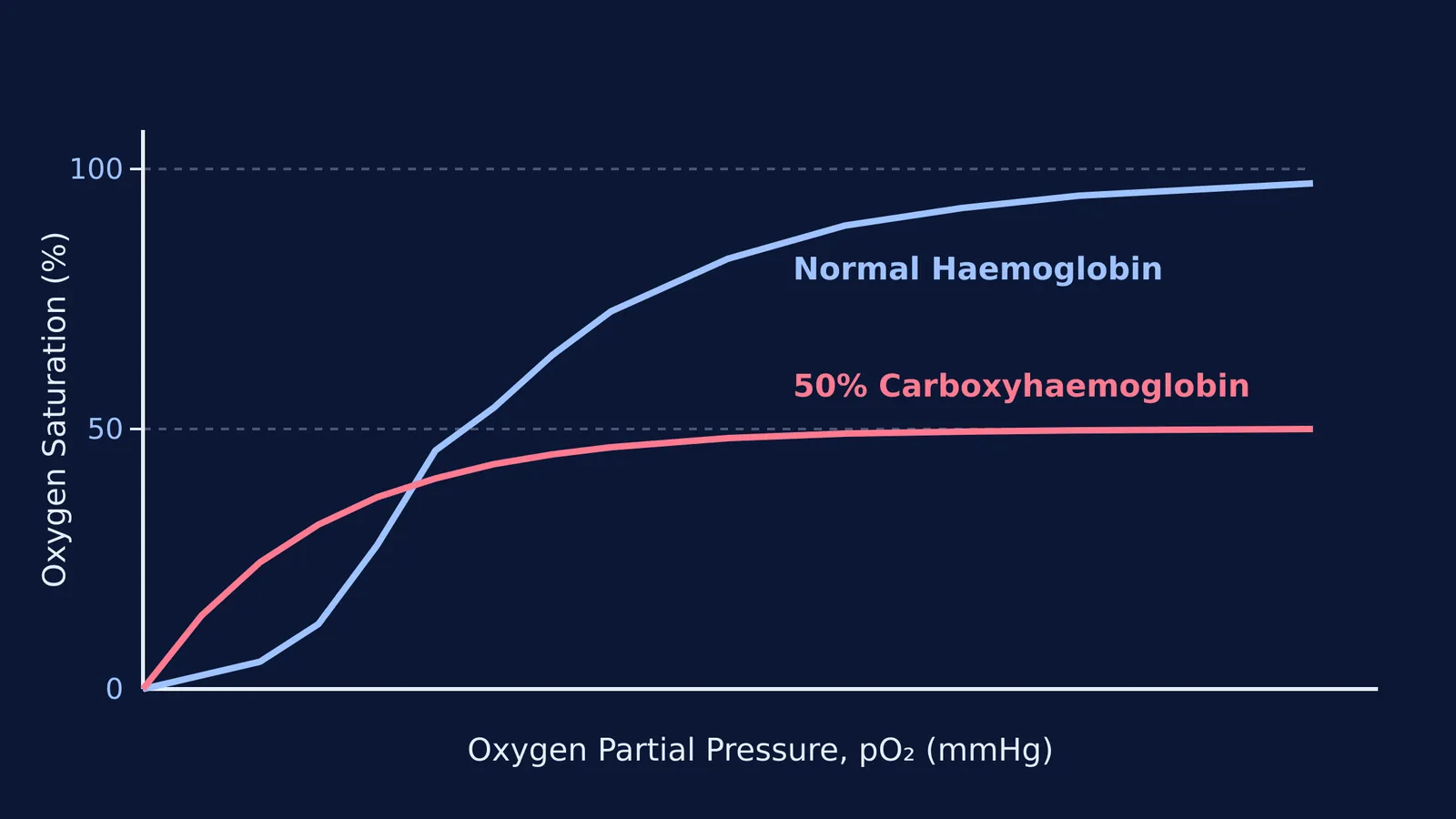
Normal haemoglobin exhibits a property called cooperative binding. When one oxygen molecule binds, the protein changes shape slightly, making it easier for the next oxygen molecule to attach, and so on. This creates the classic S-shaped (sigmoidal) oxygen dissociation curve.
When carbon monoxide occupies one or more of the four haem sites on a molecule, it forces the haemoglobin into a high-affinity state. This increases the affinity of the remaining, unoccupied haem sites for oxygen.
As a result, the oxygen dissociation curve experiences a severe leftward shift source. While the haemoglobin picks up oxygen easily in the lungs, it holds onto that oxygen too tightly when it reaches the tissues. The oxygen cannot be unloaded where it is needed most. This combination of a lowered carrying capacity and blocked unloading leads to severe cellular hypoxia (oxygen starvation) and metabolic acidosis source.
How is carbon monoxide poisoning treated?
Because carbon monoxide binds so tightly to the iron in haem, ordinary fresh air is not always enough to displace it quickly. The high affinity means the carboxyhaemoglobin complex eliminates slowly on its own.
Treatment relies on the chemical principle of mass action—overwhelming the equilibrium with a competing reactant. By administering 100% pure oxygen, doctors flood the blood with oxygen to outcompete the carbon monoxide, pushing the equilibrium back towards normal oxyhaemoglobin source. In life-threatening cases where COHb levels reach 50% to 60%, hyperbaric oxygen therapy may be used source. This drives oxygen into the blood at high pressures, forcing the toxic gas off the haem groups even faster.
What causes a left shift vs a right shift?
For biology and chemistry exams, remembering which factors shift the oxygen dissociation curve is crucial. If you have concept gaps about how these shifts alter the mathematics of binding, the Concept Library contains every concept in physics, chemistry, biology, mathematics and computing, each with its own lesson and its place in the map.
Use this checklist to predict how the curve will move:
Left Shift (Holds O₂ tighter, harder to unload)
High carbon monoxide (COHb)
High pH (alkalosis)
Low temperature
Low carbon dioxide (pCO₂)
Fetal haemoglobin (which naturally has a higher affinity for CO than adult haemoglobin source)
Right Shift (Releases O₂ easier, the "Bohr effect")
High carbon dioxide (pCO₂)
Low pH (acidosis, such as during heavy exercise)
High temperature
These right-shift factors are typically found in actively working muscles, which perfectly triggers haemoglobin to drop off its oxygen cargo right where cellular respiration is happening. (For more on how cells use this fuel, see Respiration as an amphibolic pathway: where fats and proteins enter). Carbon monoxide is so deadly because it breaks this elegant system, forcing a left shift exactly when the tissues desperately need a release.


